13-1 Death Ends Covenants
Torah Portion 13-1 Bereshith (Genesis) 15:1-16:16
And it came to pass, that, when the sun went down, and it was dark, behold a smoking furnace, and a burning lamp that passed between those pieces.
Why is this an important concept to understand? Why do we need to understand that “death ENDS covenants”? Today, leaders teach people that Messiah Yahusha administered a “new covenant” right before his death. If covenants END when an individual dies, then wouldn’t this alleged covenant made before his death END when he took his last breath a few hours later? What does the evidence tell us? Here is the text from the New Covenant in Yirmeyahu (Jeremiah):
Behold, the days come, says Yahuah, that I will make a New Covenant with the House of Yashar’El, and with the House of Yahudah: Not according to the covenant that I made with their fathers in the day that I took them by the hand to bring them out of the land of Egypt; which my covenant they break, although I was an husband unto them, says Yahuah: But this shall be the covenant that I will make with the House of Yashar’El; After those days, says Yahuah, I will put my Law [Torah] in their inward parts, and write it in their hearts; and will be their Elohiym, and they shall be my people. And they shall teach no more every man his neighbor, and every man his brother, saying, Know Yahuah: for they shall ALL know me, from the least of them unto the greatest of them, says Yahuah: for I will forgive their iniquity, and I will remember their sin no more.
Many people teach that Messiah Yahusha administered the New Covenant mentioned in Jeremiah 31:31-34 on the night before he died. Was this the covenant mentioned in Yirmeyahu (Jeremiah)? Was this an actual covenant at all? Here is the testimony from Mattithyahu (Matthew):
And as they were eating, Yahusha took bread, and blessed it, and break it, and gave it to the disciples, and said, Take, eat; this is my body. And he took the cup, and gave thanks, and gave it to them, saying, Drink ye all of it; For this is my blood of the New Testament, which is shed for many for the remission of sins. But I say unto you, I will not drink henceforth of this fruit of the vine, until that day when I drink it new with you in my Father’s kingdom.
In this passage, Yahusha never mentions the covenant described in Yirmeyahu (Jeremiah) 31:31-34. He does not say that the Laws of Yahuah written by Moshe would be written upon our hearts. He does not say that we will no longer need teachers, leaders and pastors to teach us the Word of Yahuah. And the House of Yashar’El is not represented because they were still scattered at the time. Here is the passage in Luke:
And when the hour was come, he sat down, and the twelve apostles with him. And he said unto them, With desire I have desired to eat this Passover with you before I suffer: For I say unto you, I will not any more eat thereof, until it be fulfilled in the kingdom of Elohiym. And he took the cup, and gave thanks, and said, Take this, and divide it among yourselves: For I say unto you, I will not drink of the fruit of the vine, until the kingdom of Elohiym shall come. And he took bread, and gave thanks, and break it, and gave unto them, saying, This is my body which is given for you: this do in remembrance of me. Likewise, also the cup after supper, saying, This cup is the New Testament in my blood, which is shed for you.
If we were lawyers presenting a case before a judge, we could not use this testimony to prove that Messiah Yahusha administered the covenant mentioned in Yirmeyahu (Jeremiah) 31:31-34. Yahusha does not refer to the covenant nor does he mention anything about the details of this covenant. We have two witnesses. The testimony in Yochanan (John) does not even record this event as described in Mattithyahu (Matthew) and Luke.
Wouldn’t the administration of the New Covenant in Yirmeyahu (Jeremiah) 31:31-34 be one of the most important features to include in an eyewitness account?
Why isn’t it mentioned anywhere in the eyewitness account written by Yochanan (John)? The new covenant described in Yirmeyahu (Jeremiah) 31:31-34 never appears in Yochanan’s account either. This is the evidence. If Yahusha administered a new covenant the night before his death, it was not the new covenant mentioned in Yirmeyahu 31:31-34.
That night after the last supper, Yahusha was arrested and falsely accused of blasphemy. A few hours later after this event, he died. Here is one testimony regarding his physical death.
Yahusha, when he had cried again with a loud voice, yielded up the spirit.
If he administered a “new covenant,” then it ENDED at this moment in time when he yielded up his spirit. When reviewing the eyewitness accounts as a lawyer, we have no testimony of Messiah Yahusha actually renewing this “new covenant” after his death. If the covenant in Yirmeyahu (Jeremiah) has not been given, then the only covenant available with Yahuah is the covenant given at Mount Sinai. Does the Torah support this conclusion?
Bereshith (Genesis) 15 is an excellent example of a covenant between Yahuah Elohiym and Abraham and its relationship with death. Covenants are very serious oaths. As the text in Bereshith explains, animals are cut in half and the blood pools in a pathway between them. The parties agree to the terms of the covenant and walk in the midst of the blood between the pieces. They say, “Let what has been done to these animals be done to me if I fail to keep the terms of this covenant”. In this particular covenant, our Father in heaven was the only one who walked between the pieces.
And he said, Adonai Yahuah, whereby shall I know that I shall inherit it? And he said unto him, Take me a heifer of three years old, and a she goat of three years old, and a ram of three years old, and a turtledove, and a young pigeon. And he took unto him all these, and divided them in the midst, and laid each piece one against another: but the birds divided he not. And when the fowls came down upon the carcasses, Abram drove them away. And when the sun was going down, a deep sleep fell upon Abram; and, lo, a horror of great darkness fell upon him. And he said unto Abram, Know of a surety that your seed shall be a stranger in a land that is not theirs, and shall serve them; and they shall afflict them four hundred years; And also that nation, whom they shall serve, will I judge: and afterward shall they come out with great substance. And you shall go to your fathers in peace; you shall be buried in a good old age. But in the fourth generation they shall come here again: for the iniquity of the Amorites is not yet full. And it came to pass, that, when the sun went down, and it was dark, behold a smoking furnace, and a burning lamp that passed between those pieces. In the same day Yahuah made a covenant with Abram, saying, Unto your seed have I given this land, from the river of Egypt unto the great river, the river Euphrates:
Yahuah Elohiym, the Creator of Heaven and Earth, walked through the pieces of this covenant agreement and said, “Do unto Me what has been done to these animals if I fail to keep the promises of this covenant agreement”. If Yahuah fails to give Abraham this land of promise, He dies. This ENDS the covenant agreement. It is dissolved.
Marriage is another example of a covenant agreement between a husband and a wife. When the husband dies, the covenant agreement has ENDED. This is described by Shaul of Tarsus (Paul) in the following passage:
For the woman which has a husband is bound by the Law [Covenant] to her husband so long as he LIVES; but if the husband be dead, she is set free from the Law [Covenant] with her husband. So then if, while her husband lives, she be married to another man, she shall be called an adulteress: but if her husband be dead, she is free from that Law [Covenant]; so that she is no adulteress, though she be married to another man.
The wife is bound to her husband through their covenant agreement as long as he LIVES. When he dies, the covenant agreement has ENDED. She is no longer bound to her dead husband. Likewise, If Messiah Yahusha made a covenant agreement with his disciples that night, they were bound to that covenant agreement as long as he LIVES. However, when Messiah Yahusha died, they were set free from this covenant agreement because he died. The same is true of covenants with Yahuah. If He were to die, ALL covenants that He ever made would END. Here is an illustration of this concept:
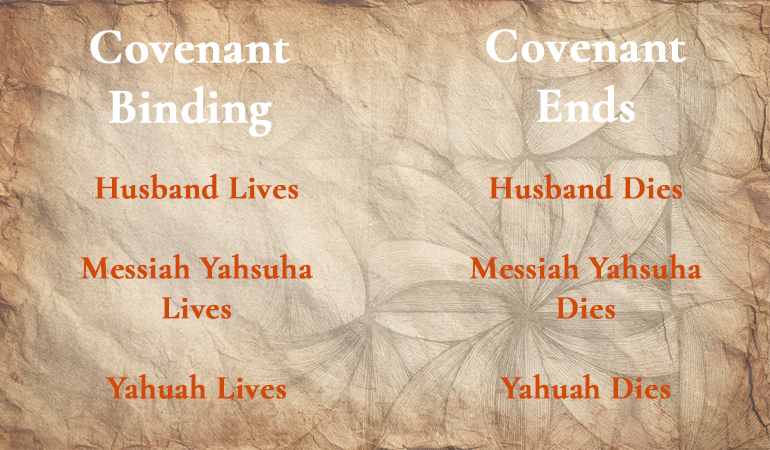
If Yahuah dies, ALL covenants with Him END. If Yahusha is Yahuah in the flesh, then ALL covenants made by Yahuah would have ENDED the moment Yahusha took his last breath. However, we still see rainbows in the sky after a rain. The covenant with Noach and all the creatures of the earth still stand. Based on this evidence, we can conclude that Yahusha was and is a man. He is not Yahuah in the flesh because this covenant made with Noach is still active.
We have another example in the Torah. Abimelech sought a covenant agreement with Abraham in the following passage:
And Abimelech said unto Abraham, What mean these seven ewe lambs which you have set by themselves? And he said, For these seven ewe lambs shall you take of my hand, that they may be a witness unto me, that I have dug this well. Wherefore he called that place Beersheba; because there they swore both of them. Thus, they made a covenant at Beersheba: then Abimelech rose up, and Phichol the chief captain of his host, and they returned into the land of the Philistines.
After Abraham died, this covenant ENDED and Abimelech sought to renew the covenant with Yitzhak (Isaac).
Then Abimelech went to him from Gerar, and Ahuzzath one of his friends, and Phichol the chief captain of his army. And Yitzhak said unto them, Why do you come to me, seeing you hate me, and have sent me away from you? And they said, We saw certainly that Yahuah was with you: and we said, Let there be now an oath betwixt us, even betwixt us and you, and let us make a covenant with you; That you will do us no hurt, as we have not touched you, and as we have done unto you nothing but good, and have sent you away in peace: you are now the blessed of Yahuah. And he made them a feast, and they did eat and drink.
The covenant between Abraham and Abimelech ENDED when Abraham died. If Abimelech wanted a covenant with Yitzhak, he had to renew the covenant between their households after the death of Abraham. The pattern is consistent. If Messiah Yahusha made a covenant before his death, it ENDED when he took his last breath.
Covenants with Yahuah are extremely valuable because He does not DIE. The Word confirms this and tells us that Yahuah lives FOREVER.
For I [Yahuah Elohiym] lift up my hand to heaven, and say, I live FOREVER.
This means that ALL covenants made with Yahuah Elohiym stand FOREVER. None of them END. If Yahusha Ben David was Yahuah in the flesh, then ALL covenants ever made by Yahuah would have ENDED the moment Yahusha took his last breath and we know this is not true as previously stated.
We can examine the underlying evidence and confirm that Yahusha died. In Romans 7:2, the author used the Greek word “apothnēskō” translated as “dead” which is Strong’s Exhaustive Concordance of the Bible reference number G599. It is the same exact word used in the following passage stating that “Yahusha died”.
For if we believe that Yahusha died [G599] and rose again, even so them also which sleep in Yahusha will Elohiym bring with him.
When Yahusha died, any covenant that he made prior to his death ENDED. He would be required to “renew” the covenant after his death and we do not have any testimony in which this was done. Based on this evidence, we can make the following conclusion:
Messiah Yahusha did not institute the new covenant in Yirmeyahu 31:31-34.
The only covenant available with Yahuah Elohiym and Messiah Yahusha is the one given at Mount Sinai through the Prophet Moshe. It is open and available to ALL people everywhere. It is not exclusively reserved for the House of Yashar’El. Consider the following testimony in this regard:
Thus says Yahuah, Keep judgment, and do justice: for my salvation is near to come, and my righteousness to be revealed. Blessed is the man that does this, and the son of man that lays hold on it; that keeps the Shabbat from polluting it, and keeps his hand from doing any evil [dysfunction]. Neither let the son of the stranger, that has joined himself to Yahuah, speak, saying, Yahuah has utterly separated me from his people: neither let the eunuch say, Behold, I am a dry tree. For thus says Yahuah unto the eunuchs that keep my Shabbats, and choose the things that please me, and take hold of my covenant; Even unto them will I give in my house and within my walls a place and a name better than of sons and of daughters: I will give them an everlasting name, that shall not be cut off. Also the sons of the stranger, that join themselves to Yahuah, to serve him, and to love the name of Yahuah, to be his servants, every one that keeps the Shabbat from polluting it, and takes hold of my covenant; Even them will I bring to My set-apart mountain, and make them joyful in my House of Prayer: their burnt offerings and their sacrifices shall be accepted upon My altar; for My House shall be called an House of Prayer for all people. Adonai Yahuah which gathers the outcasts of Yashar’El says, Yet will I gather others to him, beside those that are gathered unto him.
In context, this is a reference to the covenant given at Mount Sinai. It is open and available to all people everywhere. The text says that He will gather all of the outcasts who have placed their faith in Him whether they are bloodline children or strangers who sojourn with Yashar’El.
The covenant given at Mount Sinai is actually the only covenant that promises eternal life. Our Father presents us this choice in the following passage:
See, I have set before you this day LIFE [without death] and good, and DEATH [without life] and evil;
The Covenant given at Mount Sinai gives people two choices: LIFE without death or DEATH without life. People who choose LIFE avoid this death. People who choose DEATH will not receive life. The text in Debarim (Deuteronomy) 30:15 is the same choice given to Adam in the Garden of Eden.
And Yahuah Elohiym commanded the man, saying, Of every tree of the garden you may freely eat: But of the Tree of the Knowledge of Good and Evil, you shall not eat of it: for in the day that you eat thereof you shall surely die.
Adam could eat from every tree in the Garden including the Tree of Life which would allow him to LIVE forever. Or he could eat from the forbidden tree and DIE. Death was a choice for him at this point. He could have resisted the temptation and not have eaten from the forbidden tree. We are given the same choice in Debarim (Deuteronomy) 30:15. We can choose LIFE without death which is eternal life or we can choose DEATH and not receive life. Death is presented as an option. It is something we can avoid if we follow the instructions summarized in this passage:
See, I have set before you this day LIFE [without death] and good, and DEATH [without life] and evil; In that I command you this day to love Yahuah your Elohiym, to walk in his ways, and to keep his commandments and his statutes and his judgments, that you may live and multiply: and Yahuah your Elohiym shall bless you in the land whither you go to possess it. But if your heart turn away, so that you will not hear, but shall be drawn away, and worship other mighty ones, and serve them; I denounce unto you this day, that you shall surely perish, and that you shall not prolong your days upon the land, whither you pass over Jordan to go to possess it. I call heaven and earth to record this day against you, that I have set before you LIFE and DEATH, blessing and cursing: therefore, choose life, that both you and your seed may live: That you may love Yahuah your Elohiym, and that you may obey his voice, and that you may cleave unto him: for he is your life, and the length of your days: that you may dwell in the land which Yahuah swore unto your fathers, to Abraham, to Yitzhak, and to Ya’aqob, to give them.
This the “Second Death” because this is the second time death is presented as a choice by our Father. The “First Death” is the first time our Father presented a choice between life and death in Bereshith (Genesis) 2:16-17. The judgement for the first choice given in Bereshith 2:16-17 was executed in Bereshith 3:14-24. The judgement for the “Second Death” summarized in Debarim (Deuteronomy) 30:15-20 has not happened yet. It will occur at the end of the thousand-year reign of shalom.
And I saw a great white throne, and him that sat on it, from whose face the earth and the heaven fled away; and there was found no place for them. And I saw the dead, small and great, stand before Elohiym; and the books were opened: and another book was opened, which is the Book of Life: and the dead were judged out of those things which were written in the books, according to their works. And the sea gave up the dead which were in it; and death and Sheol delivered up the dead which were in them: and they were judged every man according to their works. And death and hell were cast into the lake of fire. This is the second death. And whosoever was not found written in the Book of Life was cast into the lake of fire.
This text says the people are judged according to their “works”. What “works” is our Father going to use to make these decisions? Debarim (Deuteronomy) 30:15-20 summarizes the actions that lead to eternal life. People who avoid the “Second Death” do the following:
- Love Yahuah
- Walk in His Ways
- Guard His commandments, statutes and ordinances written by the Prophet Moshe.
- Hear and obey His Voice which is His Word.
- Cleave to Him in the bond of covenant
People who do these things will receive a LIFE without death or eternal life. Those who do not will be cast into the Lake of Fire at the end of the age. At that time, our Father will evaluate the words and actions of each individual to determine if they were in alignment with the Words summarized in Debarim (Deuteronomy) 30:15-20 or not. Debarim 30:15-20 is part of a covenant Yahuah made with the House of Yashar’El. This means that if Yahuah does not follow through on the words spoken in this promise, He can be cut in half like the animals depicted in Bereshith (Genesis) 15.
He is saying, “Let what has been done to these animals, be done unto Me if I fail to fulfill the conditions of this covenant agreement”.
This means, anyone who fulfills the instructions mentioned in Debarim (Deuteronomy) 30:15-20 will receive a LIFE without death with great blessings in a land of promise with absolute certainty. If Yahuah does not fulfill this promise, He will be cut in half. This also means, anyone who does not fulfill these instructions summarized in Debarim 30:15-20 will receive the Second Death after the resurrection with absolute certainty. If Yahuah does not fulfill this promise, He will be cut in half.
Because the judgement for the Sinai Covenant has not happened yet, there is still time to avoid the “Second Death”. We do this by fulfilling the instructions summarized in Debarim 30:15-20 through repentance.
Messiah Yahusha redeemed us from the first judgement in Bereshith (Genesis) 3:14-24 which allows Yahuah to resurrect every man, woman and child born to Adam. The death in Debarim 30:15-20 is called the “Second Death” because this is the death that occurs after the resurrection of ALL people. Yahusha has not redeemed us from this death because the judgement has not happened yet. The death we experience is the first death mentioned in Bereshith 3:14-24.
We are accountable for all the sins we personally commit.
However, we can be forgiven if we STOP committing the sins and ask for our Father’s forgiveness with a humble, contrite heart. He abundantly pardons.
Let the wicked forsake his way, and the unrighteous man his thoughts: and let him return unto Yahuah, and he will have mercy upon him; and to our Elohiym, for he will abundantly pardon.
ALL of us have committed sins. In order to receive forgiveness, we need to STOP committing the sin and seek His forgiveness with sincerity. If we sin again, we STOP doing the sin and seek His forgiveness again. Messiah Yahusha was asked the following question and this was his response.
Then came Kepha to him, and said, Adonai, how often shall my brother sin against me, and I forgive him? till seven times? Yahusha said unto him, I say not unto you, Until seven times: but, Until seventy times seven.
He instructs us to forgive our brother 490 times for each transgression. Our Father does the same thing. He is extremely merciful and will abundantly pardon over and over and over again. This is all that is required to remove the penalty of our sins hanging over our heads. In Yeshayahu (Isaiah) 55:7, He does not mention animal sacrifices. They are not required to receive forgiveness from our Father. We receive forgiveness by STOPPING our sin and asking for His forgiveness with sincerity. We can avoid the “Second Death” by following this process.
Based on this evidence, it is clear the new covenant in Yirmeyahu (Jeremiah) 31:31-34 has not been given yet. Messiah Yahusha has not administered or initiated any new covenant. If he did, it ended a few hours later when he died. This is the reality that we need to face. If we want to be in covenant with Yahuah Elohiym and Messiah Yahusha, then we must enter into the covenant given at Mount Sinai. There are no other covenants available despite the plethora of teachers who say differently. Look at the evidence presented here and make your own determinations. It is truly a matter of eternal LIFE and DEATH.
Download this Article here