551-1 Hebrew Word Study: Shanah
And Yahuah said, My Spirit shall not rule over conflicts with man forever, for he also is flesh: yet his days shall be a hundred and twenty years.
The Hebrew word, “shanah,” is most often translated as “year” in the Hebrew writings. The “year” in our culture is one revolution around the sun beginning and ending in January so when we see the English word “year,” we interpret it in this fashion. When the text speaks about the number of years an individual has lived, they think it is based upon their birthday because we base our age upon our birthdays.
In our Father’s Word, the first month in His calendar begins in the Spring when the barley is harvested. This is around the time of Pesach (Passover) and the Feast of Matzah (Unleavened Bread). During the Feast of Matzah, we are required to present a sheaf of mature barley on First-Fruits. This means that the barley fields must be ready to harvest when the first month begins in our Father’s method of reckoning time. This is why we examine the barley in the Spring. We re determining if the next moon will be the first month.
Based on this evidence, we would consider a “year” in His calendar to be one cycle Spring to Spring. This seems logical, however, there are some discrepancies in which this definition of a “year” is not really the right word to express the underlying concept as in the following example:
And Yahuah said, My Spirit shall not rule over conflicts with man forever, for he also is flesh: yet his days shall be a hundred and twenty years.
This statement highlighted in orange does not make sense. We are missing a piece to the puzzle. Perhaps, our definition of a “year” is not the actual definition of “shanah”. This is the reason, for this study. If our concept of a “year” is not the actual definition of “shanah,” then what does it mean to an ancient Hebrew? What is the definition of this word in their eyes?
This passage cannot be interpreted as a reference to the age of a man. Noach lived 950 years. Shem lived 600 years. Abraham lived 175 years. King David lived 70 years. It is obvious that this is not a reference to the actual age of men and women. People die at all ages. We can see this evidence for ourselves even today. In fact, it is very rare in our current culture for a man or woman to live 120 years. So, the evidence clearly illustrates that this is not a reference to the “age” of men and women.
The text in Bereshith (Genesis) 6:3 says that the Spirit of Yahuah “will not rule over conflicts with man forever”. In some translations, it states that it is a time when Yahuah will no longer strive with mankind.
And the LORD said, My spirit shall not always strive with man, for that he also is flesh: yet his days shall be an hundred and twenty years.
It has been thousands of years since these Words were spoken by our Father and mankind has continued to strive with our Father in Heaven. Our Father is a King and Judge. He has a set of Laws which were written down in the covenant given at Mount Sinai. When individuals violate His Laws they could be classified as “criminals” or “rebellious” just as they would here in the United States.
Leaders of the earth do not rule according to the Laws of Yahuah written by the Prophet Moshe. They rule and reign according to their own Laws. Some of their Laws are in alignment with our Father’s Laws but some are not. It is a mixture and a rejection of our Father’s Laws as well as His authority. It is rebellion against our Father which began the moment Adam ate from the forbidden tree in the Garden. This is the starting point of our timeline given in Bereshith (Genesis) 6:3.
When will this striving come to an end?
Yahuah has given us this a timeline in “years” or “shanah”. It is a period of time in which Yahuah allows the Sons of Adam to rule and reign over the earth even in their rebellion. He had given Adam dominion over all the inhabitants of the earth in the beginning before he sinned.
And Elohiym blessed them, and Elohiym said unto them, Be fruitful, and multiply, and replenish the earth, and subdue it: and have dominion over the fish of the sea, and over the fowl of the air, and over every living thing that moves upon the earth.
Gifts given by Yahuah cannot be revoked, deleted or transferred. This gift belongs to Adam and has been transferred to his firstborn sons, generation after generation even unto this day. The leaders of the earth are the firstborn sons of Adam. They have a lawful right to rule and reign over the earth. This is why Yahuah said the following to Nebuchanezzar:
You, O king, are a king of kings: for the Elohiym of heaven has given you a kingdom, power, and strength, and glory.
When did Yahuah give Nebuchadnezzar a kingdom, power, strength and glory? He did in Bereshith (Genesis) 1:28. Nebuchadnezzar is a firstborn son of Adam who inherited this gift from his father. Nebuchadnezzar had a lawful right in the eyes of Yahuah to rule and reign over the inhabitants of the earth. Yahuah cannot take it away from Adam or his firstborn sons.
As we can see, this conflict between Heaven and Earth has existed for far more than 120 years since the day the conflict started in the Garden of Eden. Leaders of the earth still choose to rule and reign according to their own Laws to this very day and conditions under their reign is pretty dismal.
Based on this evidence, the term “shanah” must relate to a cycle that embodies one revolution around the sun as well as other cycles our Father uses in His reckoning of time. For many years, I have concluded that is a reference to the Yovel (Jubilee) cycle but have not been able to conclusively prove this association. One Yovel Cycle is 50 years. Here is the math:
120 Shanah X 50-year Yovel Cycle = 6000 years
Based on historical evidence, our own experiences and the current timeline, this seems like the most plausible interpretation of this phrase in Bereshith (Genesis) 6:3. Yahuah is allowing Adam and his sons to reign for a period of 6000 years. Then, it will end. Who will assume power and control over the earth? According to Bereshith (Genesis) 1:28, the individual must be an “Adam”. Shaul of Tarsus (Paul) actually refers to Messiah Yahusha as the “Last Adam”.
And so it is written, The first man Adam was made a living soul; the last Adam was made a quickening spirit.
Messiah Yahusha fulfills the definition of an “Adam” and can receive the gift given in Bereshith (Genesis) 1:28. However, he cannot take it away from the first Adam and his sons. The firstborn sons of Adam would all have to perish. This is like the situation with King David. He was anointed King but could not assume the throne over the House of Yashar’El until King Shaul and his heir had perished. This is what King David said:
And it came to pass afterward, that David’s heart smote him, because he had cut off Shaul’s skirt. And he said unto his men, Yahuah forbid that I should do this thing unto my master, Yahuah’s anointed, to stretch forth my hand against him, seeing he is the anointed of Yahuah.
At the end of the 6000 years, there will be an event that kills all of the firstborn sons of Adam leaving the earth no heir.
This also parallels Levirate marriage. When a man dies and has no son, his brother can marry his brother’s wife and provide an heir for his brother. We see this in the situation with Yahudah and Tamar as well as Boaz and Ruth. In this situation, Yahuah provided an heir for His dead son, Adam.
For Elohiym so loved the world, that he gave his only begotten Son, that whosoever believes in him should not perish, but have everlasting life.
But the heir cannot assume power and control until the death of the first Adam and his firstborn sons. It appears that it will be at the end of the 6000 years. Testimony illustrates that Messiah Yahusha will return on Yom Teruah which would mark the end of the 6000 years. So, we can conclude that Adam and Chavah sinned on the first day of the seventh month which is Yom Teruah. The Hebrew word “Teruah” is a trumpet blast that sounds an alarm for war. As we have demonstrated the war between Heaven and Earth began the day Adam sinned and it will end with the return of the King.
These conclusions seem logical. But can we clarify the meaning of “shanah” using the ancient Hebrew pictographic language to prove that it actually includes the Yovel Cycles (Jubilee)? Let us take a deep dive and determine the meaning of “shanah” from an ancient Hebrew perspective.
The Word Shanah:
“Shanah” translated as “year” seems appropriate when it is related to the passage of time or the age of an individual. Here is an example:
In the six hundredth year [H8141] of Noah’s life, in the second month, the seventeenth day of the month, the same day were all the fountains of the great deep broken up, and the windows of heaven were opened.
This seems really clear. The Hebrew word below is the way it appears in the underlying language in this passage. We have used the ancient Hebrew pictographic language. It includes the letters, “shin, nun and hey”.
HNF
This same exact word is also translated as “sleep” in several passages. Here is an example:
You carry them away as with a flood; they are as a sleep [H8142]: in the morning they are like grass which grows up.
We could not use the English word “year” in this passage because it would not fit the context of the testimony. Here is the Hebrew word as it appears in this passage. It is identical to the Hebrew word translated as “year”.
HNF
How can the same letter sequence have two different meanings and seem to be completely unrelated?
In our Greek mind, these two concepts are completely different and unrelated. Both are cycles, but one occurs in a single night and the other is one revolution around the sun. These are our definitions of these cycles using a Greek way of thinking and not the way ancient Hebrews visualized these terms. Because we are not defining “shanah” the way they did, Bereshith (Genesis) 6:3 does not make any sense to us as it relates to “120 years”.
The ancient Hebrews considered these concepts related to one another. The ancient Hebrew pictographic language was the original language used to document the Torah. This is discussed in our series titled, The Identity of our Father. We can attempt to piece together the definitions of each pictographic letter of the Hebrew word “shanah” and determine the original meaning of this Hebrew word from their perspective which is also Yahuah’s perspective.
The “Shin”:
The first letter in the word, “shanah” is the letter “shin” which is a word in and of itself. It actually includes the first two letters in “shanah” which are the “shin” and the “nun”. In the ancient Hebrew language, it is a picture of two front teeth. Here is the pictographic letter. We can see for ourselves that this pictographic letter is a picture could be two-front teeth.
F
We do not need a scholar to interpret the meaning of this letter for us or its image. Even the modern Hebrew letter looks like two-front teeth:
ש
What is the relationship between a “year” and two front teeth? In our culture, this does not make sense. What did the ancient people see in this relationship between the letter “shin” and a “year”? We must think the way an ancient Hebrew individual would think. It is not the appearance of the two front teeth that is important. It is their function. What are the things we DO with our teeth? We chew. We press down. We use them to tear open a bag. They are also white and hard like marble. We need to think in terms of “function” and not “appearance”. Can we see a relationship between the function of teeth and a “year”?

Let’s take a deeper look at the teeth. When a child loses its baby teeth, permanent teeth appear as a tiny sliver on the gum line as illustrated in the picture. Smaller, weaker teeth are replaced or exchanged for something better, stronger and bigger that lasts much longer than the original baby teeth.
In each season of the year, we see an exchange. Winter is exchanged for Spring. This would exchange would mark the beginning of a “year” in our Father’s method of reckoning time.
The typical age when children lose their first baby tooth is six years old. The number six, itself is two “shins” as illustrated below in the ancient Hebrew pictographic language.
FF
Children begin losing their two front teeth at the age of six. They are exchanging inferior teeth for superior teeth.

In the Creation account, two people were created on the sixth day: Adam and Chavah. The Hebrew word represented by the number six is a memorial for events that occurred on the sixth day of Creation.
Do the two letter “shins” represent the two front teeth of Adam and Chavah?
Adam and Chavah sinned against our Father and were removed from their lofty position in the Garden of Eden like baby teeth in the mouth of a child. If our Father is going to replace them, it is like a child losing its baby teeth and replacing them with bigger, more permanent, stronger teeth. Our Father is replacing or exchanging Adam and Chavah with leaders who are better, stronger, and who will rule much longer. They will not sin like Adam and Chavah. This is the transition and it happens on the sixth day.
- Adam and Chavah are represented by the baby teeth which are removed at age six.
- Messiah and his Bride are represented by the permanent teeth.
The child is six years old when they lose their first tooth. This pattern aligns with the 6000 years in the millennial cycle. Will our Messiah and his Bride replace Adam and Chavah on the sixth day or sixth millennium? Every detail in our Father’s Word is significant.
The letter “shin” is also closely related to the “moon”. Modern science says that it takes 2-4 weeks for a permanent tooth to fully emerge in a child’s mouth. It takes two weeks for the moon to fully reveal itself. If we examine a two-week period, the incoming tooth is a mirror image of the moon’s cycles. Here are two illustrations for comparison. The first chart is an image of two-front teeth. One tooth is emerging from the gum line and over a period of two weeks, it has fully emerged.

This is a mirror image of the moon as illustrated in the image below.

It is clear that the letter “shin” has a close association to the cycle of the waxing moon. In fact, the Hebrew word “chodesh” contains the letter “shin”. If the letter “shin” is related to the cycle of the moon, then the Hebrew word “chodesh” is definitely related to the moon. Let’s consider the ancient Hebrew letters in this Hebrew word. The “shin” is highlighted in orange.
FDX
“Chodesh” also contains the letters “chet and dalet”. The “chet” is a picture of a wall and the “dalet” is a picture of a door. If we are thinking in concrete terms like ancient Hebrews, both the tooth and the moon appear to be exiting a door in the wall. The tooth and the moon are coming outside and we can see them coming out the door over a period of two weeks.
The arrival of the permanent tooth is a “renewal” of the tooth. The moment the moon exits the door in the night sky, it appears as the “waxing sliver” just like a permanent tooth in the mouth of a child. This is the concept of “chodesh”. In the dark cycle of the moon, it as if the moon is in the throne room of Yahuah behind the curtain. When our Father says it is time for the month to begin, the moon walks through a door in the night sky and makes its announcement to the earth as a waxing sliver.
People on earth are waiting for the announcement from our Father when they go out to look for the waxing sliver of the crescent moon. Once they get the Word from our Father, they go and make the announcement to the rest of the community. The announcement is not based upon the calculations of a man. It is when the moon decides to speak and it speaks with its light. This is the function of the luminaries. If they are not giving light, they are not functioning at that moment. They are not testifying.
And let them be for lights in the firmament of the heaven to give light upon the earth: and it was so.
We can provide another witness to this association between the moon and the appearance of a permanent tooth in the Hebrew word “rosh” which also contains the letter “shin”. The letter “resh” is a picture of a man’s head. How does this relate to the appearance of a permanent tooth in the mouth of a child or the waxing sliver of the moon?

When a woman bears a child by natural means, the head is typically the first thing that exits the womb. Right before the birth of the child, we would see the top of the head crowning first as it exits the womb. It is the very crown of the head that appears first. It would look similar to the sliver of the moon or the first appearance of a permanent tooth in the mouth of a child.
The “head” is the first thing that exits the womb. The waxing sliver of the moon is the “head” of the month or the first day of the month. It looks like the head of a baby being born.
The letter “resh” means the “head” or “chief” of a tribe and is typically a reference to the “firstborn” son. In the creation account, Adam was the “firstborn” son of mankind and Chavah was the “firstborn” daughter. They were designated as the “chiefs” over all the earth in the very beginning. They were responsible for the welfare of all inhabitants of the earth. This is the responsibility of the firstborn son which is beautifully depicted with the patriarch Yoseph (Joseph).
Haste ye, and go up to my father, and say unto him, Thus says your son Yoseph, Elohiym has made me Adonai of all Egypt: come down unto me, tarry not: And you shall dwell in the land of Goshen, and you shall be near unto me, you, and your children, and your children’s children, and your flocks, and your herds, and all that you have: And there will I nourish you; for yet there are five years of famine; lest you, and your household, and all that you have, come to poverty.
When we consider the concept of a “year” in relation to this understanding, we can see an exchange between an inferior season when everything is dead (Winter) to a superior season thriving with life (Spring). In fact, Yahuah calls “Spring” the “head” of the “year”.
This month [Chodesh] shall be unto you the beginning [Rosh] of months [Chodesh]: it shall be the first [Rishon] month [Chodesh] of the year [Shanah] to you.
The first day of the first month is the “head” of the “year”. The sliver of the moon is like the head of a baby crowning as it exits its mother’s womb. This is exactly what it looks like. The moon is essentially being born again each month so-to-speak. It is a rebirth or renewal. This is what the ancient people would have seen. The waxing sliver is literally the “head” of the month.
We can see all of this just in the first letter in the Hebrew word “shanah”. Let us investigate further by examining the Hebrew letter “nun”.
The “Nun”:
The second letter in “shanah” is the letter “nun” which contains a picture of two seeds sprouting. This means “sprouting seed of sprouting seed”. It could also represent “conception” when the reproductive cells from the man, combine with the reproductive cells of a woman. It represents a viable conception that will come to fruition. A seed producing a seed.
NN
In plants, seeds do not form without being pollenized. Seeds do not sprout if they are not exposed to moisture. They remain in their impervious state until they are exposed to moisture. In order to grow, they need light and nutrients contained in the soil. Once they sprout, they grow into a mature plant and produce fruit which contains the seeds used for the crop the following year. It is a cycle that continues to produce fruit as well as seeds, year after year. This letter can be interpreted as “sprouting seed of continuance”. Seeds that do not sprout, do not continue their generations. They just sit there and lose their viability each year. The “nun” represents seeds that produce seeds. It does not represent a seed that is not viable.
We have “seed” inside of us. We produce sons and daughters but not every “seed” within us is viable because very few actually produce children from the many that exist within us which is similar in the plant kingdom. Our sons and daughters have “seed” and reproduce sons and daughters as well. The generations continue as long as we bear fruit. The two letter “nuns” represent seeds that sprout, are viable and produce fruit with seeds to be used the following season.

The tomato seedling in this picture is like the permanent tooth in a child’s mouth. A very small seedling appears from the earth with its new leaves. Then, it grows and matures into a full-grown plant that bears fruit. This is like the full emergence of the permanent tooth. The “shin” is related to the harvest.
Our bodies are also like a “seed”. They are typically planted in the ground when we die. The body of our Messiah was planted in the earth in a tomb but he sprouted when he was resurrected from the dead. His life continues to this very day.
This is in pictured in the patriarch that became leader after the death of Moshe. His name was, “Yahusha Son of Nun”. His original name was “Oshea” until Moshe changed it to “Yahusha”.
These are the names of the men which Moshe sent to spy out the land. And Moshe called Oshea the son of Nun, Yahusha.
The name, “Yahusha, Son of Nun” means “Yahuah’s Salvation, Son of Continuance”. This is a prophecy fulfilled by our Messiah who is the successor to Moshe.
Why did Moshe change the name of Oshea?
It has prophetic significance in relation to our Messiah. The Prophet Moshe brought the House of Yashar’El to the edge of the Promised Land but it was the patriarch, Yahusha, Son of Nun who brought them into the land. This is an important prophetic message to us.
The Laws written by Moshe help us reach the edge of the Promised Land and it is Yahusha Ben David who will bring us into the actual Promised Land.
Yahusha Ben David is the “Son of Continuance” because he was resurrected and is still alive to this day. He is living in the Presence of Yahuah with access to the Tree of Life which allows him to live forever. Yahusha is the seed that sprouted in the resurrection.
When our bodies are planted in the earth, the seed inside of us will germinate and will also sprout in the resurrection. When we look at nature, most seeds sprout in the Spring. The resurrection of Messiah Yahusha occurred on the 18th day of the first month in the Spring of the year on First-fruits. He is the first-fruits of the resurrection as confirmed by Shaul of Tarsus (Paul).
But now Messiah is risen from the dead, and become the First-Fruits of them that slept.
Spring is the season in which branches sprout leaves, seedlings emerge from the ground, flowers and trees begin blooming. It is also the season when the barley is harvested. It is the season of “springing forth” and the first harvest of the year. This is the season for the resurrection.
Our Father follows patterns. On First-Fruits during the Feast of Matzah (Unleavened Bread), we are instructed to present new grain from the barley harvest. The barley is planted in the Fall. It springs up a little bit in the fields then, goes dormant. As temperatures warm, the barley starts growing again and accelerates tremendously right before the harvest in the Spring.
We are like the barley. Our Father has planted seed in the world. It sprouted but then went dormant. Then, temperatures began to increase and the barley started growing again. This is similar to my awakening 30 years ago. The barley was just beginning to grow again. At that time, hardly anyone on social media knew anything about the awakening and returning to the Torah. There were not very many teachers and the movement was very small. As time has passed in my lifetime, the awakening has accelerated tremendously! Social media is covered with people discussing the return to the Torah and our Father in Heaven. This tells me the barley is growing and maturing. We are getting close to the time when the barley will be harvested. “Harvest language” can be seen in the following testimony when our Messiah returns.
For the earth brings forth fruit of herself; first the blade, then the ear, after that the full corn in the ear. But when the fruit is brought forth, immediately he puts in the sickle, because the harvest is come.
And I looked, and behold a white cloud, and upon the cloud one sat like unto the Son of Man, having on his head a golden crown, and in his hand a sharp sickle. And another messenger came out of the Temple, crying with a loud voice to him that sat on the cloud, Thrust in your sickle, and reap: for the time is come for thee to reap; for the harvest of the earth is ripe. And he that sat on the cloud thrust in his sickle on the earth; and the earth was reaped.
These are they which were not defiled with women; for they are virgins. These are they which follow the Lamb wheresoever he goes. These were redeemed from among men, being the First-Fruits unto Elohiym and to the Lamb.
Messiah Yahusha Ben David is going to “harvest” his barley when he returns. The first resurrection will include the righteous. They represent the barley harvest and will be presented on First-Fruits which is the same day our Messiah was resurrected. Here is a calendar of events in his day which will likely be mirrored in the resurrection of the righteous.

Yahusha was murdered on Pesach (Passover) on the 14th day of the first month. He was in the earth for three nights and three days. Then he, was resurrected on the first day of the week on First-Fruits which was the 18th day of the first month. Yahuah will likely resurrect the righteous on First-Fruits during the Feast of Matzah (Unleavened Bread) just like He did with Yahusha.
Barley seed sprouts in the Fall and is harvested in the Spring. In the Fall, it appears as a sliver like the permanent tooth in a child’s mouth. When the barley has fully ripened, it is like the permanent tooth that has fully emerged in the child’s mouth. It is the same pattern. This is the letter “shin” and “nun” together.
The “Hey”:
The third letter in “shanah” is “hey” and it is a picture of a man with his arms raised trying to get someone’s attention. It is a man saying, “hey, hey, look at this!” The word for this letter is literally “hey” containing the letter “hey” and the letter “yod” which is a picture of a hand and arm. It involves all the functions of the hand and arm which is just about everything we do. Here is the Hebrew word for the letter itself.
YH
This illustrates a man trying to get our attention regarding some “work” that has been done. Like this comment, “did you see what he did!” It is something that draws our attention and is something we want to show others.
For example, the moon shines or is in its dark phase at night. The moon is a visible “sign” or “work” that tells us that it is getting closer to bedtime. We might say to our child, “it is time for bed!” This is the letter “hey” in action and show how “shanah” is related to “sleep”. Another example would be the sighting of the waxing sliver of the moon that would begin a month. Groups of people gather and scan the sky. The moon’s illumination is not very strong at this point and sometimes it is challenging to see. When someone spots the sliver, they point their finger to it and say, “there it is!” This is also the letter “hey” in action.
Here are the pictures we use to describe the individual pictographic letters in the Hebrew word, “shanah”:

The Hebrew word, “shanah” is the first appearance of a seedling in the soil that draws our attention. If this is related to the barley, then it is a reference to the Fall plantings of wheat and barley which happen on a yearly basis except in the Shabbat and Yovel years. If it is a reference to Spring, it is the time of year when everything “springs forth”.
Putting it Together:
The “year” is a cycle of four seasons that are repeated. It has a period of “light” like the “daylight” in an actual “day” and it has a period of “darkness” represented by the “night”. The seasons included in the “day” are Spring and Summer. “Spring” is likened to “sunrise” and the last day of “Summer” is likened to “sunset”. Here is an illustration of this pattern.

The Sun rules the day and the Moon rules the night. The letter “shin” is related to the cycle of the “moon” so “shanah” is a reference to the Fall plantings of wheat and barley which occur in the “dark” part of the year.
The Appointed Times of our Father only occur during the “day” part of the year. The barley harvest begins the new year and the grape and olive harvests end the year. It is the last harvest. This is why the Feast of Sukkot marks the “end of the year” in our Father’s reckoning of time.
And the Feast of Harvest, the First-fruits of your labors, which you have sown in the field: and the Feast of Ingathering, which is in the end of the year [shanah], when you have gathered in your labors out of the field.
And you shall observe the Feast of weeks, of the First-Fruits of wheat harvest, and the Feast of ingathering [Sukkot] at the year’s end.
A land which Yahuah Elohiym cares for: the eyes of Yahuah your Elohiym are always upon it, from the beginning of the year even unto the end of the year.
In this study we have illustrated that the Spring is the first month in our Father’s year or the “head” of the year. And now, we are seeing testimony that says His “year” ends in the seventh month. The Feast of Ingathering is the Feast of Sukkot which occurs in the seventh month. This is the definition of a “year” or “shanah” from our Father’s perspective.
- The first month begins in the Spring: the “head” of the “year”.
- The seventh month ends late Summer: the “end” of the “year”.
This leaves months 8-12 as the months of darkness represented by “night”. Planting for ancient people began in the eighth month for the next harvest of barley and wheat. This is why the Year of Yovel (Jubilee) was announced on Yom Kippur on the tenth day of the seventh month. This message is sent to the people so they will not plant anything in the eighth month because they are not permitted to gather a harvest in the Year of Yovel.
Adam began his reign on the eighth day after the seven days of Creation. The first day of the second week of Creation is also the eighth day which is the same time wheat and barley are planted. The number eight is related to “new beginnings”. Here are some examples.
- Our Father restarted creation with eight people after the flood. It was a new beginning.
- Our Messiah was resurrected on the eighth day after the seventh day Sabbath. His resurrection marked a new beginning for mankind.
- He was resurrected on the 18th of the first month which contains the number eight and is the beginning of life in the resurrection.
- Hebrew children are circumcised on the eighth day. This is when they enter the covenant of circumcision with our Father. It is a new beginning.
After the millennial reign of shalom, the eighth millennium symbolizes a fresh start with a renewed heaven and a renewed earth. All of these represent a new, fresh start. So, the planting cycle begins in the eighth month but it is not the first month or the “head” of the year. It is a mirror image of the daily cycle which also begins at sunset.

The darkness existed before our Father created the “Light”.
And the earth was without form, and void; and darkness was upon the face of the deep. And the Spirit of Elohiym moved upon the face of the waters. And Elohiym said, Let there be light: and there was light.
Darkness existed first, then the Light. This is the pattern for our daily and annual cycles. The “date” for the day changes at the end of the “day” or sunset. The “number” for the year changes at the end of the “year” in the Fall at sunset. This is our Father’s pattern.

Our life begins in darkness like the barley. We are born into the Kingdom of Darkness and then we go “dormant”. We die and are not actively serving our Father in His Kingdom. Then, the temperatures begin to warm and people start awakening like the barley in the fields.
People start growing and maturing in our Father’s Ways. They progressively learn more and more about our Father. The awakening starts with a few sprigs of barley awakening but then growth accelerates. Here is a prophecy spoken by Yeshayahu (Isaiah) that makes this same parallel:
Yet now hear, O Ya’aqob my servant; and Yashar’El, whom I have chosen: Thus says Yahuah that made you, and formed you from the womb, which will help you; Fear not, O Ya’aqob, my servant; and you, Yeshurun, whom I have chosen. For I will pour water upon him that is thirsty, and floods upon the dry ground: I will pour My Spirit upon your seed, and my blessing upon your offspring: And they shall spring up as among the grass, as willows by the water courses. One shall say, I am Yahuah’s; and another shall call himself by the name of Ya’aqob; and another shall subscribe with his hand unto Yahuah, and surname himself by the name of Yashar’El.
The bloodline children of Ya’aqob (Jacob) will spring up like grass all over the world. Barley is a grass. All of a sudden, they will say, “I belong to Yahuah!” They will say, “I belong to Ya’aqob!” They will say, “I belong to the House of Yashar’El!” This is happening right now. The barley has started to grow! Many people are returning to our Father and His Ways. The barley is getting ready to be harvested. This is when our Messiah thrusts in his sickle and reaps the harvest. Here is an illustration:
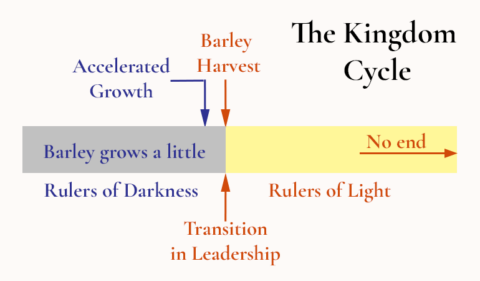
There is a transition between the Sons of Adam and Messiah Yahusha. At this junction, our Messiah reaps his harvest which is symbolized by the barley. Based on these factors, we can expect the barley to have exponential accelerated growth in our culture as the day approaches.
We are currently living in the Kingdom of Darkness which started on the eighth day, after the first week of creation when Adam fell. This was the moment when mankind chose to rule according to their own Laws rather than the Laws of Yahuah Elohiym. They rebelled against Yahuah and a war between heaven and earth was started which is depicted in the Hebrew word for “enmity” in the following passage:
And I will put enmity between you and the woman, and between your seed and her seed; it shall strike your head, and you shall strike his heel.
This was the moment when strife between Yahuah and mankind began. The moon’s cycle also represents earthly Kingdoms ruled by men and women which also has an association to “shanah”. The leaders of the earth use their own laws rather than the Laws of our Father in Heaven to rule their kingdoms. Every empire on earth has “waxed” and “waned” like the moon. Empires begin as a sliver of light and reach their peak representing the full moon. Then, they slowly decline and are replaced by another king.
Here is an example in Dani’El. King Nebuchadnezzar had a dream of a statue made of different substances. The Babylonian Empire was represented by the head of gold. It rose like the moon, flourished, then declined.
You, O king, are a king of kings: for the Elohiym of heaven has given you a kingdom, power, and strength, and glory. And wheresoever the children of men dwell, the beasts of the field and the fowls of the heaven he has given into your hand, and has made you ruler over them all. You are this head of gold.
It was replaced by the Kingdom of Persia which was inferior to the Babylonian Empire. It was represented by the chest of silver. It rose like the moon, flourished and then declined just like the moon’s cycle.
And after you shall arise another kingdom inferior to you, and another third kingdom of brass, which shall bear rule over all the earth.
The third kingdom was the Greek Empire which was inferior to the Persian Empire. It was represented by the groin of brass. It rose like the moon, flourished and then declined. The fourth kingdom was the Roman Empire which was inferior to the Greek Empire. It was represented by the legs of iron. It rose like the moon, flourished and then declined.
And the fourth kingdom shall be strong as iron: forasmuch as iron breaks in pieces and subdues all things: and as iron that breaks all these, shall it break in pieces and bruise.
The last kingdom resembles the Roman Empire but it is not as cohesive and much more inferior than any of the originals. It is represented by iron mixed with clay which is not a very solid substance. This is represented by the ten toes on the statue. It has risen like the moon, flourished and is currently in decline.
And whereas you saw the feet and toes, part of potters’ clay, and part of iron, the kingdom shall be divided; but there shall be in it of the strength of the iron, forasmuch as you saw the iron mixed with miry clay. And as the toes of the feet were part of iron, and part of clay, so the kingdom shall be partly strong, and partly broken. And whereas you saw iron mixed with miry clay, they shall mingle themselves with the seed of men: but they shall not cleave one to another, even as iron is not mixed with clay.
According to this prophecy, it is the last earthly kingdom that rules according to the laws of men and women. These are the Kingdoms of Darkness. Because these kingdoms represent the moon, they are the “rulers of darkness” or the “night”. After “night” comes the sun rises. The “Greater Light” will rise in the East and rule the “day”. This prophecy says that this is a Kingdom that will never end.
And in the days of these kings shall the Elohiym of heaven set up a kingdom, which shall never be destroyed: and the kingdom shall not be left to other people, but it shall break in pieces and consume all these kingdoms, and it shall stand FOREVER. Forasmuch as thou saw that the stone was cut out of the mountain without hands, and that it broke in pieces the iron, the brass, the clay, the silver, and the gold; the great Elohiym has made known to the king what shall come to pass hereafter: and the dream is certain, and the interpretation thereof sure.
Bereshith (Genesis) 3:15 says the “seed” of woman will “strike the head” of the serpent. The “head” is a representation of leadership or the firstborn sons of Adam which will occur during this transition. Tehillah 110 tells us its “fulfillment”.
He shall judge among the heathen, he shall fill the places with the dead bodies; he shall strike the heads over many countries.
Tehillim (Psalms) 110 is a prophecy regarding the return of our Messiah. It says that “he will strike the heads over many countries”. This is clearly a “fulfillment” of Bereshith (Genesis) 3:15. The “heads over many countries” are the “seed of the serpent”. They have ruled according to their own Laws which are grossly inferior to the Laws of our Father written by the Prophet Moshe. This transition marks the end of the strife between Yahuah and mankind which refers back to our initial passage in Bereshith (Genesis) 6:3.
And Yahuah said, My Spirit shall not rule over conflicts with man forever, for he also is flesh: yet his days shall be a hundred and twenty “shanah”.
“Shanah” is related to “harvest cycles”. The barley is planted in the eighth month. This marks the new count for the “year”. When the Word of our Father says that Abraham lived 175 “years” or “shanah”, this means he lived 175 “harvest cycles”. The count was not determined from an individual’s date of birth because that is not what the Hebrew word “shanah” means. Here is another example.
And Mahalalel lived sixty and five “harvest cycles”, and begat Yared: And Mahalalel lived after he begat Yared eight hundred and thirty “harvest cycles”, and begat sons and daughters: And all the days of Mahalalel were eight hundred ninety and five “harvest cycles”: and he died.
When we think in terms of “harvest cycles”, there are actually three in our Father’s Laws.
-1-
The first cycle in our Father’s Kingdom is the Annual Planting Cycle which is repeated every year. Shemini Atzeret is the “eighth” day of the Feast of Sukkot and marks the end of the year and a transition into a new annual cycle. The year or shanah does not begin until the first month in the Spring. Our Father does not include the “dark months” in a reference to a “year” or “shanah”. Shemini Atzeret is a Shabbat like the Year of Yovel (Jubilee). It serves as a “marker” or “point” of transition from one cycle to another.

The eighth day of Sukkot marks the END and the BEGINNING of the annual cycle. Planting the fields in the land of Yashar’El began in the “eighth” month. This is related to the “shin” because the “baby tooth” is replaced or exchanged with a “permanent tooth” which is bigger and stronger. The “old harvest” is replaced or exchanged with the “new harvest”. Here is the math as it relates to Bereshith (Genesis) 6:3:
120 shanah X 1 annual cycle = 120 years
The striving between Yahuah and man continued beyond 120 years. Bereshith (Genesis) 6:3 is not a reference to the annual cycle.
-2-
The second cycle in our Father’s Kingdom is the Land Shabbats which occur every seven years. This includes six years of yearly harvest cycles and one year of rest for the land. Then, the cycle begins again in the “eighth” annual cycle which is also the “first” year in the next cycle. The “eighth” year marks the beginning of the next cycle.

Year 8 and 1 mark the END and BEGINNING of a new Harvest Cycle in our Father’s Kingdom. Here is the math for Bereshith (Genesis) 6:3 in relation to this cycle.
120 shanah X 7 years = 840 years
The striving between Yahuah and man has continued beyond 840 years. (Genesis) 6:3 is not a reference to the Land Shabbat cycle.
-3-
The third harvest cycle in our Father’s Kingdom is the Year of Yovel (Jubilee) which occurs every 50 years. This includes seven sets of Shabbats for the land and one Year of Yovel when all people return to their land of origin. They do not have time to harvest fields because they are packing up their belongings and returning to their land of origin.

Year 8 and 50 END a harvest cycle in our Father’s Kingdom. “Eight” is the marker for a “new beginning” in our Father’s Realm.
120 shanah X 50 years = 6000 years
The striving between Yahuah and mankind has continued for thousands of years. We are near the 6000th year since the beginning. It is at this point the striving between Yahuah and man will END and a new government will replace the old government. The new government uses the Laws of our Father to rule and reign over the earth which is a set of superior Laws that replaces the old government which uses the Laws of Men. The old government is like the “baby tooth” a child loses at the age of six. It is replaced with a “permanent tooth” which is stronger and bigger. The permanent tooth endures for the rest of our lives and is never exchanged again. Likewise, the new government will endure for the rest of our eternal lives.
The Sign of the Times:
The barley represented by our Father’s people are awakening and their growth is accelerating right now. This serves as a sign that the final harvest is going to commence. It will be a Year of Yovel (Jubilee) in which everyone returns to the land of their origin. Those who belong to the House of Yahuah will return to their original intended place in the Garden of Eden. This place is reserved for people who have chosen to abandon their sinful lives and align themselves with the Laws in our Father’s Kingdom. They will be permitted to enter His City and have access to the Tree of Life.
The “Lesser Light” has ruled the “night” which are the firstborn sons of Adam who have ruled and reigned over the inhabitants of the earth. The “night” in this cycle is almost over. The “Son” will begin to rise in the east and will rule the Day for eternity. The Kingdom of Darkness will never rise again. This is prophesied in the following passage:
Violence shall no more be heard in your land, wasting nor destruction within your borders; but you shall call your walls Salvation, and your gates Praise. The sun shall be no more your light by day; neither for brightness shall the moon give light unto you: but Yahuah shall be unto you an everlasting light, and your Elohiym your glory. Your sun shall no more go down; neither shall your moon withdraw itself: for Yahuah shall be your everlasting light, and the days of your mourning shall be ended.
This does not necessarily mean that the sun and moon will no longer exist. It is a reference to the Kingdom of Light. It will never end. Yahuah will be our everlasting Light because the Kingdom will be ruled by His Laws by His Messiah. This is the reason there is no evening or morning mentioned in the seventh day.
And on the seventh day Elohiym ended his work which he had made; and he rested on the seventh day from all his work which he had made. And Elohiym blessed the seventh day, and set it apart: because that in it he had rested from all his work which Elohiym created and made.
It is a “Day” that never ends. The Laws of Yahuah written by the Prophet Moshe have given us understanding and wisdom. These writings contain the promises of our Father and His covenants. They have helped people arrive to the moment of transition. Moshe wrote the Law at Mount Sinai thousands of years ago. These manuscripts have been handed down and copied over and over and contain scribal errors. In order to understand the Law, we must read and study it for ourselves. The culture in which it was written has been lost. After the transition, our Messiah will sit in Yerushalayim and restore a correct understanding of the Law. We will be able to correct our misunderstandings because we will hear it directly from him. This is prophesied in the following passage:
The word that Yeshayahu the son of Amoz saw concerning Yahudah and Yerushalayim. And it shall come to pass in the last days, that the mountain of Yahuah’s House shall be established in the top of the mountains, and shall be exalted above the hills; and all nations shall flow unto it. And many people shall go and say, Come, and let us go up to the mountain of Yahuah, to the House of the Elohiym of Ya’aqob; and he will teach us of his ways, and we will walk in his paths: for out of Tziyon shall go forth the Law [Torah], and the Word of Yahuah from Yerushalayim. And he shall judge among the nations, and shall rebuke many people: and they shall beat their swords into plowshares, and their spears into pruninghooks: nation shall not lift up sword against nation, neither shall they learn war any more. O house of Ya’aqob, come ye, and let us walk in the light of Yahuah.
The Prophet Moshe helps us reach the edge of the promised land. Yahusha, Son of Nun who is our Messiah will bring us into the promised land. When our Messiah returns, he will rule and reign over the earth and will quell all conflicts. The conflict between Yahuah and the nations of the earth will end. In this prophecy it states that they will beat their swords into plowshares and will not learn war anymore. This happens at the 6000th year mark according to Bereshith (Genesis) 6:3.

Moshe was 120 years old when he died. This parallels the passage in Bereshith (Genesis) 6:3 which says the days of man will be 120 “years” or “shanah”. The Prophet Moshe helps us reach the edge of the Kingdom and our Messiah will help us cross over into the Land of Promise. The age of Moshe’s death and the timeline given in Bereshith 6:3 are prophetic messages to us. They are referring to the same timeline.
The Barley Harvest is coming!
Download this Article here