641-2 “Nephilim” in the Hebrew Writings
Yahuah upholds all that fall, and raises up all those that be bowed down.
We can observe how the underlying Hebrew word is used in other passages to determine its meaning as well. Many people use Strong’s Exhaustive Concordance of the Bible reference numbers to locate Hebrew words in other passages with the same meaning. In my Esword collection of resources, I have a Hebrew version of the Hebrew writings with these reference numbers. In order to determine occurrences of this Hebrew word, I chose to copy the word exactly from Bereshith (Genesis) 6:4 and search the actual Hebrew text for occurrences rather than rely upon Strong’s reference numbers. Here are the results:
- Strong’s Exhaustive Concordance of the Bible reference #H5303, “nephilim” is found in two verses with three occurrences.
- The Hebrew word search revealed ten occurrences in ten verses for the same exact word, “nephilim”. The reference numbers were H5303 and #H5307 in Strong’s Concordance.
The question:
Why did James Strong use two different reference numbers for the same exact word with the same exact Hebrew letters?
We are going to examine this evidence closely. The Hebrew word for “nephilim” in all of these passages looks like this in modern Hebrew and the ancient pictographic language:
הנפלים
MYLPNH
M-Y-L-PH-N-H
Hebrew is read right to left. The English equivalents are posted underneath so we can see which part of the word is a reference to “nephilim”. The three-lettered root is highlighted in orange. The letter “hey” at the beginning of the word is a prefix meaning “the” so this phrase is read as “the nephilim”. The “yod” and “mem” on the end makes the word plural meaning more than one. Here is the exact word in English and Hebrew highlighted in orange in all ten occurrences.
1. Tehillah (Psalm) 145:14 uses the exact same word in Debarim (Deuteronomy) 6:4 but it is not translated as “giant”.
Yahuah upholds all that fall [Nephilim H5307], and raises up all those that be bowed down.
סומך H5564 יהוה H3068 לכל H3605 הנפלים H5307 וזוקף H2210 לכל H3605 הכפופים׃ H3721
2. Bereshith (Genesis) 6:4 is often translated as “giant” but it is the same exact word used in Tehillah (Psalms) 145:14. The word “giant” does not fit the context of the Tehillah.
There were giants [Nephilim H5303] in the earth in those days; and also after that, when the sons of Elohiym came in unto the daughters of men, and they bare children to them, the same became mighty men which were of old, men of renown.
הנפלים H5303 היו H1961 בארץ H776 בימים H3117 ההם H1992 וגם H1571 אחרי H310 כן H3651 אשׁר H834 יבאו H935 בני H1121 האלהים H430 אל H413 בנות H1323 האדם H120 וילדו H3205 להם המה H1992 הגברים H1368 אשׁר H834 מעולם H5769 אנשׁי H376 השׁם׃ H8034
3. Bemidbar (Numbers) 13:33 is also translated as “giants”.
And there we saw the giants [Nephilim H5303], the sons of Anak, which come of the giants [Nephilim H5303]: and we were in our own sight as grasshoppers, and so we were in their sight.
ושׁם H8033 ראינו H7200 את H853 הנפילים H5303 בני H1121 ענק H6061 מן H4480 הנפלים H5303 ונהי H1961 בעינינו H5869 כחגבים H2284 וכן H3651 היינו H1961 בעיניהם׃ H5869
In this particular passage, the first occurrence of “nephilim” has an extra “yod”.
MYLYPNH
MYLPNH
This rendering of the word “nephilim” is claimed to be an Aramaic word and not a Hebrew word. But as we pointed out earlier in the study, the Aramaic language also originated from the ancient pictographic language used by Hebrews.
The word still has the same three-lettered root, “Naphal” so the definition is still related to this idea of “fallen men”. “Nephilim” with the extra letter “yod” only occurs once.
4. Yahusha (Joshua) 8:25 is translated as “fell”:
And so it was, that all that fell [Nephilim H5307], that day, both of men and women, were twelve thousand, even all the men of Ai. (Yahusha/Joshua 8:25)
ויהי H1961 כל H3605 הנפלים H5307 ביום H3117 ההוא H1931 מאישׁ H376 ועד H5704 אשׁה H802 שׁנים H8147 עשׂר H6240 אלף H505 כל H3605 אנשׁי H376 העי׃ H5857
5. Shophetim (Judges) 20:46 is translated as “fell”.
So that all which fell [Nephilim H5307] that day of Benjamin were twenty and five thousand men that drew the sword; all these were men of valor.
ויהי H1961 כל H3605 הנפלים H5307 מבנימן H1144 עשׂרים H6242 וחמשׁה H2568 אלף H505 אישׁ H376 שׁלף H8025 חרב H2719 ביום H3117 ההוא H1931 את H853 כל H3605 אלה H428 אנשׁי H376 חיל׃ H2428
6. 2 Melakim (Kings) 25:11 is translated as “fugitives” and “fell away”.
Now the rest of the people that were left in the city, and the fugitives [Nephilim H5307] that fell away [Naphal H5307] to the king of Babylon, with the remnant of the multitude, did Nebuzaradan the captain of the guard carry away. (2 Melakim/Kings 25:11)
ואתH853 יתר H3499 העם H5971 הנשׁארים H7604 בעיר H5892 ואת H853 הנפלים H5307 אשׁר H834 נפלו H5307 על H5921 המלך H4428 בבל H894 ואת H853 יתר H3499 ההמון H1995 הגלה H1540 נבוזראדן H5018 רב H7227 טבחים׃ H2876
7. Yirmeyahu (Jeremiah) 39:9 is translated as “fell away” and “fell”.
Then Nebuzaradan the captain of the guard carried away captive into Babylon the remnant of the people that remained in the city, and those that fell away [Nephilim H5307], that fell [Nephilim H5307] to him, with the rest of the people that remained.
ואת H853 יתר H3499 העם H5971 הנשׁארים H7604 בעיר H5892 ואת H853 הנפלים H5307 אשׁר H834 נפלו H5307 עליו H5921 ואת H853 יתר H3499 העם H5971 הנשׁארים H7604 הגלה H1540 נבוזר אדן H5018 רב H7227 טבחים H2876 בבל׃ H894
8. Yirmeyahu (Jeremiah) 52:15 is translated as “fell away” and “fell”.
Then Nebuzaradan the captain of the guard carried away captive certain of the poor of the people, and the residue of the people that remained in the city, and those that fell away [Nephilim H5307], that fell [Nephal H5307], to the king of Babylon, and the rest of the multitude.
ומדלות H1803 העם H5971 ואת H853 יתר H3499 העם H5971 הנשׁארים H7604 בעיר H5892 ואת H853 הנפלים H5307 אשׁר H834 נפלו H5307 אל H413 מלך H4428 בבל H894 ואת H853 יתר H3499 האמון H527 הגלה H1540 נבוזראדן H5018 רב H7227 טבחים׃ H2876
9. Yechezqel (Ezekiel) 32:22 is translated as “fallen”.
Asshur is there and all her company: his graves are about him: all of them slain, fallen [Nephilim H5307] by the sword:
שׁם H8033 אשׁור H804 וכל H3605 קהלה H6951 סביבותיו H5439 קברתיו H6913 כלם H3605 חללים H2491 הנפליםH5307בחרב׃ H2719
10. Yechezqel (Ezekiel) 32:24 is translated as “fallen”.
There is Elam and all her multitude round about her grave, all of them slain, fallen [Nephilim H5307] by the sword, which are gone down uncircumcised into the nether parts of the earth, which caused their terror in the land of the living; yet have they borne their shame with them that go down to the pit.
שׁם H8033 עילם H5867 וכל H3605 המונה H1995 סביבות H5439 קברתה H6900 כלם H3605 חללים H2491 הנפלים H5307 בחרב H2719 אשׁר H834 ירדו H3381 ערלים H6189 אל H413 ארץ H776 תחתיות H8482 אשׁר H834 נתנו H5414 חתיתם H2851 בארץ H776 חיים H2416 וישׂאו H5375 כלמתם H3639 את H854 יורדי H3381 בור׃ H953
All references to “nephilim” in these passages are related to this idea of “falling”. Bemidbar (Numbers) 13:33 is the only passage which describes men of large stature in context implying the “nephilim” in this instance were giants.
Could the men of large stature, mentioned in Bemidbar (Numbers) 13:33 just happen to be described as “fallen men”?
Is it possible for men of small stature to also be described as “fallen men”?
Ancient Hebrew is a concrete language that focuses more on action rather than appearances. Jeff A. Benner describes this in his article titled, The Philosophy of the Hebrew Language:
In our Modern western language verbs express action (dynamic) while nouns express inanimate (static) objects. In Hebrew all things are in motion (dynamic) including verbs and nouns. In Hebrew sentences the verbs identify the action of an object while nouns identify an object of action. The verb מלך (malak) is “the reign of the king” while the noun מלך (melek) is the “the king who reigns”. A mountain top is not a static object but the “head lifting up out of the hill”. A good example of action in what appears to be a static passage is the command to “have no other gods before me” (Exodus 20:3). In Hebrew thought this passage is saying “not to bring another one of power in front of my face”. https://www.ancient-hebrew.org/language/philosophy-of-the-hebrew-language.htm
The ten spies in Bemidbar (Numbers) 13:33 were describing the “actions” of the men who were of large stature in the land. This is how their brains operated. They were focused on the actions of the men who were of large stature and they described them as “fallen men”.
What are the actions the people dwelling in the land were doing that caused the ten spies to describe them as “fallen men”?
This is a question that we will answer later in this study. The Hebrew word “nephilim” without the Hebrew letter “hey” occurs seven more times in the Hebrew writings. Following are the entries in English and Hebrew for these occurrences as well.
11. Debarim (Deuteronomy) 22:4 is translated as “fall down”.
You shall not see your brother’s ass or his ox fall down [Nephilim H5307] by the way, and hide yourself from them: you shall surely help him to lift them up again.
לא H3808 תראה H7200 את H853 חמור H2543 אחיך H251 או H176 שׁורו H7794 נפלים H5307 בדרך H1870 והתעלמת H5956 מהם H1992 הקם H6965 תקים H6965 עמו׃ H597
12. Shophetim (Judges) 7:12 is translated as “lay”.
And the Midianites and the Amalekites and all the children of the east lay [Nephilim H5307] along in the valley like grasshoppers for multitude; and their camels were without number, as the sand by the sea side for multitude.
ומדין H4080 ועמלק H6002 וכל H3605 בני H1121 קדם H6924 נפלים H5307 בעמק H6010 כארבה H697 לרב H7230 ולגמליהם H1581 אין H369 מספר H4557 כחול H2344 שׁעל H5921 שׂפת H8193 הים H3220 לרב׃ H723
13. 1 Shemuel (Samuel) 31:8 is translated as “fallen”.
And it came to pass on the morrow, when the Philistines came to strip the slain, that they found Shaul and his three sons fallen [Nephilim H5307] in mount Gilboa.
ויהי H1961 ממחרת H4283 ויבאו H935 פלשׁתים H6430 לפשׁט H6584 את H853 החללים H2491 וימצאו H4672 את H853 שׁאול H7586 ואת H853 שׁלשׁת H7969 בניו H1121 נפלים H5307 בהר H2022 הגלבע׃ H1533
14. 1 Dibre HaYamin (Chronicles) 10:8 is translated as “fallen”.
And it came to pass on the morrow, when the Philistines came to strip the slain, that they found Shaul and his sons fallen [Nephilim H5307] in mount Gilboa.
ויהי H1961 ממחרת H4283 ויבאו H935 פלשׁתים H6430 לפשׁט H6584 את H853 החללים H2491 וימצאו H4672 את H853 שׁאול H7586 ואת H853 בניו H1121 נפלים H5307 בהר H2022 גלבע׃ H1533
15. 2 Dibre HaYamin (Chronicles) 20:24 is translated as “fallen”.
And when Yahudah came toward the watch tower in the wilderness, they looked unto the multitude, and, behold, they were dead bodies fallen [Nephilim H5307] to the earth, and none escaped.
ויהודה H3063 בא H935 על H5921 המצפה H4707 למדבר H4057 ויפנו H6437 אל H413 ההמון H1995 והנם H2005 פגרים H6297 נפלים H5307 ארצה H776 ואין H369 פליטה׃ H6413
16. Yechezqel (Ezekiel) 32:23 is translated as “fallen”.
Whose graves are set in the sides of the pit, and her company is round about her grave: all of them slain, fallen [Nephilim H5307] by the sword, which caused terror in the land of the living. (Yechezqel/Ezekiel 32:23)
אשׁר H834 נתנו H5414 קברתיה H6913 בירכתי H3411 בור H953 ויהי H1961 קהלה H6951 סביבות H5439 קברתה H6900 כלם H3605 חללים H2491 נפלים H5307 בחרב H2719 אשׁר H834 נתנו H5414 חתית H2851 בארץ H776 חיים׃ H2416
17. Yechezqel (Ezekiel) 32:27 is translated as “fallen”.
And they shall not lie with the mighty that are fallen [Nephilim H5307] of the uncircumcised, which are gone down to She’ol with their weapons of war: and they have laid their swords under their heads, but their iniquities shall be upon their bones, though they were the terror of the mighty in the land of the living.
ולא H3808 ישׁכבו H7901 את H854 גבורים H1368 נפלים H5307 מערלים H6189 אשׁר H834 ירדו H3381 שׁאול H7585 בכלי H3627 מלחמתם H4421 ויתנו H5414 את H853 חרבותם H2719 תחת H8478 ראשׁיהם H7218 ותהי H1961 עונתם H5771 על H5921 עצמותם H6106 כי H3588 חתית H2851 גבורים H1368 בארץ H776 חיים׃ H2416
ALL of these entries are the actual word “nephilim” in Hebrew. The word “Naphal” without the plural ending occurs in 403 passages in the Hebrew writings. They are overwhelmingly translated as “fell”, “fallen” and “fall”. It is also translated as “died” and “perish” which is the result of falling on the battle field.
The Hebrew word “nephilim” means “fallen men”. This evidence is overwhelming and stands directly opposed to the book of Enoch. These definitions stand opposed to most modern interpretations of the pre-flood account. If “nephilim” is not a reference to “giants” or “angelic offspring”, then what is actually happening in Bereshith (Genesis) 6:1-8?
The Fall of Mankind:
Hebrew is concrete. The concept of “falling” is someone who is on higher ground “falls” to lower ground. If a man is on a roof and loses his balance, he may “fall” to the ground and hurt himself. Falling and tripping is often associated with pain and/or injury. Someone in a higher position is demoted to a lower position. They have “fallen” and have likely received a reduction in their earnings.
The fall of mankind has created pain and injury among the inhabitants of the earth. Mankind was originally in the Garden of Eden in the Presence of Yahuah. After Adam and Chavah sinned, they were removed from the Garden and no longer had access to Yahuah or the Tree of Life.
And Adonai Yahuah said, Behold, the man is become as one of us, to know good and evil: and now, lest he put forth his hand, and take also of the tree of life, and eat, and live forever: Therefore, Adonai Yahuah sent him forth from the garden of Eden, to till the ground from where he was taken. So, he drove out the man; and he placed at the east of the garden of Eden Kerubim, and a flaming sword which turned every way, to keep the way of the tree of life.
Adam and Chavah are literally a “fallen man and woman” or “nephilim” when we consider the concrete definition of the word. They were cast out of the Garden and prohibited from returning to it. They lost their “high” position in the earth and were brought to a “lower” position in the earth. The individual in the following passage was also cast out of the Garden Eden which is also called the set-apart mountain of Yahuah in this passage. Mountains are high places.
Moreover, the word of Yahuah came unto me, saying, Son of man, take up a lamentation upon the king of Tyrus, and say unto him, Thus says Adonai Yahuah; You seal up the sum, full of wisdom, and perfect in beauty. You have been in Eden the garden of Elohiym; every precious stone was thy covering, the sardius, topaz, and the diamond, the beryl, the onyx, and the jasper, the sapphire, the emerald, and the carbuncle, and gold: the workmanship of thy tabrets and of thy pipes was prepared in you in the day that you were created. You are the anointed kerub that covers; and I have set you so: you were upon the set-apart mountain of Elohiym; you have walked up and down in the midst of the stones of fire. You were perfect in your ways from the day that you were created, till iniquity was found in you. By the multitude of your merchandise, they have filled the midst of you with violence, and you have sinned: therefore, I will cast you as profane out of the mountain of Elohiym: and I will destroy you, O covering kerub, from the midst of the stones of fire. Your heart was lifted up because of your beauty, you have corrupted your wisdom by reason of your brightness: I will cast you to the ground, I will lay you before kings, that they may behold you. You have defiled your sanctuaries by the multitude of your iniquities, by the iniquity of your trafficking; therefore, will I bring forth a fire from the midst of you, it shall devour you, and I will bring you to ashes upon the earth in the sight of all them that behold you. All they that know you among the people shall be astonished at you: you shall be a terror, and never shall you be any more.
The only individuals who were in the Garden of Eden based on testimony were Adam and Chavah. The King of Tyrus is a man and a descendant of Adam. He was in the loins of his father, Adam, when Adam was in the Garden of Eden. Adam sinned and was cast out of the mountain of Elohiym. He went from a mountain which is a high place to a lower place outside the Garden of Eden. In this passage, Yahuah says He has cast him to the ground. Adam is a “fallen one” literally because he sinned against Yahuah Elohiym. Here is an illustration:
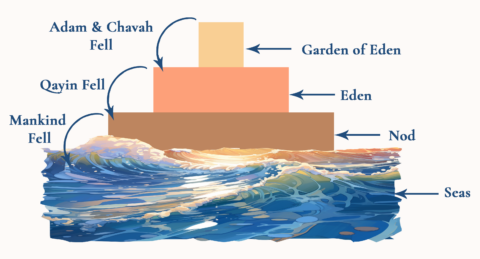
Adam and Chavah were removed from the Garden of Eden, the mountain of Elohiym and dwelt in Eden outside the Garden. Qayin was removed from Eden and dwelled in Nod. Mankind was removed from the earth and cast into the sea. All of these people were considered “fallen people” because they literally were removed from a higher place in the earth to a lower place. Here is another passage talking about Adam which uses the word “Naphal”:
How are you fallen [Naphal #H5307] from heaven, O Shining one, son of the morning! how are you cut down to the ground, which did weaken the nations! For you have said in your heart, I will ascend into heaven, I will exalt my throne above the stars of Elohiym: I will sit also upon the mount of the congregation, in the sides of the north: I will ascend above the heights of the clouds; I will be like the Most High. Yet you shall be brought down to She’ol, to the sides of the pit. They that see you shall narrowly look upon you, and consider you, saying, Is this the man [Aniysh #H376] that made the earth to tremble, that did shake kingdoms; That made the world as a wilderness, and destroyed the cities thereof; that opened not the house of his prisoners? All the kings of the nations, even all of them, lie in glory, everyone in his own house. But you are cast out of your grave like an abominable branch, and as the raiment of those that are slain, thrust through with a sword, that go down to the stones of the pit; as a carcass trodden under feet. You shall not be joined with them in burial, because you have destroyed your land, and slain your people: the seed of evildoers shall never be renowned. Prepare slaughter for his children for the iniquity of their fathers; that they do not rise, nor possess the land, nor fill the face of the world with cities. For I will rise up against them, says Yahuah of hosts, and cut off from Babylon the name, and remnant, and son, and nephew, says Yahuah.
He was taken down from his position because he sinned. He was dysfunctional in the eyes of Yahuah Elohiym. The passage says the “seed of evildoers shall never be renowned”. Adam and Chavah sinned which caused them to be cast out of the Garden. Committing sin causes one to “fall”. Beyt Yashar’El and Beyt Yahudah have also “fallen”. Here is an illustration:
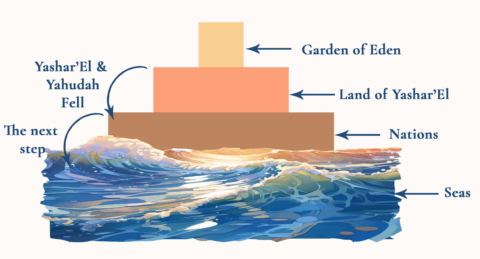
The House of Yashar’El and the House of Yahudah were in the land of Yashar’El which is just outside the gates of heaven or the Garden of Eden (Bereshith/Genesis 28:12-22). They transgressed the commandments of Yahuah Elohiym written in the Torah over and over again. As a result, they were cast out of the land and scattered among the nations. If they continue to sin, the next step is the water in which life can no longer be sustained as in the days of Noach’s flood. The House of Yashar’El and the House of Yahudah are “fallen people” or “nephilim” by definition.
In the Garden of Eden, no “fallen people” exist. This means that no one who commits sin exists in the Garden of Eden. People cannot fall upwards. The only way any of us can be restored to our original position is by eliminating sin from our lives through repentance. Kerubim are stationed at the entrance to the Garden to prevent those who sin from re-entering the Garden. There are clear and distinct boundaries between each section: the Garden of Eden (heaven), Eden (land of Yashar’El), Nod (Nations) and the Seas (She’ol).
Download this Article here