641-1 Definition of “Nephilim”
And Yahudah and his brethren came to Yoseph’s house; for he was yet there: and they fell before him on the ground.
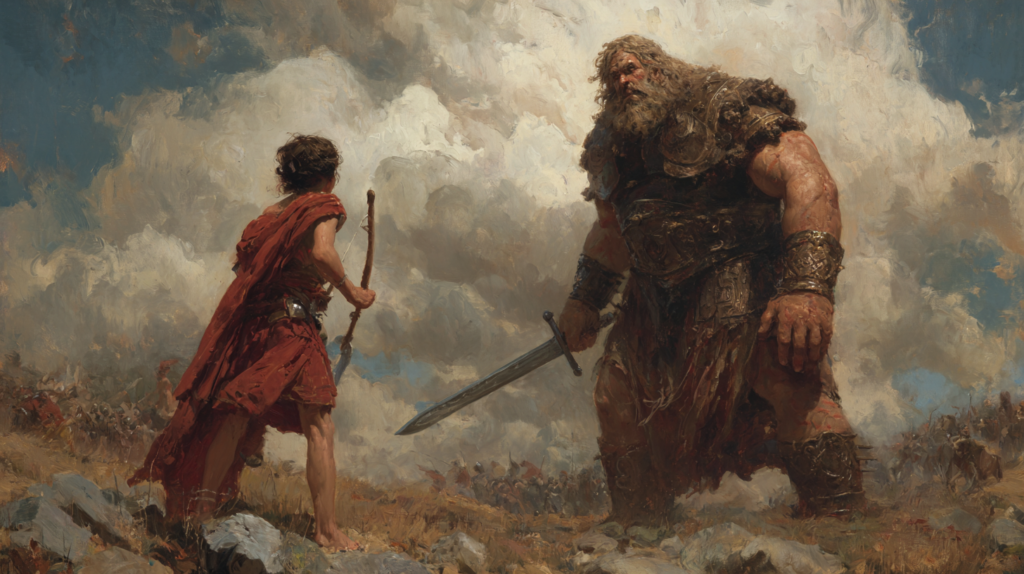
In our world today, the term “nephilim” is a typically understood as a reference to the offspring between angels and the daughters of men. They are perceived as malformed giants who are evil beings that destroy mankind and the earth. Many of these ideas are generated from the first book of Enoch. Here is a passage regarding this scenario in the book of Enoch, chapter 15:
- And He answered and said to me, and I heard His voice: ‘Fear not, Enoch, thou righteous man and scribe of righteousness: approach hither and hear my voice. 2. And go, say to the Watchers of heaven, who have sent thee to intercede for them: “You should intercede” for men, and not men for you: 3. Wherefore have ye left the high, holy, and eternal heaven, and lain with women, and defiled yourselves with the daughters of men and taken to yourselves wives, and done like the children of earth, and begotten giants (as your) sons? 4. And though ye were holy, spiritual, living the eternal life, you have defiled yourselves with the blood of women, and have begotten (children) with the blood of flesh, and, as the children of men, have lusted after flesh and blood as those also do who die and perish. 5. Therefore have I given them wives also that they might impregnate them, and beget children by them, that thus nothing might be wanting to them on earth. 6. But you were formerly spiritual, living the eternal life, and immortal for all generations of the world. 7. And therefore I have not appointed wives for you; for as for the spiritual ones of the heaven, in heaven is their dwelling. 8. And now, the giants, who are produced from the spirits and flesh, shall be called evil spirits upon the earth, and on the earth shall be their dwelling. 9. Evil spirits have proceeded from their bodies; because they are born from men, and from the holy Watchers is their beginning and primal origin; they shall be evil spirits on earth, and evil spirits shall they be called.10. As for the spirits of heaven, in heaven shall be their dwelling, but as for the spirits of the earth which were born upon the earth, on the earth shall be their dwelling. 11. And the spirits of the giants afflict, oppress, destroy, attack, do battle, and work destruction on the earth, and cause trouble: they take no food, but nevertheless hunger and thirst, and cause offences. And these spirits shall rise up against the children of men and against the women, because they have proceeded from them. https://sacred-texts.com/bib/boe/boe018.htm
People accept this as truth and some even claim that it is the Word of the Most High. However, many questions arise from this passage which seem to contradict the Torah as well as the nature and character of Yahuah Elohiym.
- This passage says the “angels” were not given women to procreate; however, they were given male genitals and sperm? Male and female reproductive organs were designed to reproduce children. This is their function. Why would our Father give these angels anatomy that would serve no function? Why would they have a desire to procreate if this was not part of their original intended function? Do we invent television sets with a gas tank? The logic of this passage is flawed.
- If Yahuah did not intend “angels” to reproduce then why would He give them reproductive organs?
- These reproductive organs are used in procreation. They are generated in our “flesh” and this text says these “angels” are not flesh but spirit. In Hebrew, “ruach” means breath or wind. How can something like the wind impregnate a woman and produce a giant?
- In the beginning, Yahuah created everything male and female even in the plant world. He says “like produces like kind” (Bereshith 1:21-22, 24-28). How is it possible for an “angel” to even procreate with a woman? They are two different types of beings according to Enoch.
- Yahuah Elohiym gave Adam and Chavah (Eve) the ability to procreate before the “Fall” which means they could bear children even if they were to live forever. Why would our Creator tell the author of Enoch that He created women to be impregnated? The Torah says she was created to be a “helper” before the Fall when they both had access to the Tree of Life and could live forever. Is Yahuah contradicting Himself?
Writings like this fill gaps in the Torah which create stumbling blocks that prevent us from seeing the truth. The author of Enoch is defining “nephilim” in the eyes and ears of people. Then we look at the situation in Bereshith (Genesis) 6:1-8 and project the author of Enoch’s definition upon the text. People claim that this passage verifies and validates that the book of Enoch is true. Is this the case?
In this study, we are going to allow the Torah and Prophets to define “nephilim”. Does this word have any relationship with “giants” or “the offspring of angels”? For example, the word “nephilim” is used in the following Tehillah (Psalm):
Yahuah upholds all the giants [nephilim H5307], and raises up all those that be bowed down.
If “nephilim” are giants earmarked for destruction, why then is Yahuah lifting them up in this passage? It clearly does not make sense to translate “nephilim” as “giants” in this passage. Is it possible that “nephilim” means something else? Truth is not defined by our perceptions or those conveyed by the author of Enoch. Truth is established by Yahuah Elohiym and we use His Word to help us determine what is real and factual. Yahuah says truth is established on the testimony of two to three reliable, credible witnesses (Debarim/Deuteronomy 19:15).
Definition of “Nephilim”:
We can put the pieces together to this puzzle by examining the definition of “nephilim” from an ancient Hebrew perspective. The Ancient Hebrew Lexicon of the Bible written by Jeff A. Benner defines “Naphal”, which is the singular form of the word, “Nephilim”, as:
LPN ( common, נפל / n.p.l ) Translation: FALL (V) Definition: To leave an erect position suddenly and involuntarily; to descend freely by the force of gravity. Edenics: fall, topple KJV Translations: fall, cast, divide, overthrow, present, lay, rot, accept, inferior, light, lost Strong’s Hebrew #: h.5307 Strong’s Aramaic #: a.5308
“Naphal” is best translated as “fall”. Nothing in this definition leads us to believe that it is a reference to “giants” or beings who are very large in stature. Our own English words “fall” and “topple” are linked to “Naphal”. We can see “fall” and “fail” in the two-lettered root of “Naphal”:
L P
L PH
Following are charts illustrating the link between the ancient pictographic language and languages today. Aramaic was adopted from this pictographic language as well. This is important evidence we will use to address the Aramaic version of the word, “nephilim”.
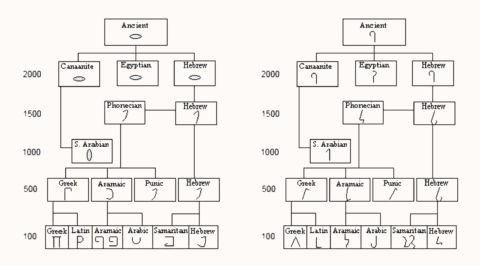
This chart reveals that our own language originated from the ancient Hebrew pictographic language. “Edenics” shows the relationship between the original language that was spoken in Eden by Adam and Chavah as well as our Creator and our languages today. For example, “PH” in our English language is an “F” sound and the “lamed” is an “L” sound, so we can actually see the word “fall” in this ancient Hebrew pictographic language. Etymonline provides the following word etymology for “fall”:
Old English feallan (class VII strong verb; past tense feoll, past participle feallen) “to drop from a height; fail, decay, die,” from Proto-Germanic *fallanan (source also of Old Frisian falla, Old Saxon fallan, Dutch vallen, Old Norse falla, Old High German fallan, German fallen, absent in Gothic).
These are from PIE root *pol– “to fall” (source also of Armenian p’ul “downfall,” Lithuanian puolu, pulti “to fall,” Old Prussian aupallai “finds,” literally “falls upon”).
The meaning “come suddenly to the ground” is from late Old English. Of darkness, night, from c. 1600; of land sloping from 1570s; of prices from 1570s. Of empires, governments, etc., from c. 1200. Of the face or countenance from late 14c. The meaning “to be reduced” (as temperature) is from 1650s. That of “die in battle” is from 1570s. The meaning “to pass casually (into some condition)” is from early 13c. https://www.etymonline.com/search?q=fall
We can actually see the “pey” and “lamed” in the Proto-Indo-European (PIE) words highlighted in orange. The definition in our language is the same as the ancient Hebrew pictographic language definitions. Following is the word etymology for the word “fail” at Etymonline:
1200, “be unsuccessful in accomplishing a purpose;” also “cease to exist or to function, come to an end;” early 13c. as “fail in expectation or performance,” from Old French falir”be lacking, miss, not succeed; run out, come to an end; err, make a mistake; be dying; let down, disappoint” (11c., Modern French faillir), from Vulgar Latin *fallire, from Latin fallere”to trip, cause to fall;” figuratively “to deceive, trick, dupe, cheat, elude; fail, be lacking or defective.” De Vaan traces this to a PIE root meaning “to stumble” (source also of Sanskrit skhalate “to stumble, fail;” Middle Persian škarwidan “to stumble, stagger;” Greek sphallein “to bring or throw down,” sphallomai “to fall;” Armenian sxalem “to stumble, fail”). If so, the Latin sense is a metaphorical shift from “stumble” to “deceive.” Related: Failed; failing.
Replaced Old English abreoðan. From c. 1200 as “be unsuccessful in accomplishing a purpose;” also “cease to exist or to function, come to an end;” early 13c. as “fail in expectation or performance.” https://www.etymonline.com/search?q=fail
This excerpt shows the morphology of the word “fall” with its definition preserved to this very day. In Mr. Benner’s definition of “naphal”, the word “topple” has an Edenics relationship as well. Here is the entry for “topple” in Etymonline:
1580s, “tumble down, fall headfirst,” earlier “tumble or roll about” (1540s), from top (v.) “to tip” + frequentative suffix -le. Transitive sense also is from 1590s. Related: Toppled; toppling. https://www.etymonline.com/word/topple
“Topple” means to fall down head first. This is actually a compound word. The first part of the word is “top” which is like the “top” of a mountain. Following is the word etymology for “top” from Etymonline.
“put a top on,” 1580s, perhaps mid-15c., from top (n.1). Earlier “cut the top off, shave the head” (c. 1300). The meaning “be higher or greater than” also is first recorded 1580s. Meaning “strike (a ball) towards its top” is from 1881. Related: Topped; topping. To top off “to finish” is colloquial from 1836; in sense “fill up, add more to bring to fullness” it is from 1917. https://www.etymonline.com/word/topple
The second part of the compound word “topple” is “PL” which are the same letters in “Naphal”.
LP
L P
“Top-ple” is literally someone or something on “top” falling down. We can see the influence of this ancient language in our own language today with the definition preserved. We can see this with our own eyes. In fact, we have a season called “Fall” which is depicted by leaves falling from trees. We see leaves fall from trees every year with our own eyes.
The word “Naphal” is also related to the idea of a miscarriage and refuse:
LPN ( masc., נפל ) Translation: MISCARRIAGE Definition: [To be verified] As a fallen pregnancy. KJV Translations: birth Strong’s Hebrew #: h.5309
LPNM ( masc., מנפל ) Translation: REFUSE Definition: [To be verified] What is thrown down as worthless. Alternate Spellings: מפל KJV Translations: flake, refuse Strong’s Hebrew #: h.4651
The first letter of “nephilim” is the “nun” which is a picture of a sprouted seed. In its most basic sense, “naphal” means “seed falling down speaking to Authority”. Based on these definitions, Tehillah (Psalms) 145:14 could be translated as:
Yahuah upholds all the “fallen men and women who have been discarded and thrown down as worthless”, and raises up all those that be bowed down.
This statement makes much more sense. Yahuah does raise up those who are downtrodden or have fallen down. The people in this Tehillah have been mistreated and cast out. They have stumbled or toppled. Yahuah is lifting up those who have been cast down or who have stumbled.
“Naphal” is also related to this idea of pleading and judging:
LLP ( common, פלל / p.l.l ) Translation: PLEAD (V) Definition: To entreat or appeal earnestly; to fall to the ground to plead a cause to one in authority; prevent a judgment. Edenics: pray – with the exchange of the l for the r. KJV Translations: pray, judge, made, intreat, judgment, prayer, supplication, thought Strong’s Hebrew #: h.6419
LYLP ( masc., פליל / pa-lil ) Translation: JUDGE Definition: One who presides over a dispute. KJV Translations: judge Strong’s Hebrew #: h.6414
When an individual is seeking mercy from the judge, they fall down to their knees in submission or even flat on their face as in the following two examples. Both words in these passages are the Hebrew word, “Naphal”:
And Abram fell [Naphal #H5307] on his face: and Elohiym talked with him, saying,
And Yahudah and his brethren came to Yoseph’s house; for he was yet there: and they fell [Naphal #H5307] before him on the ground.
In the context of both these passages, we see men falling down to the ground in submission to someone in authority. Their actions reveal the definition of “naphal”. “Naphal” is also used in the following passage:
But unto Qayin and to his offering he had not respect. And Qayin was very wroth, and his countenance fell [Naphal #H5307]. And Yahuah said unto Qayin, Why are you wroth? and why is your countenance fallen [Naphal #H5307]?
Qayin’s (Cain) demeanor fell from a state of shalom to one of anger. This is a visible change that can be seen in an individual’s face. All of these passages convey this idea of “falling down”. The root of all these words in this word-family is defined by The Ancient Hebrew Lexicon of the Bible as:
LP פל Action: Fall, Plead, Perform, Weigh Object: Dark, Bean Abstract: Distinct, Judgment Definition: A coming to one in authority falling down on the face to intercede on ones own behalf or for another. Ancient Hebrew: The pictograph P is a picture of mouth, the L is a picture of a shepherd staff representing authority. Combined these mean “speak to authority”.
In our minds, we can visualize people falling down to their knees before the Judge and “speaking to their Authority” asking for mercy. We can see this in the actual pictographic language:
LP
Shepherd’s staff-open mouth
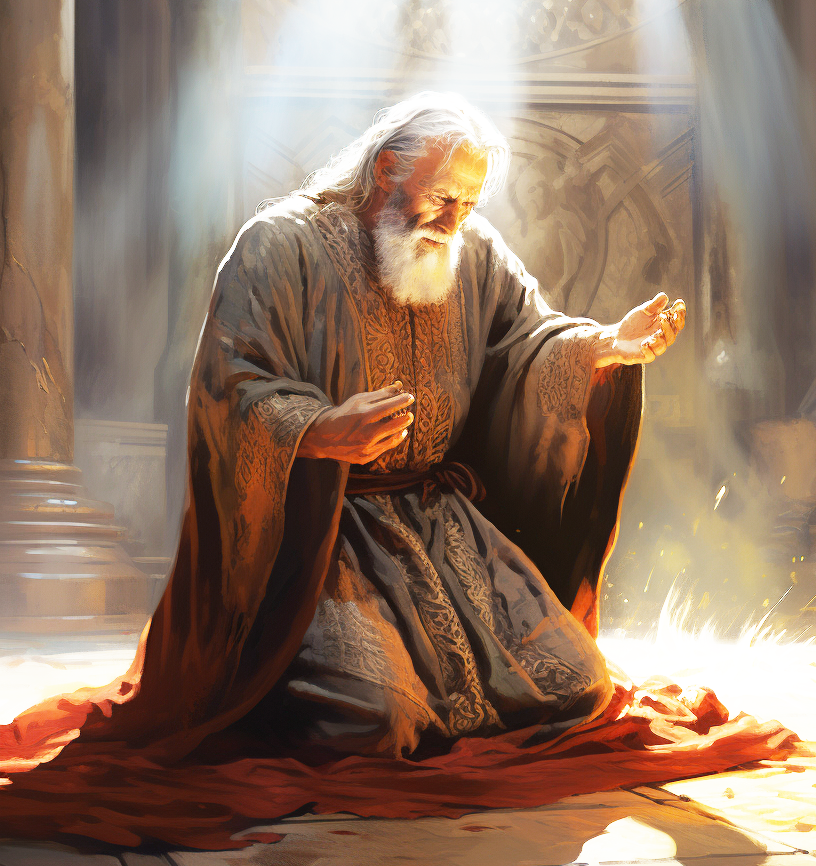
Based on this evidence, “nephilim” ought to be translated as “fallen men” and not “giants”. Not one single definition in this Hebrew word family illustrates any relationship to this idea of “giants” or “angelic offspring”. When translators use the English word “giants”, they are misleading people. They are deceiving people and manipulating their minds to believe something that is not real or true.
Download this Article here