4-1 Walk in the Spirit
Torah Portion 4-1 Bereshith (Genesis) 4:1-26
And Yahuah said unto Qayin, Why are you angry? and why has your countenance fallen? If you do well, shall you not be accepted? and if you do not do well, sin lies at the door. And its desire is for you, and you shall rule over him.
This Torah portion discusses the first murder. We know that it was unintentional because our Father did not put Qayin (Cain) to death immediately. He was cast away from our Father’s Presence into Nod which was likely designated as a city of refuge for people who killed someone unintentionally.
But if he thrust him suddenly without enmity, or have cast upon him anything without laying of wait, Or with any stone, wherewith a man may die, seeing him not, and cast it upon him, that he die, and was not his enemy, neither sought his harm: Then the congregation shall judge between the slayer and the revenger of blood according to these judgments: And the congregation shall deliver the slayer out of the hand of the revenger of blood, and the congregation shall restore him to the city of his refuge, where he was fled: and he shall abide in it unto the death of the high priest, which was anointed with the set-apart oil.
If Qayin (Cain) had intentionally killed his brother, then the avenger of blood which would be Adam could kill him immediately.
But if he thrust him of hatred, or hurl at him by laying of wait, that he die; Or in enmity smite him with his hand, that he die: he that smote him shall surely be put to death; for he is a murderer: the revenger of blood shall slay the murderer, when he meets him.
Adam was not permitted to slay Qayin (Cain) for what he had done. We know the Law existed in the beginning because our Father mentions “sin” in the following passage:
And Yahuah said unto Qayin, Why are you angry? and why has your countenance fallen? If you do well, shall you not be accepted? and if you do not do well, sin lies at the door. And its desire is for you, and you shall rule over him.
“Sin” is defined as “transgression of the Law” (1 Yochanan/John 3:4). Shaul of Tarsus confirms this definition in the following passage:
What shall we say then? Is the law sin? Elohiym forbid. Nay, I had not known sin, but by the Law: for I had not known lust, except the Law had said, You shall not covet.
The commandment, “You shall not covet” establishes a boundary line that defines “functional” behavior and “dysfunctional” behavior. Here is an illustration:
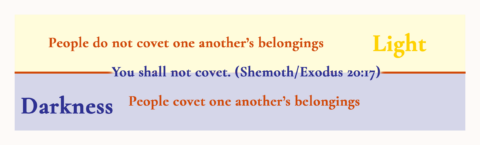
We cannot define a “sin” without a Law. The Law must be in place and well-established before we can distinguish between “functional” and “dysfunctional” behaviors. In the situation with Qayin (Cain), our Father could see the struggle Qayin was facing. He was angry and it was apparent by the look on his face. Our Father established a very important piece of advice.
If we commit the sin, we will desire the sin but it is best if we rule over it.
This describes an “addiction” which is defined the following way:
Addiction is a chronic medical disorder characterized by the compulsive use of substances (like drugs or alcohol) or engagement in behaviors (like gambling) despite harmful consequences. It fundamentally alters the brain’s reward and impulse-control circuits, making it difficult to stop without support.
We become a “slave” to our unhealthy desire and it causes us harm. Our Messiah confirms this in the following:
Yahusha answered them, Verily, verily, I say unto you, Whosoever commits sin is the servant of sin.
Shaul of Tarsus urges his followers to not allow sin to reign in our bodies which causes us to obey its lust.
Let not sin therefore reign in your mortal body, that you should obey it in the lusts thereof. Neither yield your members as instruments of unrighteousness unto sin: but yield yourselves unto Elohiym, as those that are alive from the dead, and your members as instruments of righteousness unto Elohiym.
“Sin” is characterized by a compulsory desire to repeat the sin again like an addiction. The Hebrew word translated as “desire” in Bereshith 4:7 is “teshuqah”. This word and its roots are defined the following way by The Ancient Hebrew Lexicon of the Bible written by Jeff A. Benner as:
QF (שק) Action: Drink, Rush, Overflow Object: River, Course, Beverage Definition: During the rain season, repeated each year, the riverbeds become full of water. The surrounding land is soaked with water allowing for the planting of crops. Ancient Hebrew: The pictograph F is a picture of the two front teeth representing the idea of two, the Q is a picture of the sun at the horizon that cycles around the earth. Combined these mean “repeat a cycle”.
QWF ( common, שוק ) Translation: OVERFLOW (V) Definition: [To be verified] The overflowing of the banks of a river. KJV Translations: overflow Strong’s Hebrew #: h.7783
HQWFT ( fem., תשוקה / te-shu-qah) Translation: FOLLOWING Definition: To go, proceed or come after. Being next in order or time. Subsequent to. As the river follows the path of its banks. KJV Translations: desire Strong’s Hebrew #: h.8669
It is characterized by a cycle that is repeated over and over. Each year, rivers overflow their banks. It is a cycle that is repeated each year. ALL sin originates with our primitive urges. Bereshith 4:7 says that Qayin (Cain) was “angry”. This is an emotion that can be difficult to tether and originates in our “serpent brain”. Our brain is divided into three sections: the neocortex (thinking brain), the limbic brain (emotion) and the reptilian or serpent brain (primal survival instincts). The serpent brain is given this name because it is the part of our nervous system that looks and operates similar to a snake.
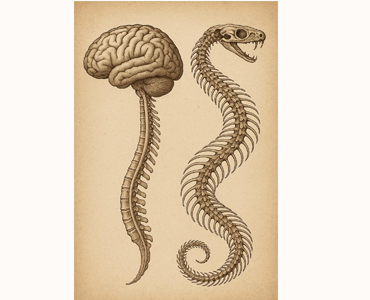
Snakes do not have a neocortex or a limbic brain as illustrated. They are purely characterized by “primal survival instincts”. This is the area of our brain that perceives threats and responds to them. It drives our hunger for food and our desire to procreate. It is responsible for greed and power.
These impulses trigger releases of hormones and substances that create powerful urges in our bodies. In Qayin’s situation, it triggered his anger. His body flooded with chemicals that he was experiencing in that moment. It created a struggle within him to either master it or allow it to overtake him.
It is clear based on testimony that he did not tether his anger and allowed it to overflow its banks. As a result, he killed his brother. He committed a grievous sin.
Adultery is committed because of the primitive desires to procreate. A man sees his best friend’s beautiful wife. He becomes aroused. His body has secreted hormones and chemicals that have created this strong impulse and desire within him. He can either subdue his desires or allow them to overflow its banks. Perhaps, he acts upon his desires and commits adultery. The next morning, the hormones and chemicals have subsided from this primitive impulse and his “thinking” brain awakens. He realizes what he has done and feels guilt.
This is what happened in the Garden of Eden. Adam and Chavah desired the forbidden fruit and what it could give them. They would be like the Most High. After they ate the fruit, the hormones and chemicals subsided. They felt guilt and hid themselves from our Father for what they had done.
ALL of us have this internal struggle within us. The primitive urges we experience are real and powerful. They are beneficial. We would not eat food if the desire did not exist within us. We would probably not procreate if there was no desire. So, these primitive urges serve a purpose as long as we don’t allow them control our lives.
- “Walking in the Flesh” is characterized by someone who allows their primitive urges to control their actions. This is like an animal. They procreate when the urge occurs. They eat when they are hungry. They fight or flee when threatened. They fight for domination. This individual is behaving like a “beast”.
- “Walking in the Spirit” is characterized by someone who tethers the primitive urges of their flesh. They set boundaries and do not allow the desires of the flesh to exceed or overtake those boundaries. The Laws of our Father are boundaries. It is like a river channel. Committing a “sin” extends over the boundaries established by the Law. This parallels our definition of “Teshuqah” translated as “desire” in Bereshith 4:7.
Shaul of Tarsus confirms this understanding in the following testimony:
For they that are after the flesh do mind the things of the flesh; but they that are after the Spirit the things of the Spirit. For to be carnally minded is death; but to be spiritually minded is life and peace. Because the carnal mind is enmity against Elohiym: for it is not subject to the Law of Elohiym, neither indeed can be. So, then they that are in the flesh cannot please Elohiym.
Here is an illustration:
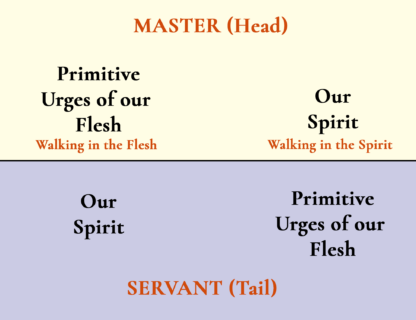
Those who “Walk in the Flesh” are not subject to the Laws of our Father. For this reason, it is impossible to please Him. The adulterous man succumbs to his desires for his best friend’s wife. He does not tether his desires and force them to remain with the boundaries. When an individual allows their primitive desires to reign in one area, it will be prevalent in all areas. “Doing the right thing” is subdued in people who “Walk in the Flesh”. Shaul tells us to “mortify the deeds of our flesh”.
Therefore, brethren, we are debtors, not to the flesh, to live after the flesh. For if you live after the flesh, you shall die: but if you through the Spirit do mortify the deeds of the body, you shall live. For as many as are led by the Spirit of Elohiym, they are the sons of Elohiym.
The Greek word translated as “mortify” means “kill”. We must silence the primitive urges of our bodies and not allow them to be our Master. We can effectively do this through fasting regularly. In the days of our Messiah, it was a practice to fast two days a week. Both the Didache and the Babylonian Talmud tells us that this was done the second day of the week (Monday) and the fifth day of the week (Thursday).
I fast twice in the week, I give tithes of all that I possess.
Fasting strengthens our Spirit by learning how to resist the primitive urge to eat. The body acts like it’s going to die and desperately wants to eat food. However, our Spirit knows that it is not going to die if we miss a few meals. Our Spirit essentially tells the child within us that he or she can’t eat yet. Eventually, the child understands that our Spirit is the Master and doesn’t resist as much.
Based on the evidence presented in this study, the “Beast” in Revelation is someone who “Walks in the Flesh”. They do not mortify the deeds of their flesh and bring them into subjection to our Father’s Laws. This individual is LAW-less. People who do not obey the Laws of our Father are without Law. They are LAW-less and bear the image of the “Beast”.
We encourage people to embrace ALL of the Laws of our Father and learn how to tether the primitive urges of their flesh.
Download this Article here