231-6 Fulfillment
Think not that I am come to destroy the Law, or the Prophets: I am not come to destroy, but to fulfill. For verily I say unto you, until heaven and earth pass, one jot or one tittle shall in no wise pass from the Law, until all be fulfilled.
Religious leaders today make a claim that the Covenant given at Mount Sinai has been completely “fulfilled” by Messiah Yahusha and it is no longer necessary or applicable in the life of a believer. What does it mean to “fulfill” the Law? In Mattithyahu (Matthew) 5:17-19, the statement made by our Messiah leads us to believe that “fulfill” means the opposite of destroy. He said that he did not come to “destroy” the Law and the Prophets. He came to “fulfill” them. What is the opposite of “destroy”? Antonyms to the word “destroy” include: construct, build, create, establish, repair, fix, preserve, conserve, maintain, restore, and generate. Based on this evidence, we can conclude that our Messiah came to build, establish, repair, conserve, and restore the Law and the Prophets. If this is the case, then why has the Law been completely disregarded and considered no longer of any value by many religious belief systems?
Let’s logically consider the situation using an example from the Law. If our Messiah “fulfilled” the Law that says, “you shall not steal,” then are we are no longer obligated to “fulfill” this Law? Are we free to steal anything we want in the Kingdom of our Father. Imagine a community in which people can steal one another’s belongings without consequence. Let’s say Deborah’s neighbor walks into her house and goes to her jewelry box. Her neighbor takes the diamond ring that belonged to Deborah’s great grandmother. Because Yahusha “fulfilled” the Law that says, “you shall not steal,” this thief is no longer held accountable according to the teachings of these religious leaders. The thief is free to take whatever he or she wants without consequence. This does not make sense.
Religious leaders generally as a rule do not promote stealing because in their mind, Messiah Yahusha affirmed this commandment “not to steal” in Mattithyahu (Matthew) 19:18. We are simply using this as an example to help define “fulfillment” of the Law. Based on our example, just because Yahusha “fulfilled” the Law does not mean that it is no longer applicable and relevant in the life of a believer. We can draw the following conclusion based on these facts.
“Fulfilling” a Law does not mean that we are no longer obligated to abide by that Law.
Let’s consider another commandment in the Law of Moshe not specifically mentioned by Messiah Yahusha in the eyewitness accounts (New Testament writings).
You shall neither vex a stranger, nor oppress him: for you were strangers in the land of Egypt.
This is a good commandment. It is good not to vex a stranger or a brother or sister. It is good not to oppress others. Messiah Yahusha obeyed this Law. He did not vex strangers or oppress them. Because Yahusha “fulfilled” this Law, does this mean that we are no longer obligated to “fulfill” this Law ourselves? Is it really permissible for us to vex strangers and oppress them? Is it really okay to vex anyone and oppress them? How would an eternal community look if this Law was no longer applicable?
Would you feel eternal peace and joy if you were the one being vexed and oppressed in the future Kingdom of our Father?
This Law is still applicable in the Kingdom of our Father right now. If we vex or oppress others, we will not be permitted to enter the Garden of Eden. Our Messiah protects his flock from those who would vex or oppress them. If no oppressors exist in the eternal Kingdom of our Father, we have great potential to create a community that experiences shalom and great joy. If we want to be a part of this Kingdom in the world-yet-to-come, then we must be the kind of people that fosters shalom and great joy. This means that we must learn to “fulfill” this commandment not to vex or oppress others in Shemoth (Exodus) 22:21.
This particular Law represents an empty pitcher. Our actions as well as the actions of our Father represents water filling the pitcher. When the pitcher is empty, it does not serve any purpose. However, when it is full, it holds water that we can use to fill our cup and quench our thirst. It is useful. It is fulfilling the purpose for which it is intended.
The Law telling us not to vex or oppress a stranger serves no purpose unless it is “fulfilled”. Our Father established this Law. Here is the Law paraphrased:
Do not vex or oppress strangers.

If people are vexing and oppressing other people, does this Law have any relevance? It is useless. What is the point of having this Law if it is not being applied? However, if we have a King that enforces this Law, it becomes relevant. When our King removes people who vex and oppress others from the community, he is “fulfilling” this Law.
The people who suffered the vexation and oppression are relieved. They are thankful and can now experience peace and shalom. When everyone in the community is applying this Law, they are also “fulfilling” it which also promotes shalom in their society. This Law in Shemoth (Exodus) 22:21 is a pitcher full of water in this community. It is useful and serves a purpose.
Yahusha said that he has come to “fulfill” the Law and the Prophets. Yahusha is going to establish the Laws of our Father when he returns. He is going to ensure that the nations fulfill the Laws of his Father. No one will be vexing or oppressing others. This is confirmed in the following messianic prophecy.
And he shall judge among the nations, and shall rebuke many people: and they shall beat their swords into plowshares, and their spears into pruninghooks: nation shall not lift up sword against nation, neither shall they learn war any more.
There will be no more war because no one will be allowed to vex or oppress other people. Yahusha is going to fulfill the Laws of our Father when he returns and is established as King. He will ensure that ALL of the Laws of Yahuah are fulfilled.
Ancient Hebrew thought is concrete. Our Messiah is a Hebrew and he thinks in concrete terms. We have an empty pitcher. It is not filled with anything. When we put water in the pitcher, it is “filled”. The pitcher contains a substance and it is now useful. It serves a purpose. This is the concept in our Messiah’s mind when he said those words in Mattithyahu (Matthew) 5:17-18. Even if he used Greek words, he was still thinking and using definitions from a Hebrew perspective.
We can gain greater insight into the mind of our Messiah by defining the Hebrew word translated as “fill” or “fulfill” in other passages. The Hebrew word translated as “fill” in the following verse is “Mala”.
And Elohiym blessed them, saying, Be fruitful, and multiply, and fill [H4390] the waters in the seas, and let fowl multiply in the earth.
The sea and the heavens are containers like the pitcher sitting on the table in our picture. Yahuah told the fishes of the sea and the birds of the air to fill the waters and the heavens with their offspring. The heavens and the seas became useful. They were serving a function.
Here is another passage that uses “mala”. Yoseph (Joseph) told his servants to “fill” his brothers sacks with food and the money they brought with them to buy the food.
And he commanded the steward of his house, saying, Fill [H4390] the men’s sacks with food, as much as they can carry, and put every man’s money in his sack’s mouth.
The sacks were empty initially and now they were filled to the brim with food to feed their families. The sacks became useful and were serving a function. An empty sack is useless and serves no purpose. The Ancient Hebrew Lexicon of the Bible written by Jeff A. Benner defines “mala” the following way:
ALM ( common, מלא / m.l.a) Translation: FILL (V) Definition: To occupy to the full capacity.Alternate Translations:fulfill; set (when written in the piel [intensive] form) KJV Translations: fill, full, fulfill, consecrate, accomplish, replenish, wholly, set, expire, fully, gather, overflow, satisfy Strong’s Hebrew #: h.4390 Strong’s Aramaic #: a.439
ALM (מלא) Definition: A conglomeration of ingredients for filling up something.
ALM ( masc., מלא / ma-ley) Translation: FULL Definition: Containing as much or as many as is possible or normal. KJV Translations: full, fill child, fully, much, multitude, worth Strong’s Hebrew #: h.4392
“Mala” means to “fill a space or object to its full capacity”. Based on this definition, we can interpret the previous passages used in this study the following way.
- Yahuah said to fill the heavens and the waters to their full capacity with fish and fowls (Bereshith 1:22).
- Yoseph said to fill his brother’s sacks to the full capacity with food and their money (Bereshith 44:1)
- Yahusha said that he came to fill the Law to its full capacity (Mattithyahu 5:17-18).
Yahusha filled the Law that says, “do not vex or oppress a stranger” to its full capacity. When he returns, he will fill this Law to its full capacity among the nations when all wars are abolished. No one will be permitted to vex or oppress others. He will fulfill this Law as King.
Here is the definition of full capacity from a modern perspective.
Full capacity refers to the maximum level of output, production, or utilization a system, facility, or individual that can be achieve using available resources and equipment. It signifies operating at the highest possible efficiency without overstraining, often meaning all resources are fully utilized.
Messiah Yahusha is going to fulfill the Laws of Yahuah using all resources to their highest, maximum level possible. This is how he defined “fulfill” in Mattithyahu (Matthew) 5:17-18. King David instructed his son, Shelomoh (Solomon), to “fulfill” the Law of Moshe on his deathbed. This is also the Hebrew word “mala”.
Then shall you prosper, if you take heed to fulfil [H4390] the statutes and judgments which Yahuah charged Moshe with concerning Yashar’El: be strong, and of good courage; dread not, nor be dismayed.
King David was telling his son to “fulfill” the Laws of Moshe to their full capacity. Using our example, King Shelomoh (Solomon) was being instructed to “fulfill” the Law that says, “do not vex or oppress a stranger” to its full capacity. He was being told to “fulfill” the Law that says, “do not steal” to its full capacity. This means that his obedience to these Laws is the act of fulfilling them. As King, he would “fulfill” these Laws by ensuring the citizens in his kingdom also obeyed these Laws. This concept is also conveyed in the following passage:
Surely none of the men that came up out of Egypt, from twenty years old and upward, shall see the land which I swore unto Abraham, unto Yitzhak, and unto Ya’aqob; because they have not wholly [H4390] followed me: Save Kaleb the son of Yephunneh the Kenezite, and Yahusha the son of Nun: for they have wholly [H4390] followed Yahuah.
The word translated as “wholly” is “mala” as well and could be translated as “fully”. Kaleb and Yahusha “fulfilled” the Laws of our Father to their full capacity. They obeyed them ALL and did so completely. “Mala” is also used in the following passage translated as “fulfill”.
Fulfill [H4390] her week, and we will give you this also for the service which you shall serve with me yet seven other years.
Ya’aqob (Jacob) served Laban for seven years to obtain Rachel’s hand in marriage. He was deceived and given Laban’s other daughter, Leah, instead. In this passage, Laban is telling Ya’aqob to “fulfill” Leah’s week which is seven years. He was instructed to complete her week to its full capacity. After serving Laban another seven years, Ya’aqob would be given Rachel’s hand in marriage. “Mala” is also used in the following passage translated as “full”.
They shall not hurt nor destroy in all My Set-apart Mountain: for the earth shall be full [H4390] of the knowledge of Yahuah, as the waters cover the sea.
At some point in the future when our Messiah is established as King, the earth will be full of the knowledge of Yahuah to its full capacity. Our Messiah cannot do this by himself. He will select individuals who will help him rule and reign. It is necessary for these people to know the Laws of Yahuah written by the Prophet Moshe. They are people who “fulfill” the Laws right now or “fulfilled” them in their respective lifetime in the past. If people are going to ensure the Laws of our Father are “fulfilled” by the nations, it is necessary to know and understand the Laws themselves. It is necessary for them to live according to these Laws.
If a man does not know how to read, then how can he teach someone to read? If a woman does not know how to knit, how can she teach someone to knit? If an individual does not know the Laws of our Father, how can they teach them? How can they be established as a Judge in the earth? Essentially, people who do not know or live by the Laws of Yahuah are empty pitchers on a table. They are useless and can serve no purpose in a leadership position. When our Messiah returns, they will be the student who must be taught.
Leaders who will rule and reign with our Messiah invested in their eternal life by learning the Laws of our Father and applying them. Here is an illustration.
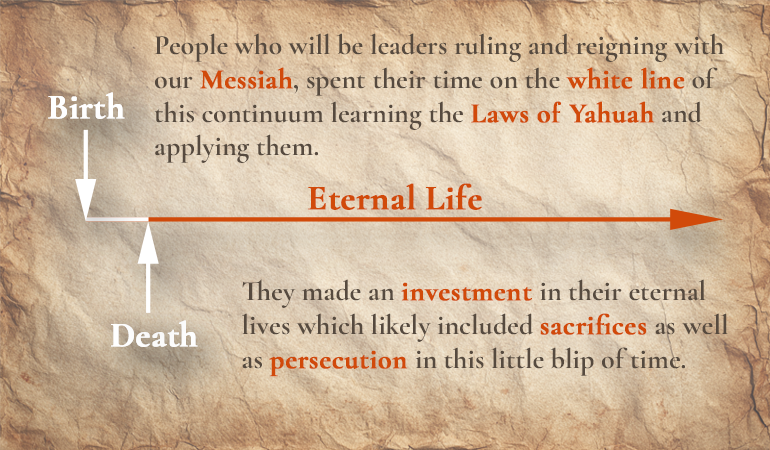
This present life is an extensive interview process for a very prestigious position in our Father’s eternal kingdom. People who will be placed in these positions will possess them for eternity. They will not die and will never be replaced by someone else. Messiah Yahusha Ben David will be King forever. Likewise, people who are selected for positions in our Father’s Kingdom will remain in that position forever. There is no such thing as “climbing the ladder” in the Kingdom of Yahuah. Our Messiah is watching us. He is evaluating the way we make decisions and how we treat others. He is watching how we make decisions when temptations come our way. He is choosing people for particular roles in his government who will rule and reign with him.
Yahusha has been made King. He is accountable for the decisions made by those he selects. If he places someone in a position of authority who does not know the Laws of Yahuah, he will be responsible for their actions. Because Yahusha is accountable, he is going to place people in positions of authority that he feels will rule with justice and righteousness according to the Laws of our Father. Preparing for our Messiah’s return involves educating ourselves so that we are useful vessels in the Kingdom of Yahuah. We become pitchers full of water sitting on the table of our King.
We can further verify the meaning of the Hebrew word, “mala” by examining the individual definitions of the letters themselves used to form the word. The ancient Hebrew pictographic letters represent our Father’s original language. When we define words based on the definitions of these letters, we understand the definition of this word from our Father’s perspective. We can confirm this meaning with the actual context of the passages in which they occur. “Mala” include the letters “mah, lamed and alef”. Here are the letters with their associated pictures.

The letter “mah” is defined the following way by The Ancient Hebrew Lexicon of the Bible written by Jeff A. Benner.
HM מה Object: Sea Definition: The sea (Mediterranean) is a place of the unknown (what is beyond or what is below). It is feared by the Ancient Hebrews because of its size, storms and fierceness. A hundred as an unknowable amount. Ancient Hebrew: The pictograph M is a picture of water.
The letter “mah” is a picture of the sea. We can see the waves of the ocean in the letter itself. Water is a substance that fills a container. The letter “lamed” is a picture of a shepherd’s staff which was used in a variety of ways. It is defined by The Ancient Hebrew Lexicon of the Bible as:
ML לם Action: Bind, Strike, Learn Object: Staff, Sheaf, People, Hammer, Goad Abstract: Toward Definition: The shepherd always carried his staff for guiding, leading and protecting the flock. The flock was bound to the shepherd, as the staff was a sign of his authority over the sheep. The yoke was a staff laid across the shoulders of two oxen. The oxen were then tied to the yokes at the neck, binding the two together for plowing or pulling a cart. A people bound together. A wound bound with bandages.: Ancient Hebrew:The pictograph L is a picture of a shepherd staff, the M is a picture of water representing might. Combined these mean “staff of might”.
The shepherd’s staff was used to guide, lead and protect the flock. It is symbolic of a king’s scepter and his authority. The king ruled over a group of people in a certain designated territory. Kings establish laws for their territory set by boundaries.

For example, the government of France establishes and enforces laws within its designated property boundaries. This is its jurisdiction which is defined as a government’s authority to exercise authority over all persons and things within its territory. The country’s boundaries define the shape of the container for its authority.
The king uses his scepter of authority to guide and direct his citizens within the boundaries of his authority. Laws established in France do not have any authority over people who live in the United States and vice versa.
Water is used to fill a container. The letter “mah” combined with the letter “lamed” is the action of substance given to one’s authority. If I tell my son to wash the car and he does not do it, then my words have no weight or bearing. The task has been left incomplete. If I tell my son to take out the garbage and he chooses not to do it, then my words have no weight. The task is left undone… unfulfilled. If my son washes the car and takes out the garbage, the tasks have been completed. They are fulfilled. My authority is strengthened through his obedience. “Strength” is the predominant definition of the letter “alef”. The Ancient Hebrew Lexicon of the Bible defines it as:
LA אל Action: Yoke, Guide, Swear Object: Ox, Oak, Yoke Abstract: Strength, Oath, Learn Definition: The yoke is understood as a “staff on the shoulders” (see Isaiah 9:4) in order to harness their power for pulling loads such as a wagon or plow. Hence, the two pictographs can also represent “the ox in the yoke”. Often two oxen were yoked together. An older, more experienced ox would be teamed up (yoked) with a younger, less experienced ox. The older ox in the yoke is the “strong authority” who, through the yoke, teaches the younger ox. Ancient Hebrew: The pictograph A is a picture of an ox head and also represents its strength. The L is a picture of a shepherd staff and also represents the authority of the shepherd. Combined these two pictographs mean “the strong authority” and can be anyone or thing of strong authority.
Obedience to the Laws of someone in authority strengthens their authority. When people do not obey the person in authority, their sphere of influence is weakened and their authority diminishes. Right now, the leaders of the earth have great authority because they have many followers who obey them. When our Messiah returns, their authority will diminish because they and their followers will be diminished.
The letters “lamed” and “alef” also form a two-lettered root that means nothing or worthless. The Ancient Hebrew Lexicon of the Bible defines it the following way:
The only difference between “mala” and “la” is the “mah” which is the substance that fills a container. If there is no substance to fill a container, it is useless or worthless.
ALM
AL
An empty pitcher serves no purpose. Empty bags with no food serve no purpose. They are worthless unless they are filled. When my son failed to do the tasks, the words I spoke were meaningless. I was wasting my breath.
The Hebrew word translated as “idol” is also in this Hebrew word family. The Ancient Hebrew Lexicon of the Bible defines it as:
AYAL ( masc., לאיא) Translation: WORTHLESS Definition: A god or being without power. Alternate Spellings: אליל KJV Translations: idol, image, no value, nought Strong’s Hebrew #: h.0457
When my son chose not to obey me, it was apparent that I did not have power over him. My words had no meaning and were left empty. They were worthless. When people do not obey the Laws of our Father in Heaven, they are telling Him that He is worthless. He does not have any value. This was the message conveyed to me by my son when he chose to disregard my requests. However, when he followed through with my requests, the tasks were completed which illustrated a high regard for me.
When we choose to vex and oppress one another, the task requested by our Father is incomplete. We are disregarding Him and communicating to Him that we think He is worthless. If my son told me that he loved me and then chose to disregard my requests, would I really feel loved? I would feel disappointment and frustration. Telling our Father in heaven that we love Him and then showing disregard for His instructions are incongruent. The words do not match the actions. It is our actions that reveal the true contents of our hearts.
Messiah Yahusha loves Yahuah Elohiym with his entire being. He has an extremely high regard for his Father. His words are in alignment with his actions. He said that he came to fulfill the Law and the Prophets. Yahusha fulfills every task given to him by our Father. He said, “not my will be done but let Your will be done”.
Saying, Father, if You be willing, remove this cup from me: nevertheless, not my will, but Yours, be done.
Adam disregarded our Father’s instructions. He did NOT do the will of our Father. He did not fulfill the instructions of our Father who told him not to eat from the Tree of Knowledge of Function and Dysfunction. It was left incomplete. Messiah Yahusha fulfilled these instructions of our Father and did not eat from the forbidden tree. He did not sin.
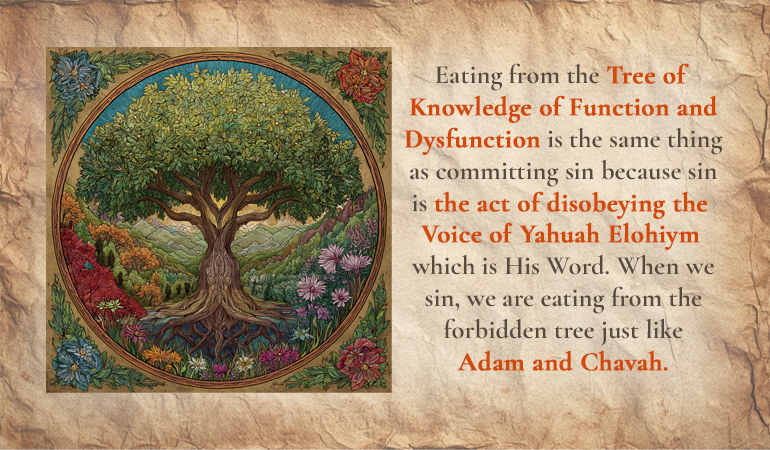
Messiah Yahusha fulfilled these words spoken by our Father.
And Yahuah Elohiym commanded the man, saying, Of every tree of the garden you may freely eat: But of the Tree of the Knowledge of Function and Dysfunction, you shall not eat of it: for in the day that you eat from it, you shall surely die.
Yahusha did not sin and will never sin. He did not eat from this forbidden tree. He completed these Words spoken by our Father. He highly regarded the Words of our Father. He loves and respects our Father. ALL Words spoken by our Father must be fulfilled. This is a principle in His Kingdom.
We can fulfill these Words as well. If we choose not to eat from the forbidden tree, we will also be granted freedom to eat from ALL the trees of the Garden including the Tree of Life. This means that we cannot commit sins by disobeying the Voice of our Father which is His Word.
Principle: The Words of Yahuah must be fulfilled. Not one single Word spoken by our Father can be left unfulfilled.
For as the rain comes down, and the snow from heaven, and returns not there, but waters the earth, and makes it bring forth and bud, that it may give seed to the Sower, and bread to the eater: So shall My Word be that goes forth out of My Mouth: it shall not return unto me void, but it shall accomplish that which I please, and it shall prosper in the thing where I sent it. (Yeshayahu/Isaiah 55:10-11)
Link to Study: What does it mean to “fulfill”?
Now that we have been enlightened on the concept of the Law of Moshe being “fulfilled,” let’s reconsider the following Law.
You shall neither vex a stranger, nor oppress him: for you were strangers in the land of Egypt.
Is this Law “fulfilled” in the earth today? Are people vexing other people? Are people oppressing others? “Vexing” is the act of annoying, irritating, tormenting and frustrating someone else. “Oppression” is the act of treating others cruelly, unfairly, and unjustly. It is exercising power and control over others to burden, restrict and subdue them. Are these things happening in our world today?
YES! YES! YES!
ALL of these behaviors are prolific in our world today. This Law in the Covenant given at Mount Sinai is not fulfilled. ALL of us are a witness to these facts. Our Messiah is going to fulfill this Law upon his return. There will be no more vexation or oppression of others. There will be no more war, strife or contention. Let’s consider another commandment.
You shall not steal, neither deal falsely, neither lie one to another.
Is this Law fulfilled in the earth today? Are their people who steal, defraud and lie to one another? Our leaders do these things to the people they govern! These Laws in the Covenant given at Mount Sinai are not fulfilled. ALL of us are witnesses to these facts. Our Messiah is going to fulfill these Laws upon his return. No stealing, defrauding or lying will be permitted. Let’s consider another Law.
And Yahuah spoke unto Moshe, saying, Speak you also unto the children of Yashar’El, saying, Verily my Shabbats you shall keep: for it is a sign between me and you throughout your generations; that you may know that I am Yahuah that does set you apart. You shall keep the Shabbat therefore; for it is set-apart unto you: every one that defiles it shall surely be put to death: for whosoever does any work therein, that soul shall be cut off from among his people. Six days may work be done; but in the seventh is the Shabbat of rest, set-apart to Yahuah: whosoever does any work in the Shabbat day, he shall surely be put to death. Wherefore the children of Yashar’El shall keep the Shabbat, to observe the Shabbat throughout their generations, for a perpetual covenant. It is a sign between me and the children of Yashar’El forever: for in six days Yahuah made heaven and earth, and on the seventh day he rested, and was refreshed. And he gave unto Moshe, when he had made an end of communing with him upon Mount Sinai, two tables of testimony, tables of stone, written with the finger of Elohiym.
Do all inhabitants of the earth observe our Father’s Shabbat on the seventh day? Has everyone who works on His Shabbat been put to death or cut-off from their people? This Law in the Covenant given at Mount Sinai is not fulfilled. Our leaders do not enforce the Laws of our Father nor do they rule according to His instructions. They are ruling according to their own laws which are different than our Father’s Laws. When Messiah Yahusha returns, he will fulfill this Law. Everyone will observe our Father’s Shabbat on the seventh day. This is confirmed in the following prophecy.
And it shall come to pass, that from one new moon to another, and from one Shabbat to another, shall all flesh come to worship before me, says Yahuah.
If our Messiah is going to fulfill this part of the Law confirmed by the Prophet Yeshayahu, then he will also fulfill the part that puts people to death for their failure to rest on Yahuah’s Shabbat on the seventh day. Failure to observe Shabbat on the seventh day is a sin in the eyes of Yahuah. People who work on the seventh day are eating from the Tree of Knowledge of Function and Dysfunction just like Adam and Chavah who also chose not to HEAR and OBEY the Words of our Father. They will be put to death upon our Messiah’s return which is conveyed in the following prophecy.
But with righteousness shall he judge the poor, and reprove with equity for the meek of the earth: and he shall smite the earth with the rod of his mouth, and with the breath of his lips shall he slay the wicked.
This is the truth. This is what the Word says. When teachers and leaders tell people the Covenant given at Mount Sinai has been fulfilled, we have evidence that they are lying to us. Much of this Covenant has been left unfulfilled. If this Covenant has not been completed, why would our Father give a “new covenant” that would give people permission to leave the Covenant given at Mount Sinai left unfulfilled? If one examines the context of the “new covenant” mentioned in Yirmeyahu (Jeremiah), it will become very clear that none of the conditions of that covenant have been instituted yet. We discuss this in great detail in our section titled Covenant. The new covenant in Yirmeyahu would never give people permission to sin against our Father’s instructions written in the Law of Moshe (Moses). Based on this evidence, we have reached the following conclusion.
The Covenant given at Mount Sinai has not been fulfilled YET.
Download this Article here