141-3 What is Authority?
You shall have no other elohiym above Me.
The next step is to establish the concept of “authority”. We view the Word of Yahuah Elohiym as the final authority on all matters. Yahuah Elohiym chose men who shared the same “perspective” as Him. They could see through His eyes. He knew He could trust them to convey His message the way He originally intended. This was the pattern established by Yahuah when the House of Yashar’El were frightened when Yahuah spoke to them directly.
Yahuah your Elohiym will raise up unto you a prophet from the midst of you, of your brethren, like unto me; unto him you shall hear and obey; According to all that you desired of Yahuah your Elohiym in Horeb in the day of the assembly, saying, Let me not hear again the voice of Yahuah my Elohiym, neither let me see this great fire any more, that I die not. And Yahuah said unto me, They have well-spoken that which they have spoken. I will raise them up a prophet from among their brethren, like unto you, and will put my words in his mouth; and he shall speak unto them all that I shall command him. And it shall come to pass, that whosoever will not hear and obey unto my words which he shall speak in my name, I will require it of him.
Members in the House of Yashar’El thought they would die if they were to hear the Voice of Yahuah directly again. Our Father in heaven thought this was a good plan and selects prophets and prophetesses who will speak on His behalf. True prophets and prophetesses speak the Words of Yahuah. Our Father in Heaven would find it very challenging to find someone who lives in this culture who perceives things the way He perceives things. They could not convey His message from His point-of-view. Here is the illustration we used in the previous lesson.
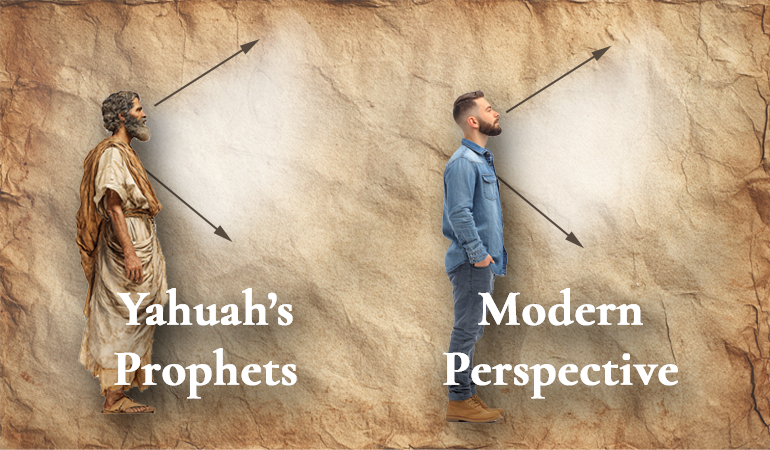
Generally, we view the world differently. We do not speak the same language or view things from an Eastern-Hebraic perspective. We have a Western-Greek mindset which is very different. The prophet Moshes (Moses) lived around 1350 BCE which is about 3300 years ago according to current the timeline. All of the things that influence our beliefs today were very different in the days of Moshe. He didn’t have books, internet, social media or cell phones. He perceived things very differently than we do today. However, we do have reliable copies of the words Moshe (Moses) penned thousands of years ago. Most of us rely upon translators to provide the Words of our Creator in our own language which is another filter. Here is an illustration of how the Word gets filtered down to us over the ages.
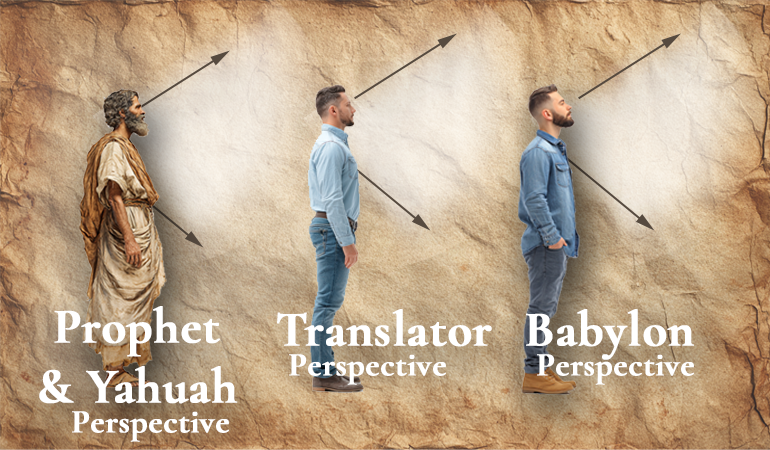
The people living in this current world system are Babylonians because it is the nature and character of the final kingdom that exists when our Messiah returns to setup the Kingdom of Yahuah. The eyewitness accounts also known as the New Testament were translated from Hebrew to Greek and then Greek to English so there is even more corruption possible in each one of these transitions.
The final authority in all matters are the Words penned by the prophets in the Hebrew language. Translations are eyewitness testimony filtered through the lens of the translator. They are a “perspective” but they are not the Words of Yahuah. When everyone agrees with this concept, then we can have discussions with one another and consult the Word of Yahuah on the matter. When His Word is the final authority then we can settle our differences. This is why recognizing “authority” is brick in our foundation.
Principle: The Word of Yahuah is spoken through His true prophets in His language and from His perspective. It is the final authority in all matters. This is based on the following passage:
I will raise them up a Prophet from among their brethren, like unto you, and will put My Words in his mouth; and he shall speak unto them all that I shall command him. (Debarim/Deuteronomy 18:18)
Link to Study: Defining the Word of Yahuah
“Authority” Defined:
Our goal is to restore the original intended message given to us through Yahuah’s true prophets so that we are not misunderstanding and misinterpreting His instructions or those of our Messiah. We have a plethora of leaders sharing their perspective on the Word of Yahuah. We do not need one more individual rising-up to give us their two-cents. It is time for Yahuah’s message to be revitalized and heard. We must understand this vital fact:
The Message of Yahuah is NOT designed to be something we want to hear.
The Message of Yahuah is a group of specific words that communicate a message to us that will help us find eternal life.
We will never find the truth if we are only willing to hear those things that please us or that validate our corrupted belief system. In order to do this, one must shred the Word of Yahuah. They must twist it to say what they want it to say. People say, “We don’t want this… We don’t want that… THIS is what it really says!” Can people really find truth with this kind of attitude? Why not just allow the Word to say what it says? This is how we approach the Word of Yahuah.
In the previous lesson, we started a discussion on the concept of “God” from a Hebrew perspective and a modern-day perspective. The ancient Hebrew language is comprised of letters that represent pictures of certain things. The following letter is an “alef” in the ancient Hebrew. It is a picture of an ox head. Our letter “A” is an upside-down ox head.
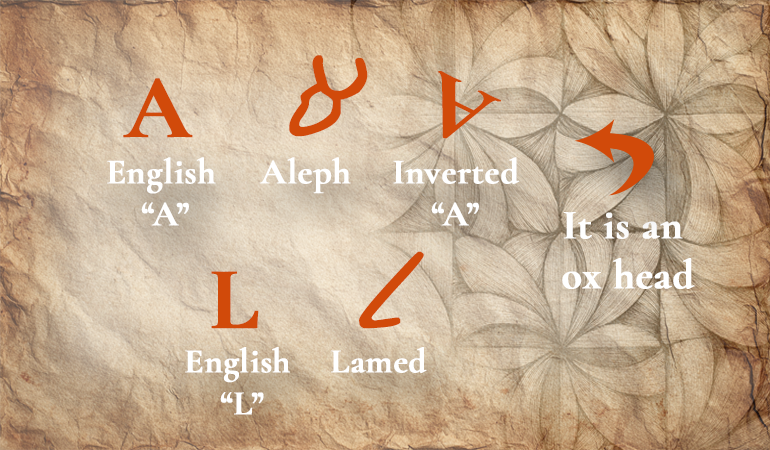
The “alef” can be understood by anything related to an “ox”. The most common interpretation represents the strength of an ox. The “lamed” is a picture of shepherd’s staff upside down which aligns with our letter “L”.

It is obvious that our own language has been influenced by the ancient Hebrew language. This is evidenced in nearly all of our letters in our own alphabet. The “lamed” is a symbol of the shepherd’s authority. We see both of these symbols represented in a “king”. The horns on the letter “alef” represent the points on a crown and the shepherd’s staff represent the scepter.
Together, these letters spell “EL” or “AL” which is translated as “God”. The crown and scepter can be seen in nearly every culture throughout time.
Moshe (Moses) would have understood that the word “EL” is a King and not a mythological figure residing on the clouds of heaven. This is confirmed when we look at the definition of “EL” in The Ancient Hebrew Lexicon of the Bible written by Jeff A. Benner:
LA ( אל ) Action: Yoke, Guide, Swear Object: Ox, Oak, Yoke Abstract: Strength, Oath, Learn Definition: The yoke is understood as a “staff on the shoulders” (see Isaiah 9:4) in order to harness their power for pulling loads such as a wagon or plow. Hence, the two pictographs can also represent “the ox in the yoke”. Often two oxen were yoked together. An older, more experienced ox would be teamed up (yoked) with a younger, less experienced ox. The older ox in the yoke is the “strong authority” who, through the yoke, teaches the younger ox. Ancient Hebrew: The pictograph A is a picture of an ox head and also represents its strength. The L is a picture of a shepherd staff and also represents the authority of the shepherd. Combined these two pictographs mean “the strong authority” and can be anyone or thing of strong authority.
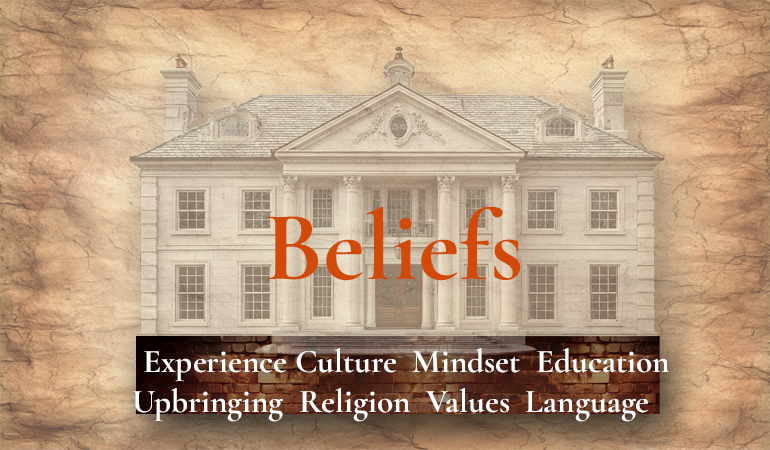
“EL” essentially means “strong authority” and not some floating deity in the clouds above holding a lightning bolt in his hand. This is different than what most of us have been taught in our society. It is more concrete and down-to-earth. Kings, presidents, popes and prime ministers actually exists in our day and age. It is more relatable than the term “god”. Let’s consider the bricks forming the foundation of our beliefs as it relates to our understanding of the concept of “god”. These factors are based on my own personal experiences and observations.
- Upbringing: Some of us were raised by parents who were raised under a Judeo-Christian culture in United States and then taught it to their children. My parents taught me that God created all things and is the Author of the Bible.
- Mindset: Parents believed “God” is a Supreme Being and false “gods” are not real. This is called monotheism which is the belief in one God. I was taught that false gods were graven images created and worshiped by ancient cultures.
- Education: In school, I learned about the Roman and Greek pantheon and was taught about the mythological gods which were not real. Sunday school also taught me that “God” is the Supreme Being. School taught me that God does not exist and that mankind evolved from apes.
- Religion: Pastors taught that God is Supreme Being who created all things. They taught that Jesus is God, the Creator of all things.
- Culture: We live in a primarily secular culture that frequently denies the existence of God such as in Science, Anthropology, History and Archeology…. Christians believe God is a Supreme Being. We watched movies made in Hollywood about mythological “gods” with special powers.
- Values: Jesus is “God” and therefore is our Creator. “God” is Supreme. We do not take his name in vain or curse Him.
- Language: We speak English which is based upon a Greek mindset. We view things in abstract terms. God is this Being living in heaven.
All of these factors influence our interpretation of passages in the Word of the Most High. We project our perceptions upon the text and understand the message from our vantage point. We do not consider the vantage point of the original author.
Let’s consider an example in the Word of Yahuah. The following is messianic prophecy attributed to our Messiah. We interpret this passage to mean that “Jesus is God” and therefore is our Creator. However, is this what it is truly saying or are we “projecting” our perspective upon the text? This is the King James Version.
For unto us a child is born, unto us a son is given: and the government shall be upon his shoulder: and his name shall be called Wonderful, Counsellor, The mighty God, The everlasting Father, The Prince of Peace.
In our minds, there is only one God based upon the factors established in our minds. If this passage is telling us that the Messiah is God then we can see how we can come to the conclusion that “Jesus is God” and therefore our Creator. Here is the same passage in The Scriptures Version:
For a Child is born unto us, a Son is given unto us, and the rule is on His shoulder. And His Name is called Wonder, Counsellor, Strong Ěl, Father of Continuity, Prince of Peace.
The underlying Hebrew word often translated as “God” in this passage is the Hebrew word “EL”.
Is this passage really telling us that “Jesus is God” and therefore our Creator?
People who want to prove that “Jesus is God” use this passage as evidence. But, is this really what the passage is saying. People who want Jesus to be God will completely ignore the truth in this situation. Can we just let the text say what it is saying? Can we stop twisting the Word to make it say what we want it to say? Remember, translations are only a point-of-view passing through the filter of the translator. Perhaps the translator believes Jesus is God. Would this belief influence how he or she translates the Word? Of course it does.
We do not twist and turn the Word to say what we want it to say. This is how we find truth. We are trying to determine what the passage is really saying from the perspective of the author who wrote it. This example illustrates how our own perceptions frequently causes us to misinterpret and misunderstand the original intended message. Testimony in the Word of our Father actually validates that other “gods” exist. Yahuah actually called the prophet Moshe (Moses) a “god”. This is from the King James Version.
And Yahuah said unto Moshe, See, I have made you a god to Pharaoh: and Aahron your brother shall be your prophet.
Yahuah used the Hebrew word “elohiym” to describe Moshe (Moses). Here is the Hebrew word in the ancient Hebrew pictographic language. “EL” is highlighted in orange.
MYHLA
The last three letters are a “hey”, “yod” and “mem”. Together, this forms a plural ending meaning more than one or someone extremely mighty in power and authority. The prophet Moshe (Moses) was not more than one man but he was a mighty man in the eyes of the people. This Hebrew word is in the same word family as the root word “EL”. It includes the concept of “strong authority” in its definition. The Ancient Hebrew Lexicon of the Bible defines it the following way:
HWLA ( masc., אלוה / e-lo-ah ) Translation: POWER Definition: Possession of control, authority, or influence over others; physical might. The power or might of one who rules or teaches. One who yokes with another. Often applies to rulers or a god. Often used in the plural form literally meaning “mighty ones,” but often used in a singular sense to mean “The Mighty One.” KJV Translations: God, god, judge, angel, mighty, godly, heathen deity Strong’s Hebrew #: h.0433 Aramaic Spelling: אלה Strong’s Aramaic #: a.0426, a.0430
We know in the text that this is a reference to someone with extreme power and might because the personal pronouns indicate that the word is singular… meaning “one”. The same word is used in the following passage and it is plural because the Hebrew pronouns indicate the word is a reference to many and not just one. This is also taken from the King James Version.
You shall have no other gods before me.
Yahuah Elohiym, Himself, is acknowledging the fact that other “gods” exist. He is telling His people not to place their authority above His Authority. The Hebrew words “EL”, “Eloah” and “Elohiym” are a reference to Leaders, Kings, Popes and Presidents which are men and women… not mythological entities floating in heaven with a lightning bolt in their hand. Yahuah Elohiym is essentially saying the following:
You shall not place the authority of other Kings, Priests, Popes, Presidents and Prime Ministers above My Authority.
This is a completely different message than what most of us had previously understood. By learning the original language of the ancient Hebrews, we shift the bricks forming the foundation for our beliefs which changes our beliefs. When we re-examine Yeshayahu (Isaiah) 9:6, it says something different.
For unto us a child is born, unto us a son is given: and the government shall be upon his shoulder: and his name shall be called Wonderful, Counsellor, The mighty strong authority, The everlasting Father, The Prince of Peace.
Is this passage really telling us that our Messiah is our Creator? ALL Kings, Popes, and Presidents in our world today are “strong authorities”. Yahuah acknowledges the existence of these powerful leaders. This passage is telling us the Messiah is going to establish a government in the earth. He will be a King who exercises great authority in the earth. This passage is not telling us that our Messiah is our Creator because the author did not understand the concept of “god” the way we comprehend it today.
We are not manipulating the text to say what we want it to say. We examined the underlying Hebrew from an ancient Hebrew perspective. We can see the Hebrew pictographic letters with our own eyes. We see the picture of the ox-head and the shepherd’s staff. We see the crown on the head of a king and the scepter in his hand. And now, we are showing them to you.
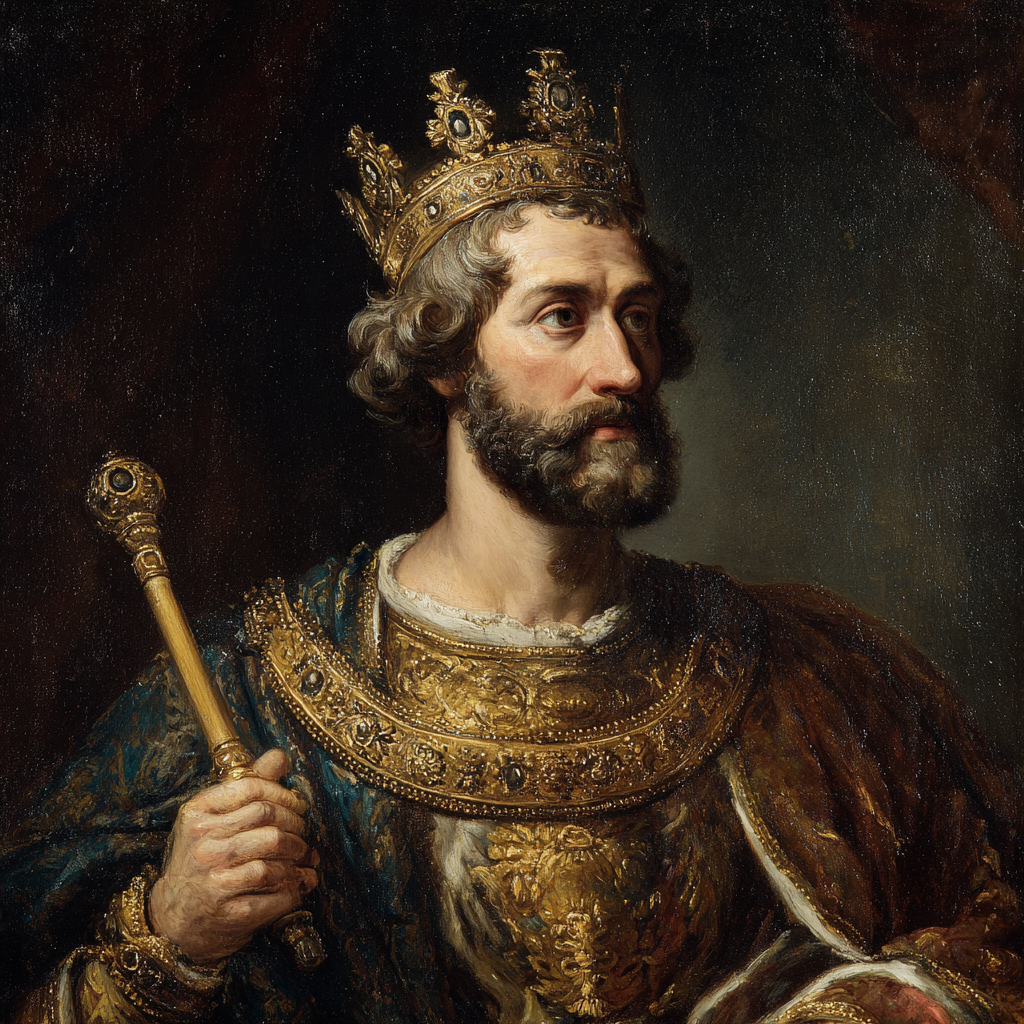
LA
The words “EL”, “Eloah” and “Elohiym” are best represented by “kings” who exercise authority in the earth. This new definition of “EL” will have a ripple effect on our understanding throughout the Word of the Most High. For example, our Messiah was and is a Hebrew who lived approximately 2000 years ago. He spoke the Hebrew language, had the mindset of a Hebrew and lived in a completely different culture than we did. The same is true of his disciples. In their minds, an “EL” is a “king” and not a mythological entity floating in the clouds of heaven. In their minds, multiple “strong authorities” existed because they viewed this concept as a “king”. Based on this understanding, how can we interpret what is being said in the following passage?
Yahusha said unto her, Touch me not; for I am not yet ascended to my Father: but go to my brethren, and say unto them, I ascend unto my Father, and your Father; and to my God, and your God.
Who is the “God” of Yahusha? The text says Messiah Yahusha’s “God” is his Father which is Yahuah. Can we just let the text say what it says? What is our Messiah actually saying from his perspective and the perspective of those who heard it and wrote this testimony?
I ascend to my Father and your Father, and to my Strong Authority and your Strong Authority.
“Strong Authority” is not a name but an attribute. Our Messiah is telling us that he is submitted to the Authority of his Father. This is a different message that tells us something different than a simple claim of an allegiance to an “Entity” floating in the clouds with a lightning bolt in his hand. Let us consider another passage and show how this changes how we perceive and understand the Word of our Father in heaven.
And our Strong Authority said moreover unto Moshe, Thus shall you say unto the children of Yashar’El, Yahuah the Strong Authority of your fathers, the Strong Authority of Abraham, the Strong Authority of Yitzhak, and the Strong Authority of Ya’akob, has sent me unto you: this is my Name forever, and this is my memorial unto all generations.
Yahuah calls Himself a “Strong Authority”. He is the “Strong Authority” of Abraham, the “Strong Authority” of Yitzhak (Isaac) and the “Strong Authority” of Ya’akob (Jacob). Yahuah is the “Strong Authority” of our Messiah as well.
What does it mean to be a “Strong Authority” or a “King”?
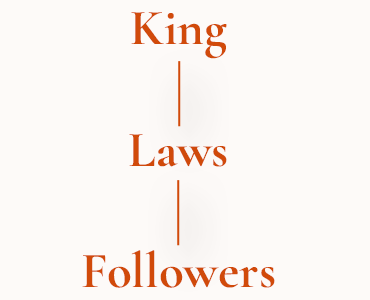
Mr. Benner’s definitions tell us that Kings have power, influence, control, and physical might. They rule and teach. Kings, leaders, popes, and presidents have a set of laws they use to govern their nations. People who obey their laws are followers of the King.
Yahuah is a “Strong Authority” and a King. He has a set of Laws as well. The message that is being communicated in Shemoth (Exodus) 3:15 is that Abraham, Yitzhak and Ya’akob obeyed the Laws of Yahuah Elohiym. The same is true of Messiah Yahusha. Yahuah was and is their Master to this very day. He exercises power, influence, control, and physical might over them. He rules over them and teaches them. The following passage confirms this conclusion.
Because that Abraham obeyed my voice, and kept my charge, my commandments, my statutes, and my laws.
Yahuah is not a mythological deity in the heavens with a lightning bolt in his hand. He is a King with a set of Laws. Abraham, Yitzhak (Isaac) and Ya’akob (Jacob) obeyed the Laws of Yahuah. Messiah Yahusha obeyed the Laws of Yahuah. Shemoth (Exodus) 20:3 is talking about placing the authority of another King above the Authority of Yahuah Elohiym.
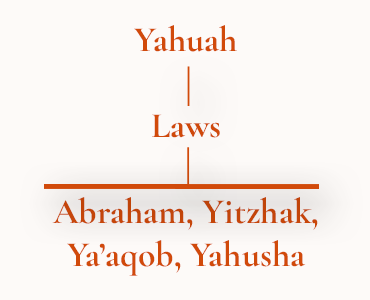
When people place the “authority” of another King above the “authority” of Yahuah, this means that people choose to obey the laws of another king rather than the Laws of Yahuah Elohiym. For example, in the beginning Chavah (Eve) chose to obey the voice of the serpent rather than the Voice of Yahuah.
And the man said, The woman whom you gave to be with me, she gave me of the tree, and I did eat. And Yahuah Elohiym said unto the woman, What is this that you have done? And the woman said, The serpent beguiled me, and I did eat.
Chavah (Eve) placed the authority of the serpent above the Authority of Yahuah. She obeyed the voice of the serpent rather than the Voice of Yahuah Elohiym. Adam chose to obey the voice of his wife rather than the Voice of Yahuah.
And unto Adam he said, Because you have hearkened unto the voice of you wife, and have eaten of the tree, of which I commanded you, saying, you shall not eat of it: cursed is the ground for thy sake; in sorrow shall you eat of it all the days of your life;
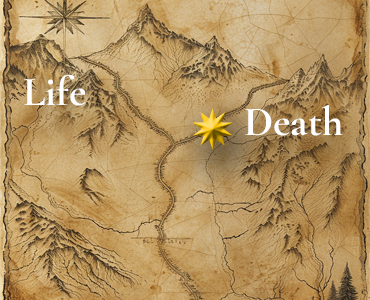
Adam placed the authority of his wife above the Authority of Yahuah Elohiym. Both Adam and Chavah (Eve) were cursed and chose to travel the trail that leads to death. Abraham, Yitzhak (Isaac), Ya’akob (Jacob) and Yahusha chose the pathway that leads to life. They did not place the authority of anyone else above the Authority of Yahuah. If we want to travel on the trail that leads to life, then we must also choose NOT to place the authority of anyone else above the Authority of Yahuah Elohiym like them. What does this look like?
The Word of Yahuah has been spoken and subsequently written by His true prophets. His Word is His Voice. His Word is His instructions. When we encounter a difference between a message given to us by our pastor and one given by our Creator, then we choose to adhere to the message given by our Creator rather than the one given to us by our pastor.
Let’s consider an example. In Christianity, leaders teach others that “we are no longer under the Law”. The “Law” they are referring to is the Law of Moshe or the first five books of the Bible, Tanakh or Cepher. They teach their followers that the “Law has been fulfilled”. However, Yeshayahu (Isaiah) is a true prophet of Yahuah Elohiym. He spoke on behalf of Yahuah and his writings are considered the very Words of Yahuah. He states the following which would include the “Law of Moshe”.
The grass withers, the flower fades: but the word of our Elohiym shall stand forever.
This message tells us that the Word of Yahuah Elohiym stands forever. This includes the writings from all of the prophets including Moshe (Moses). As stated previously in this lesson, Yahuah essentially tells us the following:
You shall not place the authority of other mighty ones [Kings, Leaders, Popes, and Presidents] above Me.
This is a Law in the writings of Moshe (Moses). If this Law has been “fulfilled”, does this mean it is no longer applicable or relevant to us? Does it mean that we are now allowed to place the authority of these Kings, Leaders, Popes and Presidents above Yahuah Elohiym? When would it ever be okay to place the authority of another leader above Yahuah Elohiym? We are at a crossroad which requires an act of freewill.
- We choose to believe the words of our leader who said that we are no longer under the Law of Moshe (Moses) and that it has been completely fulfilled. It is permissible for us to place the authority of someone else above the authority of Yahuah Elohiym… OR
- We believe the words of known true prophets of Yahuah Elohiym. The Word of Yahuah stands forever. Even though Messiah Yahusha did indeed fulfill Shemoth (Exodus) 20:3, we are to follow his example and fulfill it in our own lives as well.
Yeshayahu (Isaiah) was speaking the words of Yahuah Elohiym. Debarim (Deuteronomy) 18:18-19 specifically tells us to hear and obey everything that the prophets of Yahuah say which include the prophets Moshe (Moses) and Yeshayahu (Isaiah).
Choosing to believe the pastor instead of Yahuah Elohiym is being like Adam and Chavah (Eve). They placed the authority of someone else above Yahuah Elohiym. When they did this act, they placed themselves on the trail that led to death which eventually manifested in their lives. When we choose to believe the words of our pastor rather than the Word of Yahuah Elohiym then we have also placed ourselves on the trail that leads to eternal death.
Choosing to believe the pastor and acting upon his instructions, is communicating a message to our Father in heaven that we are more interested in the journey rather than the destination. Is it because we like the idea that we are not subject to the Laws of Yahuah written by the Prophet Moshe?
We cannot interfere with an individual’s right of freewill. We are not manipulating the text to make it say something we want it to say. We are not trying to convince you or persuade you. We are not pressuring you to believe any specific doctrines. We are simply showing you solid, reliable evidence in the Word of our Creator.
This lesson is an example of how we make the Word of Yahuah the Authority on all matters. He has the final say. There is a great deal of security in our belief system when we do this.
The deception runs deep and we have only just begun to show you the truth. We are simply discussing fundamental concepts that need to be addressed before we start delving into the studies themselves. Establishing the concept of “authority” is paramount.
In all of our studies, we place the Authority of Yahuah Elohiym on the highest plane. This is why we choose to quote an abundant number of passages from His Word. We do this to show others the perspective of Yahuah on the subject under discussion. We do this to show others what He has to say on the matter. This becomes necessary if we are going to expose falsehoods that we have all inherited in our respective belief systems.
Download this Article here