141-8 What are Patterns?
And on the seventh day Elohiym ended his work which he had made; and he rested on the seventh day from all his work which he had made. And Elohiym blessed the seventh day, and set it apart: because in it he had rested from all his work which Elohiym created and made.
In our day and age, a pattern may be someone who always puts their sock on the right foot first then the left. Then, they put their shoe on the right foot first and then the left. This is an automatic habit that we might do without thinking about it. Perhaps the first thing we do in the morning is make a cup of coffee then read the news. They are routine things we do each day.
We also see consistent habits in nature. Birds migrate at different times of years. Bears hibernate in winter. The sun always rises in the east and sets in the west. The moon has a regular 29-30 day cycle each month with its phases. The constellations make their circuit in a regular, consistent pattern. Dogs reproduce puppies. Cats reproduce kittens. These are consistent patterns that occur over and over.
Our Father in heaven also has “patterns” that are repeated over and over. He is consistent and reliable. When we know His patterns, we can predict what He would do in a given situation. This makes Him predictable. Once people know and understand His patterns, they can identify teachings that violate His established patterns. This is a factor we also consider when interpreting the original intended message in His Word. Essentially, violating a pattern in the Word of Yahuah is also taking things out-of-context.
The Pattern of Seven
Seven is a distinct pattern in the Word of Yahuah and the seventh of any count is set-apart or it is distinct from the rest. In the very beginning, our Father created the heavens and the earth in six days and then rested on the seventh day. Yahuah initiated a pattern at this point, work six days and rest on the seventh… work six days and rest on the seventh… work six days and rest on the seventh…
Thus, the heavens and the earth were finished, and all the host of them. And on the seventh day Elohiym ended his work which he had made; and he rested [shabbat] on the seventh day from all his work which he had made. And Elohiym blessed the seventh day, and set it apart: because that in it he had rested [shabbat] from all his work which Elohiym created and made.
The Hebrew word translated as “rested” is “shabbat” otherwise known as “sabbath”. Here is the pattern illustrated.
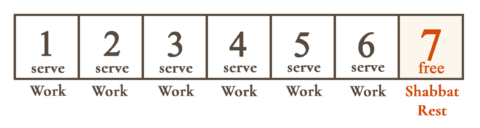
The seventh day ended the first week of creation. It is symbolic of completion. Yahuah wanted us to remember His work completed at Creation and instructed His people to “Remember the sabbath day…”
Remember the Shabbat day, to keep it set-apart. Six days shall you labor, and do all your work: But the seventh day is the Shabbat of Yahuah your Elohiym: in it you shall not do any work, you, nor your son, nor your daughter, your manservant, nor your maidservant, nor your cattle, nor your stranger that is within your gates: For in six days Yahuah made heaven and earth, the sea, and all that in them is, and rested the seventh day: wherefore Yahuah blessed the Shabbat day, and set it apart.
The House of Yashar’El is instructed to follow the pattern established at creation by Yahuah, work six days and rest on the seventh… work six days and rest on the seventh… work six days and rest on the seventh… The first day of each month also follows this pattern.
And Yahuah spoke unto Moshe, saying, Speak unto the children of Yashar’El, saying, In the seventh month, in the first day of the month, shall you have a Shabbat, a memorial of blowing of trumpets, a set-apart convocation. You shall do no servile work therein: but you shall offer an offering made by fire unto Yahuah.
This is a pattern that the House of Yashar’El are to follow… first day of the first month, we are to work… first day of the second month, we are to work… first day of the third month, we are to work; first day of the fourth month, we are to work; first day of the fifth month, we are to work; first day of the sixth month, we are to work; first day of the seventh month, we are to REST! Here is an illustration of this pattern.
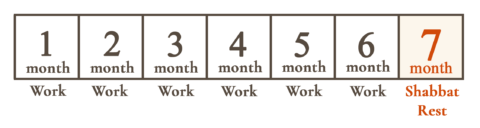
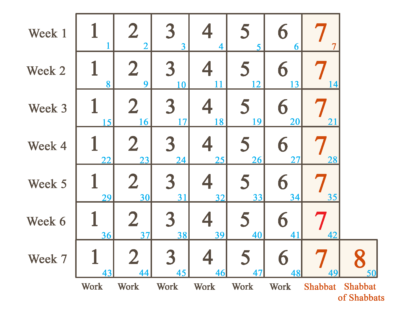
Of course, if the first day of any month falls on the weekly Shabbat, it is a day of rest. Seven Shabbats after the Feast of Firstfruits is Shavuot or Pentecost. This is a period of seven weeks and then there is another Shabbat day. This is commonly called, “counting the Omer”.
And you shall count unto you from the morrow after the sabbath, from the day that you brought the sheaf of the wave offering; seven Shabbats shall be complete: Even unto the morrow after the seventh sabbath shall you number fifty days; and ye shall offer a new meat offering unto Yahuah.
The Feast of Firstfruits during the Feast of Unleavened Bread lands on the first day of the week which is a Sunday in our method of keeping time. We begin our count of seven Shabbats on the first Shabbat after Firstfruits. We also do a count of 50 days which is “counting the Omer”. Here is an illustration of this pattern of sevens.
 The land has a Shabbat as well. We are instructed to let our land rest every seven years. Many of the nutrients from the soil accumulate in the fruits of our plants. When we allow the fruit to mature and drop around our plants, the nutrients within the fruit feed the plants and make them strong and vigorous. The land Shabbat is necessary to maintain healthy soil.
And Yahuah spoke unto Moshe in Mount Sinai, saying, Speak unto the children of Yashar’El, and say unto them, When you come into the land which I give you, then shall the land keep a Shabbat unto Yahuah. Six years you shall sow your field, and six years you shall prune your vineyard, and gather in the fruit thereof; But in the seventh year shall be a Shabbat of rest unto the land, a Shabbat for Yahuah: you shall neither sow thy field, nor prune your vineyard. That which grows of its own accord of your harvest you shalt not reap, neither gather the grapes of your vine undressed: for it is a year of rest unto the land. And the Shabbat of the land shall be meat for you; for your, and for your servant, and for your maid, and for your hired servant, and for your stranger that sojourns with you, And for your cattle, and for the beast that are in your land, shall all the increase thereof be meat.
The House of Yashar’El is instructed to follow this pattern. Work the land six years and let it rest on the seventh… work the land six years and let it rest on the seventh… work the land six years and let it rest on the seventh…
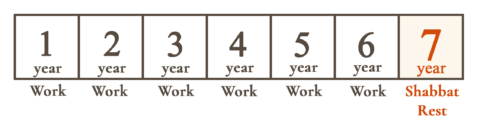
Seven sets of years begin a Yovel or Jubilee year which mirrors the Feast of Shavuot or Pentecost. In this situation, there are two Shabbat years back-to-back.
And you shall number seven Shabbats of years unto you, seven times seven years; and the space of the seven Shabbats of years shall be unto you forty and nine years. Then shall you cause the trumpet of the Yovel to sound on the tenth day of the seventh month, in the day of atonement shall you make the trumpet sound throughout all your land. And you shall set the fiftieth year apart, and proclaim liberty throughout all the land unto all the inhabitants thereof: it shall be a yovel unto you; and you shall return every man unto his possession, and you shall return every man unto his family. A Yovel shall that fiftieth year be unto you: you shall not sow, neither reap that which grows of itself in it, nor gather the grapes in it of your vine undressed. For it is the Yovel; it shall be set-apart unto you: you shall eat the increase thereof out of the field. In the year of this Yovel you shall return every man unto his possession.
In the 49th year on the Day of Atonement or Yom Kippur, the trumpet for the Yovel or Jubilee is sounded. This indicates that the beginning of the next year on the first day of the first month in the Spring is the Yovel. It is the time in which all debts are cleared and every man returns to his father’s house. The trumpet is sounded in the seventh month so that the people will know that this is the year in which they do not sow seed in the land which happens in the fall of the year. Here is an illustration of the Yovel pattern of sevens. It is exactly like the pattern seen in Shavuot (Pentecost).
The patterns of seven do not stop here! The Hebrew words for “Shabbat”, “week”, “seven”, “repentance” and “oaths” are in the same word family. The root of all these words is defined by The Ancient Hebrew Lexicon of the Bible written by Jeff A. Benner as:
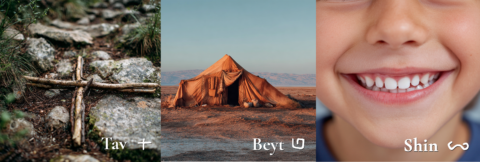
BF שב Action: Turn, Draw, Capture, Sit, Design, Weave Object: Seat, Well, Captive, Wreath, Net, Plate, Bed Abstract: Anguish, Copulation Definition: A place of dwelling as the place returned to. A turning back or away from someone or something. A captive is one turned away from a place of dwelling. Ancient Hebrew: The pictograph F is a picture of the two front teeth representing pressing, the B is a picture of tent. Combined these mean “Press to the tent”.
The concrete idea in this two-lettered root is the idea of “pressing back to the tent” which is our home. On Shabbat, we do not go outside and work our fields. We stay in our tent. On the land Shabbat, we stay in our tent for a whole year and do not go outside and work the fields for a whole year. In the year of the Yovel, we return to our father’s house and the land of our possession. When we repent, we turn back to our Heavenly Father. The Hebrew word translated as “Shabbat” is “shabbat” and it is defined the following way by The Ancient Hebrew Lexicon of the Bible as:
TBF ( fem., שבת / sha-bat ) Translation: CEASING Definition: A stopping of work or activity; An activity curtailed before completion. The seventh day of the week (often translated as Shabbat) when all business ceases for rest and celebration. KJV Translations: Shabbat, another, lost time, still, cease Strong’s Hebrew #: h.7674, h.7676
The Hebrew word ends with the letter “tav” which is two crossed sticks and represents sign or mark.
TBF
From and ancient Hebrew perspective, this word also means the “sign” or “mark” of returning to the tent. The original intended home for man was in the Garden of Eden in the very beginning. It is a place where Yahuah dwells. It is His House.
And Yahuah Elohiym planted a garden eastward in Eden; and there he put the man whom he had formed.
“Shabbat” is the “sign of returning to our Father’s House in the Garden of Eden”. Here are the pictures associated with this Hebrew word. The teeth press down. We can see the sign of pressing to the house in these pictures.
The Hebrew word translated as “week” is “shavua” and it is defined the following way by The Ancient Hebrew Lexicon of the Bible as:
[WBF ( masc., שבוע / sha-vu-a ) Translation: WEEK Definition: A period of time consisting of seven days or seven years. KJV Translations: week Strong’s Hebrew #: h.7620
One week is a period of “seven”. It can be seven days, seven years or seven millenniums. The term “Shavuot” is the plural form of “shavua” which means “weeks”. This is referred to as “Pentecost” in the book of Acts which was observed by the disciples of Messiah Yahusha. The number “seven” is “shivah” and is defined the following way by The Ancient Hebrew Lexicon of the Bible as:
H[BF ( masc., שבעה / shiv-ah ) שבע ( fem., שבע / she-va ) Translation: SEVEN Definition: A cardinal number. Alternate Translations: seventy (when written in the plural) Edenics: seven, an exchange of the s and sh KJV Translations: seven, seventh, seven times, sevenfold Strong’s Hebrew #: h.7651, h.7657, (x2) Strong’s Aramaic #: a.7655
The Hebrew word translated as “repent” is “shub” and it is defined the following way by The Ancient Hebrew Lexicon of the Bible as:
BWF ( common, שוב / sh.w.b ) Translation: TURN.BACK (V) Definition: To return to a previous place or state. Alternate Translations: return (when written in the hiphil [causative] form) Edenics: shove KJV Translations: return, again, turn, back, away, restore, bring, render, answer, recompense, recover, deliver, put, withdraw, requite Strong’s Hebrew #: h.7725 Aramaic Spelling: תוב Strong’s Aramaic #: a.8421
“Repentance” is the action of returning to a previous place or state of existence. Our original intended home is the Garden of Eden in the Presence of Yahuah Elohiym. “Shub” is the act of returning to our Father’s house which is communicated in the year of Yovel. The Hebrew word translated as “oath” is “Shaba” and it is defined the following way by The Ancient Hebrew Lexicon of the Bible as:
[BF שבע Definition: Literally to seven oneself. A common practice was to make seven declarations when making an oath. This declaration can be making the oath seven times or doing seven things to show the sincerity of the oath.
When Yahuah Elohiym makes seven declarations or does seven things, He is making an “oath” and showing His sincerity in this matter. Yahuah created heaven and earth in seven days. This indicates an “oath” that Yahuah made with Adam in the very beginning:
And Yahuah Elohiym commanded the man, saying, Of every tree of the garden you may freely eat: But of the tree of the knowledge of good and evil, you shall not eat of it: for in the day that you eat thereof you shall surely die.
Adam had access to the Tree of Life and the Tree of Knowledge of Good and Evil. Yahuah had given him the Tree of Life so that he could live forever. Adam broke the “oath” when he ate from the forbidden tree. Yahuah made an “oath” with Abraham, Yitzhak and Ya’akob. He made seven declarations this time. The first five were with Abraham and the sixth time was with Yitzhak and the seventh declaration was given to Ya’akob.
- Bereshith 12:1-3 (Yahuah made promise to Abram)
- Bereshith 13:14-17 (Yahuah made promise to Abram)
- Bereshith 15:1-21 (Yahuah made beriyth with Abram)
- Bereshith 17:1-22 (Yahuah gave beriyth of circumcision with Abraham, the “sign” of the oath)
- Bereshith 22:1-18 (Offering of Yitzhak as a sacrifice by Abraham)
- Bereshith 26:1-5 and 26:24-25 (Yahuah confirmed oath with Yitzhak)
- Bereshith 28:10-22 (Yahuah confirmed oath with Ya’akob… saw door to heaven)
The “oath” was complete after the seventh declaration. In this “oath”, Yahuah promised them a piece of land. Adam was only given dominion over the inhabitants of the earth. He was not given any land as a possession. Yahuah Elohiym has only given Abraham and his descendants land as a possession. Nations can occupy the land but it is not theirs. In the Yovel, people in the House of Yashar’El return to their land of possession. They return to their Father’s House. We see this pattern in relation to Hebrew slaves.
And if your brother, an Hebrew man, or an Hebrew woman, be sold unto you, and serve thee six years; then in the seventh year you shall let him go free from you.
Hebrew servants follow a pattern… serve six years and released in the seventh. This is the same pattern we see over and over in the Word of Yahuah. Here is an illustration:
The distinguishing characteristic between a Hebrew and a non-Hebrew is the seventh-day Shabbat (Shabbat). Yahuah Elohiym tells us that observance of the Shabbat on the seventh day is a “sign” or “mark” for the children of Yashar’El.
And Yahuah spoke unto Moshe, saying, Speak also unto the children of Yashar’El, saying, Verily my Shabbats you shall guard: for it is a sign between me and you throughout your generations; that you may know that I am Yahuah that does set you apart. You shall guard the Shabbat therefore; for it is set-apart unto you: every one that defiles it shall surely be put to death: for whosoever does any work therein, that soul shall be cut off from among his people. Six days may work be done; but in the seventh is the Shabbat of rest, set-apart to Yahuah: whosoever does any work in the Shabbat day, he shall surely be put to death. Wherefore the children of Yashar’El shall guard the Shabbat, to observe the Shabbat throughout their generations, for a perpetual beriyth. It is a sign between me and the children of Yashar’El forever: for in six days Yahuah made heaven and earth, and on the seventh day he rested, and was refreshed. And he gave unto Moshe, when he had made an end of communing with him upon mount Sinai, two tables of testimony, tables of stone, written with the finger of Elohiym.
Hebrews follow the pattern. Work six days, rest the seventh… work six days and rest the seventh… work six days and rest the seventh… This pattern is depicted as a “shadow of what is to come” as declared in the following passage.
Let no man therefore judge you in meat, or in drink, or in respect of a holyday, or of the new moon, or of the Shabbat days: Which are a shadow of things to come; but the body is of Messiah.
The author of this letter is telling us that we are not to allow others to judge us regarding eating clean meats, our observance of the Feasts of Yahuah, our observance of the new moon and our observance of the seventh-day Shabbat. Endure and persevere because these things are just a shadow of what is to come. The author is telling us that these things have prophetic significance.
Predicting the Actions of Yahuah”
Based on these patterns of seven, we can predict certain outcomes because we know Yahuah will follow these patterns. They have prophetic significance. For example, we know that the seventh millennium will be a Shabbat millennium. It has not happened as yet. Based on mathematical calculations, we know that we are close to this transition between the sixth and seventh millennium. We know that Yahuah has established a week of millenniums because Yahuah had told Adam that he would die in the “day” that he ate from the forbidden treen. Now, Adam did not die that very day. He lived to be 930 years.
And all the days that Adam lived were nine hundred and thirty years: and he died.
This amount of time is just shy of 70 years of one thousand years. Adam literally died in the “day” he ate from this forbidden tree. Yahuah also stated that His Spirit would not always strive with man. There would be a period of time allotted and then there would be “rest” or a “Shabbat” for the inhabitants of the earth with Yahuah.
And Yahuah said, My spirit shall not always strive with man, for that he also is flesh: yet his days shall be an hundred and twenty years.
Yahuah said that this time period would be 120 years. The evidence is clear that the “striving” has been going on for thousands of years to this very day. The two-lettered root of this word is defined by The Ancient Hebrew Lexicon of the Bible as:
NF שן Action: Sharp, Rest Object: Teeth, Two Abstract: Previous Definition: The two front teeth are sharp and used for cutting foods by pressing down. Ancient Hebrew: The pictograph F is a picture of the teeth, the N is a picture of a seed representing continuance. Combined these mean “teeth continue”.
How in the world is our concept of a “year” related to “teeth continuing”? The Hebrew word translated as “year” is “shanah” and it is defined by The Ancient Hebrew Lexicon of the Bible as:
HNF ( fem., שנה / sha-neyh ) Translation: YEAR Definition: The period of around 365 solar days. Relationship to Root: In the sense of repeating. KJV Translations: year Strong’s Hebrew #: h.8141 Strong’s Aramaic #: a.8140
When we eat food, we chew and chew and chew…. And we repeat this process every time we eat over and over again. Just as “day” does not always indicate a 24-hour period, a “year” is not always indicated by a 365 cycle around the sun. It is a cycle that is repeated over and over. There are prophecies that indicate there will be an end to “war” which would be classified as “striving”.
The word that Yeshayahu the son of Amoz saw concerning Yahudah and Yerushalayim. And it shall come to pass in the last days, that the mountain of Yahuah’s house shall be established in the top of the mountains, and shall be exalted above the hills; and all nations shall flow unto it. And many people shall go and say, Come, and let us go up to the mountain of Yahuah, to the house of the Elohiym of Ya’akob; and he will teach us of his ways, and we will walk in his paths: for out of Tziyon shall go forth the Law, and the word of Yahuah from Yerushalayim. And he shall judge among the nations, and shall rebuke many people: and they shall beat their swords into plowshares, and their spears into pruninghooks: nation shall not lift up sword against nation, neither shall they learn war any more. O house of Ya’akob, come ye, and let us walk in the light of Yahuah.
This time period would be an “end” to the striving between the Spirit of Yahuah and man. It is a time of shalom or peace. It will be a time when the House of Yashar’El will be made the head and not the tail.
And Yahuah shall make you the head, and not the tail; and you shall be above only, and you shall not be beneath; if that you hearken unto the commandments of Yahuah your Elohiym, which I command you this day, to observe and to do them:
This means the House of Yashar’El is currently serving the rulers of this current world system. They are slaves to the system. Following is an illustration of the millennial week.
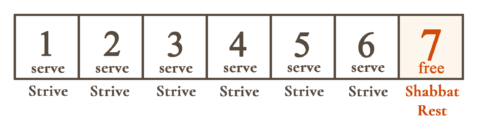
We are currently ending the 6th millennium which is 6000 years. One of the cycles in Yahuah Elohiym’s calendar is the Yovel of fifty years. Here is the math
6000 divided by 50 equals 120 Yovel Cycles
Bereshith (Genesis) 6:3 can be interpreted the following way:
And Yahuah said, My Spirit shall not always strive with man, for that he also is flesh: yet his days shall be an hundred and twenty [Yovel] revolutions or cycles.
The seventh millennium must be a Shabbat. The only way Yahuah Elohiym can ensure that the seventh millennium is a Shabbat is to prompt a transition from the rulers of this world to His righteous King, Yahusha Ben David at the end of the sixth millennium and the beginning of the seventh millennium. We know beyond a shadow of a doubt that Messiah Yahusha Ben David will return at the point of this transition. This is prophesied in the following passage:
And in that day there shall be a root of Yishai [Messiah from the line of David], which shall stand for an ensign of the people; to it shall the Gentiles seek: and his rest [Shabbat] shall be glorious. And it shall come to pass in that day, that Adonai shall set his hand again the second time to recover the remnant of his people [second exodus], which shall be left, from Assyria, and from Egypt, and from Pathros, and from Cush, and from Elam, and from Shinar, and from Hamath, and from the islands of the sea. And he shall set up an ensign for the nations, and shall assemble the outcasts of Yashar’El, and gather together the dispersed of Yahudah from the four corners of the earth. The envy also of Ephraim shall depart, and the adversaries of Yahudah shall be cut off: Ephraim shall not envy Yahudah, and Yahudah shall not vex Ephraim. But they shall fly upon the shoulders of the Philistines toward the west; they shall spoil them of the east together: they shall lay their hand upon Edom and Moab; and the children of Ammon shall obey them. And Yahuah shall utterly destroy the tongue of the Egyptian sea; and with his mighty wind shall he shake his hand over the river, and shall smite it in the seven streams, and make men go over dry-shod. And there shall be a highway for the remnant of his people, which shall be left, from Assyria; like as it was to Yashar’El in the day that he came up out of the land of Egypt [second exodus].
Our Messiah will gather together Yashar’El and Yahudah in a second exodus which will be like the first exodus from Egypt with all of its plagues and miracles. Yahusha will be like Moshe and lead the people of Yahuah to the land of promise. They will spoil the nations just like Yashar’El spoiled the Egyptians in the first exodus. We know this because Yahuah Elohiym follows patterns. He is consistent and reliable. His people will even go through a sea on dry ground. Essentially, the first exodus is a prophecy for the second exodus.
The Hebrews will be gathered at the end of the “sixth” millennium. It will be a “Yovel” year in which every man, woman and child returns to the land of their possession. This is depicted in the prophecy in Yeshayahu (Isaiah) 11:10-16. At this point, they will be made the head and will no longer be the tail. This exodus is going to include the resurrection of all Hebrews who had died in previous generations. The “first resurrection” is mentioned in Revelation.
And I saw thrones, and they sat upon them, and judgment was given unto them: and I saw the souls of them that were beheaded for the witness of Yahusha, and for the word of Elohiym, and which had not worshipped the beast, neither his image, neither had received his mark upon their foreheads, or in their hands; and they lived and reigned with Messiah a thousand years. But the rest of the dead lived not again until the thousand years were finished. This is the first resurrection.
Not everyone is resurrected at the same time. The Hebrews are resurrected at the end of the sixth millennium. Who are “Hebrews”? The main “sign” for the people of the Most High is observance of Shabbat on the seventh day as noted in Shemoth (Exodus) 31:12-18. They have been rehearsing this pattern for generations until this day. This opportunity is available to anyone who chooses to guard the Shabbats of Yahuah and takes a hold onto His beriyth (covenant).
Also the sons of the stranger, that join themselves to Yahuah, to serve him, and to love the name of Yahuah, to be his servants, everyone that guards the Shabbat from polluting it, and takes hold of my beriyth; Even them will I bring to my set-apart mountain, and make them joyful in my house of prayer: their burnt offerings and their sacrifices shall be accepted upon mine altar; for mine house shall be called an house of prayer for all people. Adonai Yahuah which gathers the outcasts of Yashar’El says, Yet will I gather others to him, beside those that are gathered unto him.
When we understand the patterns established by Yahuah, we can predict the actions He may take in the future. We can also identify teachings that have not originated with Him. The evidence regarding the pattern of sevens is overwhelming. We know beyond a shadow of a doubt that it would be way out-of-character for Yahuah to change His Shabbat from the seventh day of the week to the first day. There is no “pattern” in His Word that would suggest such a change. It is obvious that changing the Shabbat from the seventh day to the first day is manmade doctrine.
In our lessons, we pay attention to the patterns of Yahuah Elohiym. It is important to interpret His messages in proper context so that we do not unwittingly accept doctrines that are manmade and not based on the Word of Yahuah.
Download this Article here