141-4 What is Context?
You shall not add unto the word which I command you, neither shall you diminish ought from it, that you may keep the commandments of Yahuah your Elohiym which I command you.
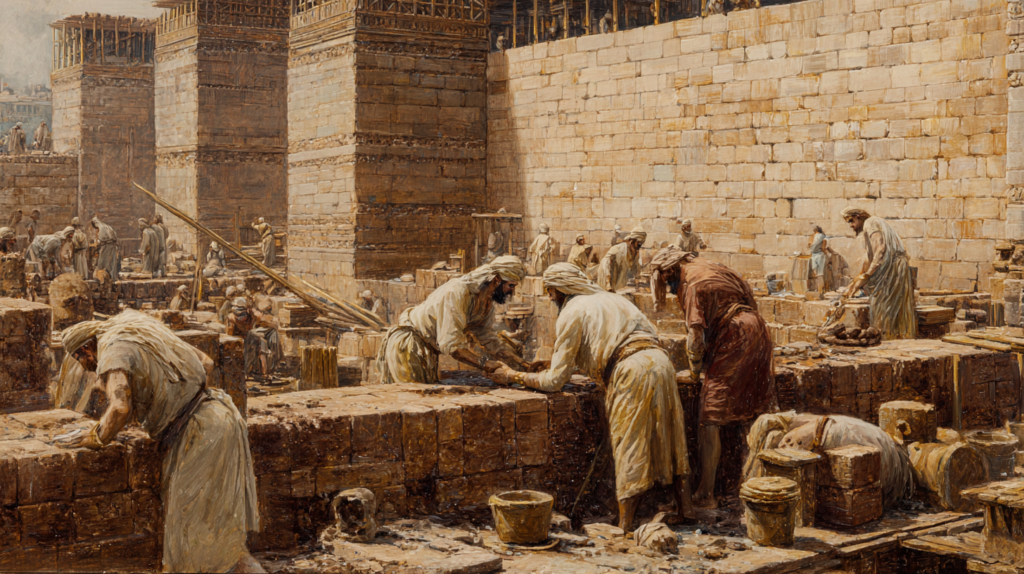
The next brick in our foundation is the concept of “maintaining context”. The message of Yahuah Elohiym involves entire passages and books. Most leaders consider a passage is “taken-out-of-context” when an individual isolates a particular verse and gives it new meaning that was not originally intended in the passage itself. This is true. However, there is far more to be considered when we are interpreting a verse out-of-context.
We have discussed the concept of “perspective” in a previous lesson. When we choose to interpret any message from our Creator from any other perspective than His, we are interpreting His message out-of-the-context in which it was given. By doing so, we are changing the original meaning of His message. When we change the original intended message, we are devising our own message which is the essence of “manmade” doctrines. In our lesson on “Authority”, we discussed the habit of some who read the following passage and say, “this passage proves Jesus is God and is therefore, our Creator”.
For unto us a child is born, unto us a son is given: and the government shall be upon his shoulder: and his name shall be called Wonderful, Counsellor, The mighty God, The everlasting Father, The Prince of Peace.
This passage does not communicate the message that “Jesus is God and is therefore, our Creator” in context. The individual who makes these claims is taking this passage out-of-context and giving it their own meaning and changing the original intended message of the passage. This is a dangerous habit because it is highly likely this individual does this with many other passages. If they are willing to twist and turn this passage, then it is likely they are twisting and turning other passages as well.
What happens when 30% of the passages we rely upon for our belief system are based on passages taken-out-of-context?
How much deception does it require to alter our course enough to miss the target? Passages taken out-of-context are manmade doctrines. We remove manmade doctrines based on passages taken-out-of-context by restoring context. For example, this passage is simply saying that our Messiah is a mighty strong authority and King who will establish a righteous government in the earth… and it will be wonderful!
Maintaining context requires us to consider the perspective of Yahuah Elohiym. It requires us to ensure an interpretation does not violate His established nature and character. It requires us to ensure our interpretation does not violate His established patterns. It requires us to consider the surrounding passages in which the verse was taken.
It requires us to resolve all apparent contradictions when interpreting His Messages. They must be resolved in order to find the error. This is how we view the concept of “maintaining context” which is imperative if we want our belief system founded on truth.
Principle: In order to find the truth, we must maintain the context of the message provided by the prophets. This includes:
- Maintaining and establishing the perspective of Yahuah Elohiym.
- Ensuring our interpretation does not violate His nature and character.
- Ensuring our interpretations do not violate any of Yahuah Elohiym’s established patterns.
- Resolving all apparent contradictions.
- Ensuring the selected verses are not being isolated and given new meaning.
When we do not follow these guidelines, we end up with a different message than what was originally intended. This is adding-to and subtracting-from His Word. This is based on the following Law:
You shall not add unto the word which I command you, neither shall you diminish ought from it, that you may keep the commandments of Yahuah your Elohiym which I command you. (Debarim/Deuteronomy 4:2)
“Context” Defined:
We have all likely heard the phrase, “you are taking that verse out-of-context!” … and then the division comes. One individual perceives one thing and another individual perceives another. Eventually, we have over a thousand different denominations and sects with our own individual interpretations of His Word. How do we reverse this division?
We reverse division in the body by restoring context.
Maintaining “context” is really challenging when we have been completely divorced from our Creator’s language, culture and practices. The difficulty actually goes even deeper than what is commonly taught in biblical hermeneutics. In this lesson, we are going to illustrate this concept as it relates to the way we interpret testimony in the Word of Yahuah and eyewitness accounts. Interpreting the Word of Yahuah to find the original meaning of the intended message, requires us to consider “context”. It is crucial. Let’s begin by considering the definition of “context” from a Greek-English perspective by Google Dictionary:
The circumstances that form the setting for an event, statement, or idea, and in terms of which it can be fully understood and assessed.
How can we fully understand a message if we have failed to consider the individual perspective of those who wrote these accounts thousands of years ago? Watermark Community Church defines “context” the following way:
Reading the Bible in its context means looking at every verse or passage in relation to the verses, chapters, and broader narratives that surround it. It means knowing what other ideas, themes, or stories the author was thinking about when writing. https://www.watermark.org/blog/reading-the-bible-in-context
This definition seemingly encompasses consideration of the perspective of the author which we have discussed in previous lessons. It is important for us to consider the author’s past experiences, education, culture, mindset, upbringing, religion, values and language. Any interpretation that contradicts the perspective of the author is a misinterpretation, a misunderstanding or taken out-of-context which leads to errors in our respective belief systems.
Prophets of Yahuah:
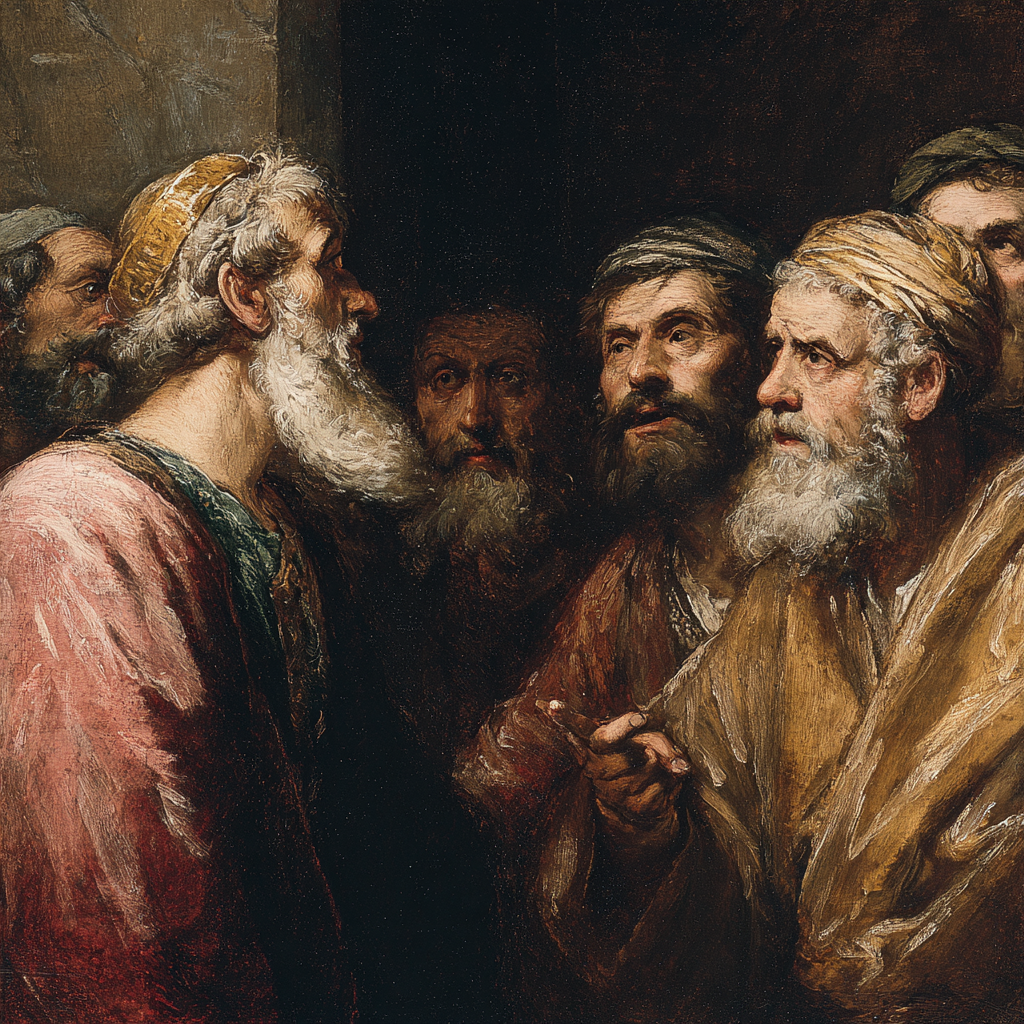
Yahuah Elohiym chooses prophets because He knows they will convey His message to the people exactly. He chose Hebrew people who live in a Hebrew culture, who think like ancient Hebrews and speak the Hebrew language… because this most closely resembles His nature and His perspective. If Yahuah presents His message to someone who does not have the same mindset, language or values as Him, would His message be properly conveyed to the people? If the translators of these writings cannot properly convey the original meaning, then it is highly likely that there is not a man or woman in existence who can communicate a message from our Creator from His perspective in our day and age. We have too much corruption in our hearts and minds to be used in this way.
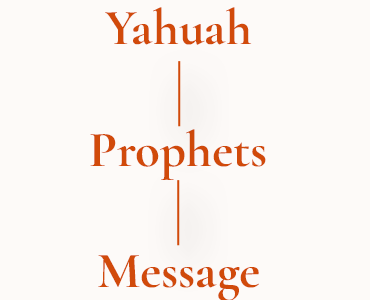
Yahuah Elohiym was and is very selective to choose people He feels are qualified to convey His message accurately to the people. If He did not feel confident that this would be the case, then He would not use them as a prophet or prophetess.
So, in order to determine the original intended message given by Yahuah, we need to understand the factors that have influenced the author’s perceptions of those He has chosen to convey His message. Failing to properly understand the author’s perspective leaves a greater potential to interpret passages out-of-context.
In the previous lesson, we used the example of “EL”, “Eloah” and “Elohiym”. These words are better translated as “strong authority”, “mighty one” or “king” because they refer to anyone including men and women who exercise power and authority in the earth. This new understanding creates a ripple effect throughout the Hebrew and Greek texts. In this example, “context” has been restored.
Maintaining Context:
Let us consider another example that illustrates this idea of “context”. Christian leaders teach people that “we are no longer under the Law but under grace”. They quote the following passage to illustrate support for their conclusion.
For sin shall not have dominion over you: for you are not under the Law, but under grace.
Shaul of Tarsus (Paul) states this plainly and clearly. We can see with our own eyes that he said these exact words in the English. Leaders have interpreted this passage to mean that people who have faith in Jesus are no longer subject to the Law of Moshe or the first five books of our Bibles, Tanakhs and Cephers.
- Can we interpret this passage in this way without considering the text surrounding this passage?
- Can we interpret this passage in this way without considering other passages from this author?
- Can we interpret this passage in this way without considering the perspective of the author?
We would like to think leaders have been diligent to verify all these things before presenting this message to their followers. For a majority of leaders, this is their full-time job. They have the time to research these matters and ensure their messages are based upon truth. But is this the case?
Since Watermark Community Church provided us an excellent definition of “context,” let us consider some of their teachings and determine if they have actually maintained context with their interpretation of Romans 6:14. Blake Holmes presented a sermon titled, Dead to Sin, Alive to Christ | Romans 6:1-14. The sermon was written and placed on their website. These are some of the take-aways from that teaching relating specifically to Romans 6:14.
- We are free not only from the penalty of sin but also the power of sin.
- Because we have been set free by grace, we can now live in such a way that is pleasing to God and is a blessing to other people.
- Because of what Christ has done for us, sin is no longer our master. We have a new master who loves us and has our best interest in mind.
All of these statements seem very good. Many of us want to live a life that is pleasing to our Father in heaven. However, did this teacher take Romans 6:14 out-of-context? The first thing we must do to restore “context” is to look at the whole passage overall, surrounding the verse. Pay close attention to the things we have highlighted in red.
Let not sin therefore reign in your mortal body, that you should obey it in the lusts thereof. Neither yield your members as instruments of unrighteousness unto sin: but yield yourselves unto Elohiym, as those that are alive from the dead, and your members as instruments of righteousness unto Elohiym. For sin shall not have dominion over you: for you are not under the Law, but under grace. What then? shall we sin, because we are not under the Law, but under grace? Elohiym forbid. Know you not, that to whom you yield yourselves servants to obey, his servants you are to whom you obey; whether of sin unto death, or of obedience unto righteousness? But Elohiym be thanked, that you were the servants of sin, but you have obeyed from the heart that form of doctrine which was delivered you. Being then made free from sin, you became the servants of righteousness.
In the “context” of this passage, Shaul of Tarsus (Paul) is telling this group of people NOT to let “sin” reign in their mortal bodies. How do we do this? We accomplish this by choosing not to commit sin. Shaul is telling them NOT to be servants of “sin” but to be servants of “righteousness”.
We cannot fully understand the “context” of this passage by projecting our definition of “sin” upon the text. Mr. Holmes from Watermark Church gave us his definition of sin in his sermon which is likely a very common understanding among Christians. This was taken from the Watermark Community Church website from the sermon titled, Dead to Sin, Alive to Christ | Romans 6:1-14 as well.
Sin is anything we think, do, or say that is contrary to the will of God, and is the ultimate, fundamental problem in the world.
Is this also the definition of “sin” from the perspective of Shaul? It is important for us to understand Shaul’s perspective because he is the author of this letter who is influenced by completely different factors than we are today. This is our question:
What is “sin” from the perspective of Shaul?
Shaul tells his followers later in the letter to the Romans that the “Law defines sin”:
What shall we say then? Is the law sin? Elohiym forbid. Nay, I had not known sin, but by the Law: for I had not known lust, except the Law had said, You shall not covet.
The commandment in the Law that says, “You shall not covet” is in Shemoth (Exodus) 20:17. “Coveting” is a sin and NOT “coveting” is obedience. Shaul (Paul) is telling us that the commandments of Yahuah define “sin” as well as “righteousness”. Here is an illustration:
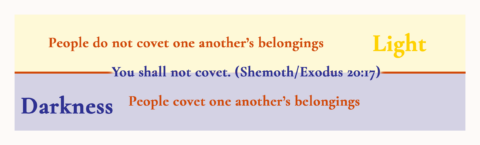
The Law that states, “You shall not covet” establishes a boundary line. Obedience to the Law is righteousness and disobedience to the Law is sin. It is this way with ALL of the commandments of Yahuah Elohiym. From the perspective of Shaul (Paul), the phrases in Romans 6:12-18 have the following meaning:
- “Let not sin reign in your mortal bodies” means “do not disobey the commandments in the Law”.
- “Do not be servants of sin” means “do not disobey the commandments in the Law”.
- “Be servants of righteousness” means “obey the commandments in the Law”.
Shaul’s (Paul’s) perspective agrees with the prophet Moshe (Moses) who speaks the Words of Yahuah.
And it shall be our righteousness, if we observe to do all these commandments before Yahuah our Mighty One, as he has commanded us.
Obedience to the Law of Moshe is “righteousness”. This is the perspective of Shaul of Tarsus (Paul). We are restoring “context” to this phrase, “we are no longer under the Law but under grace”. We would expect Shaul of Tarsus to agree with the prophet Moshe and he does.
Watermark Community Church provided key points on Romans 7:7 in an article titled, The Law and Spirit | Romans 7:1–7. This sermon was delivered by John Elmore. The key points in this sermon included the following:
Every other religion has a law, and says that following that law is your only hope to be right with God. Christianity alone says that you can’t follow the law on your own—but God Himself, through Christ, has made a way for you to be right with Him.
If we trust in Christ for our salvation and then go back to the law for our sanctification, it is adultery against Christ. https://www.watermark.org/message/8589-the-law-and-spirt-romans-7-1-7
Mr. Elmore is telling us that obedience to the Law of Moshe is adultery against “Christ”. This is a completely different message given to us by Shaul of Tarsus (Paul). Who is right? Should we believe Mr. Elmore and Mr. Holmes representing Watermark Community Church or Shaul of Tarsus? Mr. Elmore and Mr. Holmes are claiming their interpretation is the perspective of Shaul of Tarsus (Paul). It is beginning to become clear that they have not considered the actual perspective of Shaul and are taking his words out-of-context.
Resolving Apparent Contradictions:
The message in Romans 6:14 does seem confusing and contradictory. If Shaul is telling us to “obey the Law” then, what does he mean when he says we are “not under the Law”? We can gain greater insight into the perspective of Shaul (Paul) by examining testimony in other letters he has written. It is important for us to view these passages from his perspective and not our own.
There is a quote from Shaul that uses the phrase “under the curse” in Galatians. In this passage, Shaul is saying that those who do the “works of the law” are cursed but then quotes a passage from Debarim (Deuteronomy) which tells us that anyone who does not obey the Law are cursed. Which is it? Here is the passage:
For as many as are of the works of the law are under the curse: for it is written, Cursed is every one that continues not in all things which are written in the book of the Law to do them.
People are taught that the “works of the Law” mentioned in Galatians 3:10 is the “Law of Moshe”. If this is the case, then Shaul (Paul) is contradicting himself in this one verse. He would be saying those who “obey the Law of Moshe” are cursed but then says those who “disobey the Law of Moshe” are cursed. Here is an illustration of this false interpretation of Galatians 3:10.
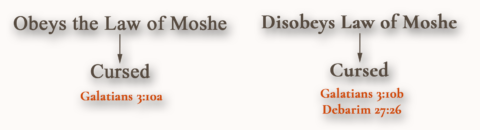
Shaul quoted Debarim (Deuteronomy) 27:26 in Galatians 3:10 to show support for his statement in the first half of the verse.
Cursed be he that confirms not all the words of this Law to do them. And all the people shall say, Amen.
This passage says people are cursed if they do NOT obey the Law of Moshe. Shaul quoted this passage to prove his point. We know beyond a shadow of a doubt that Shaul (Paul) has the following belief:
Anyone who disobeys the commandments of Yahuah Elohiym written in the Torah are cursed.
The “Law” mentioned in the first half of Galatians 3:10 cannot be a reference to the Law of Moshe. The “works of the law” is a group of laws established by men that disobey the Laws of Yahuah because Shaul quotes from Debarim (Deuteronomy) which says people who do not obey the Law of Yahuah are cursed.
The “works of the law” in context are the laws established by the scribes and Pharisees which causes one to disobey the Laws of Yahuah as illustrated in the following conversation:
Then came to Yahusha scribes and Pharisees, which were of Yerushalayim, saying, Why do your disciples transgress the tradition of the elders? for they wash not their hands when they eat bread. But he answered and said unto them, Why do you also transgress the commandment of Elohiym by your tradition? For Elohiym commanded, saying, Honor your father and mother: and, He that curses father or mother, let him die the death. But you say, Whosoever shall say to his father or his mother, It is a gift, by whatsoever you might profit from by me; And honor not his father or his mother, he shall be free. Thus have you made the commandment of Elohiym of none effect by your tradition.
The “laws of the scribes and pharisees” transgress the commandments of Yahuah written in the Law of Moshe. Therefore, they are “under the curse of the Law of Moshe”. Shaul was a Pharisee. He would have been very familiar with their laws and it was a contentious subject among new believers. Galatians 3:10 can be better understood this way. This is a paraphrase that restores the context of the entire letter of Galatians written by Shaul of Tarsus (Paul).
For those who are doing the works of the law established by the scribes and Pharisees have placed themselves under the curse of the Law of Moshe: for it is written in the Law of Moshe, Cursed is everyone who does NOT continue to do all things which are written in the Book of the Law of Moshe. (Galatians 3:10)
This understanding agrees with the words of Messiah Yahusha. This understanding agrees with the context of Debarim (Deuteronomy) 27:26. Shaul of Tarsus (Paul), Messiah Yahusha and the prophet Moshe (Moses) are in complete agreement with one another. The “curse of the Law” is also confirmed in the following passage:
But it shall come to pass, if you will not hearken unto the voice of Yahuah your Elohiym, to observe to do all his commandments and his statutes which I command you this day; that all these curses shall come upon you, and overtake you.
These passages are telling us that people who obey the commandments of Yahuah written in the Torah, are “no longer under the curse of the Law”. This means that Shaul’s reference to “works of the law” in Galatians is a different law than the Law of Yahuah. “Works of the law” is a reference to the manmade Oral Law which is practiced to this day by the descendants of the Pharisees. People who obey this law are “under the curse of the Laws of Yahuah” because some of their laws teach people to disobey the Laws of Yahuah. Based on this evidence is the phrase “under the Law” really mean “under the curse of the Law” in Romans 6:14?
“You are NOT under [the curse] of the Law, but under grace”
This interpretation agrees with the overall “context” of the Word of Yahuah and fits within the “context” of the actual passage. We know beyond a shadow of a doubt that Shaul (Paul) believes that anyone who does not obey the Laws of Moshe are cursed… because he quoted that passage in Debarim (Deuteronomy) 27:26 specifically. Why would he ever encourage people NOT to obey the Law of Moshe if this is his perspective?
Establishing the Perspective of Shaul of Tarsus:
We can solidify Shaul’s perspective by considering other testimony he has provided us in his accounts. In the following passage, Shaul is telling us that he “believes all things which are written in the Law and the Prophets”.
But this I confess unto thee, that after the way which they call heresy, so worship I the Elohiym of my fathers, believing all things which are written in the Law and in the Prophets:
Shaul (Paul) is saying that Yahuah is his authority and the One who he serves. He believes everything written in the Law of Moshe and the Prophets. He believes people are cursed if they do not obey the commandments of Yahuah written in the Law. These are his words and his perspective, not ours. During the time of Shaul, the only “scriptures” recognized were the Law and the Prophets. These are the writings Timothy had from his youth as mentioned in the following letter.
And that from a child you have known the holy scriptures, which are able to make thee wise unto salvation through faith which is in Messiah Yahusha. All scripture is given by inspiration of Elohiym, and is profitable for doctrine, for reproof, for correction, for instruction in righteousness: That the man of Elohiym may be perfect, thoroughly furnished unto all good works.
According to Shaul (Paul), the Law and the Prophets teach the message of salvation given to us by Messiah Yahusha. The Law and the Prophets are profitable for doctrine, reproof, correction and instruction in righteousness. This is the perspective of Shaul of Tarsus. He used the Law and the Prophets to the end of his life to teach people the message of salvation given to us through Messiah Yahusha.
And when they had appointed him a day, there came many to him into his lodging; to whom he expounded and testified the kingdom of Elohiym, persuading them concerning Yahusha, both out of the Law of Moshe, and out of the prophets, from morning till evening.
It is important for us to view testimony from Shaul’s perspective so that we do not take his words out-of-context. Here is a review of factors influencing his perspective:
- He uses the Law to define “sin”. This means that anywhere he talks about “sin”, he is referring to transgression of the Law of Moshe (Moses). This is based on testimony in Romans 7:7.
- He believes that people who do not obey the Law of Moshe are cursed and quoted Debarim (Deuteronomy) 27:26. This is based on testimony in Galatians 3:10.
- He believes all things written in the Law of Moshe and the Prophets. This is based on testimony in Acts 24:14.
- He believes that the Law of Moshe and the Prophets are good for doctrine, reproof, correction and instruction in righteousness. This is based on testimony in 2 Timothy 3:16.
- He taught the message of salvation given to us by Messiah Yahusha, from the Law and the Prophets until the very end of his life. This is based on testimony from Acts 28:23.
When people interpret anything written by Shaul that violates his perspective, they are taking the verse or passage out-of-context and giving it a new meaning based upon their perspective. This has been clearly illustrated by examining the teachings from Mr. Holmes and Mr. Elmore from Watermark Community Church.
Establishing Authority:
When we believe individuals who have taken the passages of Shaul (Paul) out-of-context, we are placing the authority of this individual above Shaul of Tarsus and above the authority of Messiah Yahusha who called Shaul to be a witness to the gentiles.
Whereupon as I went to Damascus with authority and commission from the chief priests, At midday, O king, I saw in the way a light from heaven, above the brightness of the sun, shining round about me and them which journeyed with me. And when we were all fallen to the earth, I heard a voice speaking unto me, and saying in the Hebrew tongue, Shaul, Shaul, why do you persecute me? it is hard for you to kick against the pricks. And I said, Who are you, Adonai? And he said, I am Yahusha whom you persecute. But rise, and stand upon you feet: for I have appeared unto you for this purpose, to make thee a minister and a witness both of these things which thou hast seen, and of those things in the which I will appear unto you; Delivering you from the people, and from the Gentiles, unto whom now I send you, To open their eyes, and to turn them from darkness to light, and from the power of Satan unto Elohiym, that they may receive forgiveness of sins, and inheritance among them which are set-apart by faith that is in me.
Shaul (Paul) gave us this testimony in the book of Acts a few times. Messiah Yahusha called Shaul to be his minister because he knew Shaul would be faithful to deliver the original intended message given to him. Yahusha Ben David trusted him to speak the truth. If we choose to interpret the writings of Shaul out-of-context then we are also taking Messiah Yahusha out-of-context and attributing messages to him that he did not condone. We are at a crossroad which requires an activation of our freewill.
- We continue to take the words of Shaul out-of-context ourselves and continue to listen to people who continue to do so as well.
- We choose to maintain the context of testimonies given to us by Shaul of Tarsus and interpret his messages based upon his perspective which happens to agree with Messiah Yahusha Ben David and the prophet Moshe (Moses).
If we want to embrace truth, then we must restore proper context. Is it really profitable for us to continue to believe that those who obey the Laws of Yahuah are committing adultery against Messiah Yahusha? If we desire the truth, then we must be willing to interpret messages written by Shaul (Paul) from the perspective of Shaul of Tarsus because it is he who was called by our own Messiah Yahusha. People who teach that “we are no longer under the law” and interpret this to mean that the Law of Moshe is no longer applicable or relevant are taking these words written by Shaul out-of-context because this interpretation violates the perspective of Shaul. In fact, Messiah Yahusha shares the same perspective as Shaul of Tarsus.
Think not that I am come to destroy the Law, or the Prophets: I am not come to destroy, but to fulfil. For verily I say unto you, Till heaven and earth pass, one jot or one tittle shall in no wise pass from the Law, till all be fulfilled. Whosoever therefore shall break one of these least commandments, and shall teach men so, he shall be called the least in the kingdom of heaven: but whosoever shall do and teach them, the same shall be called great in the kingdom of heaven.
Messiah Yahusha is the greatest in the Kingdom of Yahuah sitting on the right hand of our Father in heaven. This means that he obeyed ALL of the commandments of Yahuah written in the Law of Moshe and Prophets. This means he taught ALL of his followers to obey the Law of Moshe and the Prophets as well. This is in alignment with the perspective of Shaul. Because Messiah Yahusha called Shaul of Tarsus, he shares the same perspective as Shaul… and both agree with the prophet Moshe who defined “sin” the following way:
Speak unto the children of Yashar’El, saying, If a soul shall sin through ignorance against any of the commandments of Yahuah concerning things which ought not to be done, and shall do against any of them…
According to Moshe, “sin” is a behavior that transgresses the commandments of Yahuah written in the Law. Yochanan (John), the disciple of Messiah Yahusha who was a firsthand eyewitness to his life also defined “sin” as “transgression of the Law”.
Whosoever commits sin transgresses also the Law: for sin is the transgression of the Law. And you know that he was manifested to take away our sins; and in him is no sin.
Yochanan (John) says that Messiah Yahusha “did not sin” which means he obeyed ALL of the Laws of Yahuah written in the Torah. Shaul of Tarsus says he is a follower of Messiah and encourages people to do what he does.
Be followers of me, even as I also am of Messiah.
All of these men are in agreement with one another. This is their perspective.
- Yahusha obeyed ALL of the commandments in the Torah and taught others to do the same. He did not sin which means he never disobeyed the commandments of Yahuah written in the Law of Moshe. Because he obeyed the Laws of Yahuah, he is defined as “righteous”. If we follow his example, then how can we be accused of committing adultery against him?
- Shaul of Tarsus followed Messiah Yahusha’s example and encouraged others to do the same. This means he obeyed ALL of the commandments of Yahuah written in the Law of Moshe. He did not practice sin and therefore, is “righteous” also.
Everything in the eyewitness accounts must be interpreted based on the perspectives of these men and not our perspective or the perspective of our leaders if we want the truth. We cannot twist these testimonies to say what we want them to say.
The Overall Context of Scripture & Eyewitness Accounts:
There is one more piece of evidence that we must consider to establish the overall context of the Word of Yahuah. It is found in the following passage:
If there arise among you a prophet, or a dreamer of dreams, and gives you a sign or a wonder, And the sign or the wonder come to pass, whereof he spoke unto you, saying, Let us pursue other mighty ones, which you have not known, and let us serve them; You shall not hearken unto the words of that prophet, or that dreamer of dreams: for Yahuah your Mighty One tests you, to know whether you love Yahuah your Mighty One with all your heart and with all your soul. You shall walk after Yahuah your Mighty One, and fear him, and guard his commandments, and obey his voice, and you shall serve him, and cleave unto him. And that prophet, or that dreamer of dreams, shall be put to death; because he has spoken to turn you away from Yahuah your Mighty One, which brought you out of the land of Egypt, and redeemed you out of the house of bondage, to thrust you out of the way which Yahuah your Mighty One commanded you to walk in. So shall you put the evil away from the midst of you.
In a previous lesson, we learned that a “mighty one” is a “strong authority” who is most like a “king”. The phrase, “Let us pursue other strong authorities, which you have not known and serve them” means that these individuals are establishing their own laws and interpretations apart from Yahuah Elohiym and His followers. They are encouraging people NOT to obey the Laws of Yahuah but are encouraging people to obey the laws of another authority… another king. Watermark Community Church is a perfect example.
In the letter to the Galatians, those who follow the “works of the law” which is the Oral Law of the Pharisees are serving another mighty one. According to the perspective of Shaul of Tarsus who was once a Pharisee himself, he is saying this law contradicts the Laws of Yahuah. People who obey the Oral Law of the Pharisees are serving another authority because they are placing the authority of the Oral Law above the Authority of Yahuah Elohiym. This also violates the commandment in Shemoth (Exodus) 20:3 which tells us not to do this.
Debarim (Deuteronomy) 13:1-5 is talking about people who interpret the phrase, “we are no longer under the Law but under grace” and teach people that this means we are no longer obligated to obey the commandments of Yahuah written in the Law of Moshe. They are placing their authority above the Authority of Yahuah Elohiym as well as Messiah Yahusha and Shaul of Tarsus who are in complete alignment with the Laws of Yahuah. These individuals have assigned a “new meaning” to this phrase that was not originally intended by the author.
Debarim (Deuteronomy) 13:1-5 is telling us NOT to believe or follow their teachings. This passage says Yahuah Elohiym is “testing” people to see what they will do when presented with this option. These individuals who misinterpret the original intended messages in eyewitness testimony are allowed to exist in order to “test” us. We are at another crossroad which requires the activation of our freewill. What are we going to do? Are we going to pass or fail the “test”? Here are our options in this particular scenario:
- Accept the perspective of the individual who twisted the words of Shaul (fail the test).
- Accept the truth as revealed in its “context” (passing the test).
What are you going to do? Are you going to accept the understanding based upon the perspective of Shaul of Tarsus or are you going to accept the interpretation given to us from the perspective of a modern-day leader who has twisted the words of Shaul? If people ignore the Law of Moshe, then they do not know if the behaviors they are doing are sins or not. According to Shaul, the Law defines “sin”. In Romans 6:16, Shaul tells us the “sin leads to death”.
Know you not, that to whom you yield yourselves servants to obey, his servants you are to whom you obey; whether of sin unto death, or of obedience unto righteousness?
According to the testimony and perspective of Shaul (Paul), if we are committing sins against Yahuah, we will die.
This would seem to indicate that the Law of Moshe is extremely important and relevant in the eyes of Shaul.

This means that if we listen to our pastor who teaches us that “we are no longer under the law but under grace” and tells us that the Law of Moshe is no longer relevant, we are traveling the road that leads to death. That gold star on the map is a representation of people who align themselves with the perspective of their pastors.
This is what it means to fail the test. The blind lead the blind and both will fall into the ditch.
Debarim (Deuteronomy) 13:1-5 is telling us that if anyone teaches us to disobey the Laws of Yahuah written by the hand of the prophet Moshe, that we are NOT to follow them… even if they perform signs and wonders. This means that if Messiah Yahusha who did many miracles, would be a “false prophet” if he taught people to disobey the Torah. The Pharisees were always testing Yahusha Ben David to see if he would teach anything against the Laws of Moshe. They wanted any excuse to kill him. If Yahusha had taught people to disobey the Law of Moshe, they would have had a lawful right to put him to death and they would have done so immediately. In all four testimonies regarding his trial and death, he was never accused of being a false prophet.
If Shaul of Tarsus actually taught people that the Law of Moshe was no longer relevant and applicable in the lives of his followers, he would be classified as a “false prophet” and we should not listen to anything he says. Essentially, these pastors who teach people that the Law of Moshe is no longer relevant are actually teaching people that Shaul of Tarsus is a “false prophet”. If what they are saying is true then we should not listen to anything Shaul of Tarsus wrote.
It is vitally important for us to maintain the overall context of the Word of Yahuah and eyewitness testimony based on the perspectives of the authors and not our Greek-English, modern-day perspectives. All interpretations must be in alignment with Debarim (Deuteronomy) 13:1-5. Anything or anyone who teaches people an interpretation that causes others to disobey the commandments of Yahuah written in the Law of Moshe violates the overall context of the Word of Yahuah and eyewitness testimony. They are either misinterpretations of the original intended message of the author or false prophets.

In our lessons, we maintain the perspectives of the authors to the best of our ability and maintain the overall context of the Word of Yahuah and eyewitness testimony. It is our desire to be on the trail that leads to life and to help others find this trail.
In this lesson, we showed you the evidence that reveals the perspective of Shaul of Tarsus (Paul). Our interpretations of Shaul’s writings are based upon his perspective. We have no desire to misrepresent Shaul or our Messiah who called him into ministry.
We presented testimony from our Messiah and eyewitness testimony that reveals that Yahusha obeyed all of the Laws of Moshe and taught others to do the same. He is teaching us to obey the Laws of Moshe even today. We did not twist words and make them say what we wanted them to say. We showed you the evidence. You can open your Bibles or Cephers and see these things for yourselves.
Our role is simply to present the evidence to you. It is up to you to evaluate the evidence and make a freewill informed decision. It was Yahuah who said He tests His people. It was not us. Are you going to pass His tests or fail them? It really is a matter of eternal life and eternal death.
We realize that you may have a lot of questions because of this new information that have not been answered in this lesson. We encourage you to continue reading our lessons because those questions will be answered. We must remember our salvation is not based upon testimony that has been twisted to appeal to the masses. Salvation is based upon truth and the Word of our Father in heaven and… according to the perspective of Shaul… it can be revealed in the Law of Moshe and Prophets. Yahuah is all truth. If we are unfamiliar with the Law of Moshe and the Prophets, then how do we even know that we are believing in the message of salvation that Shaul of Tarsus saw in these ancient texts around 2000 years ago? We encourage you to grab onto the truth; you will not be disappointed.
Download this Article here