
111-5 Debunking the Documentary Hypothesis
With him will I speak mouth to mouth, even apparently, and not in dark speeches; and the similitude of Yahuah shall he behold: wherefore then why were you not afraid to speak against my servant Moshe?
Among scholars there is a theory called the “Documentary Hypothesis” regarding the writings of the prophet Moshe (Moses). They claim a written language had not yet developed during the time of Moshe. For this reason, he could not have written the first five books of Tanakhs and Bibles: Bereshith (Genesis), Shemoth (Exodus), Vayiqra (Leviticus), Bemidbar (Numbers) and Debarim (Deuteronomy). These scholars claim that that these writings were documented at much later date after the written language had been developed. Here is an excerpt from Wikipedia discussing this common belief among scholars:
Moses would have lived in the 2nd millennium BCE, before the development of Hebrew writing. Scholars date the Torah to the 1st millennium BCE. The Torah may, however, incorporate older oral traditions, such as proverbs, stories, and songs.[47] Most Jews and Christians believed in Mosaic authorship until the 17th century. Today, the majority of scholars agree that the Pentateuch does not have a single author and that its composition took place over centuries.[49] https://en.wikipedia.org/wiki/Authorship_of_the_Bible#cite_note-FOOTNOTESchniedewind20047_&_18%E2%80%9319-8
Scholars say that “Hebrew writing” did not exist during the time of the prophet Moshe (Moses). However, testimony from the documents themselves say Yahuah wrote upon tables of stone. If our Intelligent Designer wrote upon tables of stone, then the prophet Moshe would be able to read and comprehend the message. The people would be able to do so as well.
And the tables were the work of Elohiym, and the writing was the writing of Elohiym, graven upon the tables.
Are scholars telling us that this statement is not true? Are they telling us that this did not happen? If this is a lie, then what else is a lie? The Documentary Hypothesis undermines the writings attributed to the Prophet Moshe (Moses) and Words spoken by our Intelligent Designer. If the statement in Shemoth (Exodus) 32:16 is not true then these scholars are saying that the writings are essentially a fairy tale. They are saying it is the “mythological” explanation for the origins of life documented by the Hebrew people in their belief system. If these scholars think the Hebrew writings are “myths” then what do they believe themselves? Let’s think this through for a moment and consider the evidence:
- The Theory of Evolution is impossible. The probability of this event happening is 10-40,000. Emile Borel says that events with a probability of 10-50 are highly improbable. The Theory of Evolution has exceeded this probability significantly. Therefore, this theory does not explain the origins of life.
- If the Theory of Evolution is impossible, then this means life began with an “Intelligent Designer” who is “intelligent” who exceeds our intellect by leaps and bounds. He created a fully functioning man thousands of years ago and we are just now creating robot machines that mimic a man or woman. Robots are significantly inferior to the human body. This evidence alone proves that He exceeds the intelligence of mankind.
- If the intelligence of our “Intelligent Designer” far exceeds our own intellect in this technological age, then wouldn’t it seem logical that He would have a language to communicate as well, including a writing system?
Scholars are saying that “writing” did not exist in the days of Moshe (Moses) implying that mankind was not as advanced then as it is today. This statement implies that mankind evolved from cavemen which is a teaching in the Theory of Evolution. Here is an illustration:

These scholars are allowing their own belief system to influence their opinions. They believe the Theory of Evolution explains the origins of life. They do not believe an Intelligent Designer created us because an Intelligent Designer is “intelligent”. He would have His own method for communications with His creation established from the very beginning. Here is an illustration contrasting the difference between an evolutionary mindset and an Intelligent Designer mindset.
From this point-of-view, it is clearly obvious the prophet Moshe (Moses) would have known how to write and that the language he wrote was the language of our Intelligent Designer. Are these scholars basing their opinions on facts or fiction? The Theory of Evolution is a work of fiction with impossible odds. Yet, highly intelligent men and women are basing their conclusions on works of fiction. The Theory of Evolution is essentially a fairy tale.
Why should we listen to men and women who do not draw conclusions from reliable evidence?
The inscription at Serabit El-Khadim, an old Egyptian turquoise mine, actually has inscriptions using the name, “Moshe”. This is “Sinai 361” illustrated in our study: Intelligent Designers Communicate. Here is an explanation by Jeff A. Benner on his website, Ancient Hebrew Research Center describing this inscription:
Of the controversial texts that originated from Serabit El-Khadim, the turquoise mines controlled by the Egyptians just west of the traditional Mount Sinai, one in particular raises the temperature of this debate. Sinai 361 (hand drawing above and photo below) may contain the name “Moses” and actually refer to the year in which the plagues and devastation were visited on Egypt. The inscription is laid out in vertical columns from right to left with Moses (actually, the Hebrew “Moshe”) being mentioned at the bottom of the first column on the right. Petrovich reads this inscription as follows:
“Our bound servitude had lingered, Moses then provoked astonishment, it is the year of astonishment, because of the lady.”
The “astonishment” could pertain to the Judgment step seen in the film Patterns of Evidence: The Exodus when Egypt was devastated. The present tense used in the inscription could mean that the message was even written as the plagues were in the process of playing out. https://www.ancient-hebrew.org/alphabet/new-discoveries.htm#2
This inscription dates to 1446 BCE (Before the Common Era) which IS around the time of Moshe (Moses). This is evidence that we can see with our own eyes. Writing DID exist during the time of the Prophet Moshe. Evidence trumps scholarship.
If scholars don’t believe writing existed during the time of the Prophet Moshe (Moses), then they do not believe the contents of the writings themselves. Secondly, they are denying the idea of an Intelligent Designer which means they still believe in the Theory of Evolution. Because this theory is statistically impossible, belief in this theory is a religion based on blind faith.
Why would people want to continue to believe the Theory of Evolution as a viable explanation for the origins of life?
If the Theory of Evolution is impossible, this means life originated from an Intelligent Designer. If Yahuah Elohiym is our Intelligent Designer, then people would have to acknowledge His Existence and His Laws. Many people don’t like His Laws. They want to follow their own laws. This is documented by the Hebrew prophets.
As the thief is ashamed when he is found, so is the house of Yashar’El ashamed; they, their kings, their princes, and their priests, and their prophets, Saying to a stock, you are my father; and to a stone, you have brought me forth: for they have turned their back unto me, and not their face: but in the time of their trouble they will say, Arise, and save us.
The House of Yashar’El believed in one form of the Theory of Evolution during the time of the Prophet Yirmeyahu (Jeremiah). They believed the “tree” was their father and the “stone” was their mother. Does it really matter if we say life originated from a tree or a one-celled organism? The common thread between these two belief systems is they both reject the Laws of Yahuah Elohiym.
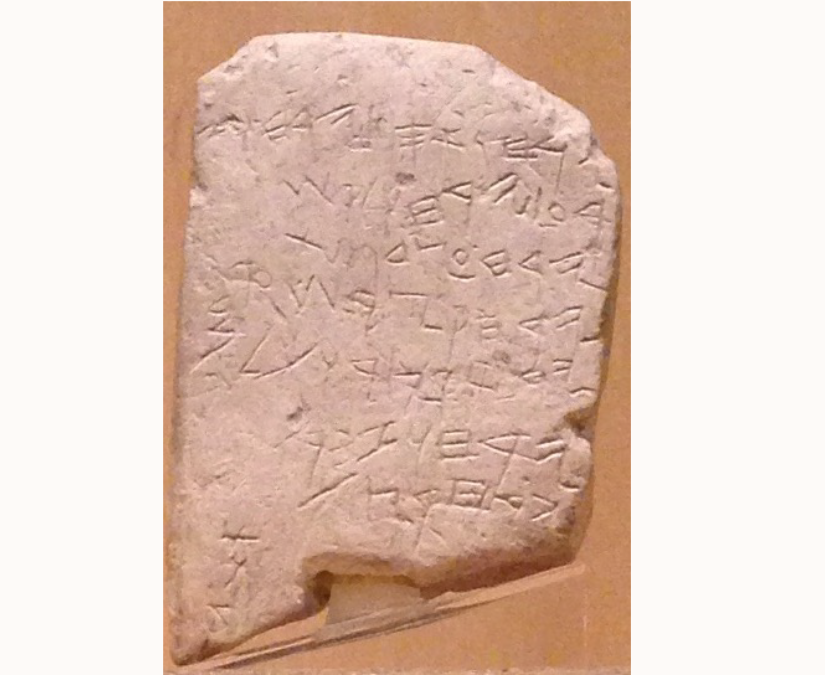
If these scholars believe in the Theory of Evolution in which no Intelligent Designer exists, then is their belief system influencing their interpretations? Mainstream scholarship says that the written Hebrew language was established around 1000 BCE, after the time of the Prophet Moshe (Moses). They say the oldest artifact with Hebrew writing is the Gezer Calendar, pictured to the left.
(Image Source: en.wikipedia.org Gezer calendar clos in the Istanbul Archaeology Museum.)
A tablet of soft limestone inscribed in a paleo-Hebrew Offsite Link script, the Gezer Calendar Offsite Link is one of the oldest known examples of writing, dating to the 10th century BCE. It was discovered in excavations of the Biblical city of Gezer, 30 miles northwest of Jerusalem, by R.A.S. in his excavations between 1902 and 1907, and it is preserved in the Museum of the Ancient Orient in Istanbul.
“The calendar describes monthly or bi-monthly periods and attributes to each a duty such as harvest, planting or tending specific crops. https://www.historyofinformation.com/detail.php?id=1280#:~:text
The letters on this stone look a little different than the ones found at Serabit El-Khadim, the Egyptian turquoise mine. Here is this Alephbet in the paleo-Hebrew.
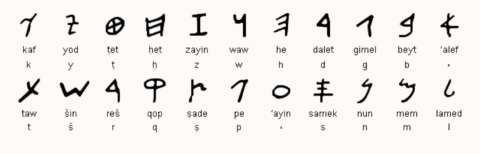
It is harder to see the pictures in this Alephbet. If this was the original writing of the Hebrews, then it would seem logical that the ancient Hebrew pictographic Alephbet labelled “Proto-Canaanite Script” could not be used to decipher words in the actual Hebrew writings.

If the “Proto-Canaanite Script” can be used to define words in the Hebrew writings then, perhaps it is not a “Canaanite” script but a “Hebrew” script as well. In our study titled, Intelligent Designers Communicate, we defined the names “Noach” and “Adam”. Let’s take a look at the word translated as “writing” in Shemoth (Exodus) 32:16. The three-lettered root of this Hebrew word is defined by The Ancient Hebrew Lexicon of the Bible as:
BTK ( common, כתב / k.t.b) Translation: WRITE (V) Definition: To inscribe a story, thoughts or instructions on in a variety of mediums including stone, papyrus, leather or parchment. KJV Translations: write, describe, subscribe, record Strong’s Hebrew #: h.3789 Strong’s Aramaic #: a.3790
This Hebrew word is “ketub” and has the letters “kaph, tav and beyt”. The letter “kaph” is a picture of an open palm. Here are the pictures associated with each letter.

This “kaph” is clearly a picture of a hand with five fingers. People use their hands to write. The next letter is the “tav” and it is a picture of two crossed sticks. It means “mark or signature”. Together, these letters mean “hand marks”. The letter “beyt” is a picture of a nomadic tent or house. This letter means “house or family” or “inside” as the family who lives “inside the tent”. Together, these letters mean “hand marks inside”.
This Hebrew word in the pictographic language definitely has a strong association with the concept of “writing”. People use their hands to make marks inside books. People use their hands to make marks inside scrolls. The ancient pictographic letters define the meaning of the Hebrew word. If these pictographic letters can be used to define Hebrew words in the context of the Hebrew writings attributed to Moshe (Moses), then it is highly likely these writings were originally written using these letters. If this is the case then the “Proto-Canaanite Script” is “Hebrew” which was likely a language spoken by the Canaanites as well.
The Hebrew word in Shemoth (Exodus) 32:16 has an additional letter added to the three-lettered root, “ketub”. The Ancient Hebrew Lexicon of the Bible defines “Miktab” the following way:
BTKM ( masc., מכתב / mikh-tav) Translation: THING.WRITTEN Definition: A composition that has been recorded by the written words. KJV Translations: writing Strong’s Hebrew #: h.4385
This Hebrew word implies that it is not just a note but an entire composition using written words. The additional letter “mah” or “mem” is a picture of water.

In this word, the letter “mah” means “mighty and powerful” like the sea. “Miktab” means “mighty hand marks inside”. This actually describes the Torah or the Law of Moshe (Moses) really well. It was so significant that Moshe placed it in the most set-part place in the Tabernacle inside the Ark of the Covenant.
And it came to pass, when Moshe had made an end of writing the words of this Law in a scroll, until they were finished, That Moshe commanded the Levites, which bare the ark of the covenant of Yahuah, saying, Take this Scroll of the Law, and put it in the side of the ark of the covenant of Yahuah your Elohiym, that it may be there for a witness against you.
The context of the document itself supports the definition of the Hebrew word based on the ancient Hebrew pictographic language found at Serabit El-Khadim. The same Hebrew word is also used in the following passages illustrating its preservation from the time of the Prophet Moshe (Moses) to the times of these men.
The writing [H4385] of Hezekiah king of Yahudah, when he had been sick, and was recovered of his sickness:
And prepare yourselves by the houses of your fathers, after your courses, according to the writing [H3791] of David king of Yashar’El, and according to the writing [H4385] of Solomon his son.
King Hezekiah, King David and King Solomon produced “mighty hand marks inside”. The same Hebrew word has been used appropriately in all passages illustrating an original ancient Hebrew pictographic language.
The writings of King David, King Solomon and King Hezekiah are classified as “Hebrew”. Therefore, the ancient pictographic language is also “Hebrew” because its definitions align with the definitions in the Hebrew language used by these powerful men. If the pictographic language was not originally used by Hebrews, then we should not be able to define Hebrew words using these pictures. However, this is not the case. We can use these pictographic letters over and over again. Each time they bring greater clarity to the original intended message recorded in the Hebrew writings. This evidence illustrates that the writings of Moshe (Moses) were originally written in the pictographic language found at Serabit El-Khadim. This evidence proves that a written language existed during the time of the Prophet Moshe.
The Hebrew word “ketub” is pronounced “kah-toob”. Most of the ancient writings were written on lambskin sewn together into a really long scroll. This scroll looks like a “tube” pictured below. This is related to our English word, “tube”. Etymonline provides the following definition:
1590s, in anatomy and zoology, “hollow organ or passage in the body;” by 1650s as “pipe or hollow cylinder,” especially a small one used as a conduit for liquids, from French tube (15c.), from Latin tubus “tube, pipe,” a word of unknown origin. https://www.etymonline.com/word/tube

“Tubes” are hollow cylinders just like a scroll. When a scroll is rolled up, it creates a hollow center. We can see the influence of this ancient Hebrew pictographic word in the English, French and Latin languages.

If the Intelligent Designer documented in the Hebrew writings is our Creator and Father, we would expect to see the influence of His original language upon the languages of the world even to this day. The Sumerian language died long ago. We do not see its influence upon languages today. But we do see the influence of the original Hebrew language upon our languages today. This is hard, reliable evidence. The Prophet Moshe would have written his document on the inside of scrolls made of lambskins which is still a practice done to this very day. Is this a coincidence? Let’s review the evidence:
- BTKM means “mighty hand marks inside”. We can see this evidence for ourselves.
- The Hebrew document written by the Prophet Moshe (Moses) says that he wrote the entire document himself and placed it on the inside of the Ark of the Covenant.
- The Theory of Evolution is impossible meaning that an Intelligent Designer created us.
- Our Intelligent Designer is “intelligent” far beyond our own capabilities in this day and age, evidenced by the miracle of the human body.
- Our Intelligent Designer would have His own language, spoken and written.
- Our Intelligent Designer would create mankind to speak and write His language so they could communicate with one another. We have provided evidence that Yahuah Elohiym had a conversation with Adam and Chavah (Eve) in the very beginning meaning that they understood one another’s speech.
- Adam passed this spoken and written language down to his sons. There would not be any other languages at this time.
- Noach (Noah) was the tenth generation from Adam. He would have spoken the same language as Adam which is the same language as our Creator.
- “Adam” and “Noach” are Hebrew names. Their meanings can be determined using the ancient Hebrew pictographic language found at Serabit El-Khadim, an ancient Egyptian turquoise mine.
- Noach had a conversation with Yahuah Elohiym in Bereshith (Genesis) 6:13-22. He understood Yahuah’s instructions to build an Ark and completed the project.
- Noach (Noah) and his family survived the flood. They taught their spoken and written language to their sons and daughters who did the same thing to their sons and daughters.
- The languages were confounded at the Tower of Babel. However, the spoken and written language of Yahuah Elohiym was preserved in the Hebrews because testimony documents Abraham having a conversation with our Father. This is documented in Bereshith (Genesis) 15:1-21.
- Moshe (Moses) is a descendant of Abraham and a Hebrew. There are several passages illustrating that Moshe and Yahuah had conversations and understood one another’s speech. Here is one:
With him will I speak mouth to mouth, even apparently, and not in dark speeches; and the similitude of Yahuah shall he behold: wherefore then why were you not afraid to speak against my servant Moshe?
- There are inscriptions found at Serabit El-Khadim referring to “Moshe” specifically written in the ancient Hebrew pictographic language. These are dated to 1446 BCE which is around the time of the Prophet Moshe.
- Testimony says the Prophet Moshe (Moses) wrote the documents attributed to him in the text itself. The spoken and written language of Yahuah was handed down to him through his fathers. His “hand marked the inside” of a scroll made from lambskins which looks like a “tube” when rolled up. This particular document was massive or mighty which is true to this day.
- We have defined several words using the ancient Hebrew pictographic language. Those definitions match the context of the passages in which they occur. This is the same ancient Hebrew pictographic script found at Serabit El-Khadim.
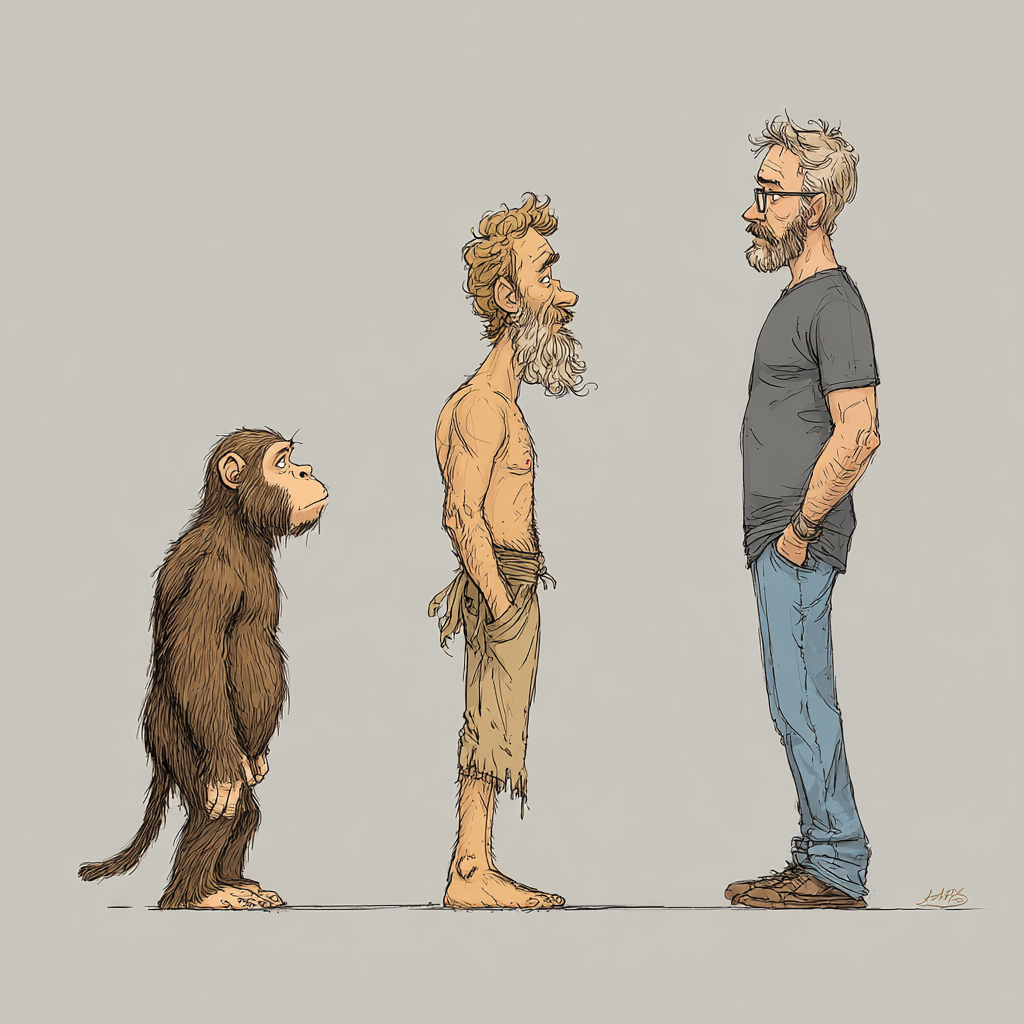
This is the evidence and it contradicts the conclusions of scholars. People who believe in the Theory of Evolution believe mankind evolved from a primitive caveman state. Language is highly complex and would have “evolved” over time from this perspective. The spoken language would eventually “evolve” into a written language.
From this point of view, the evidence that they are willing to accept says that the written Hebrew language “evolved” in 1000 BCE which is around the time of King David. This is 300-400 years after the Prophet Moshe (Moses). According to the perspective of these scholars, Moshe could not have possibly written the writings attributed to him. This means the text itself written by Moshe is dishonest and can’t be trusted. This view undermines the integrity of the writings themselves. This would be a typical response from someone who has placed blind faith in the Theory of Evolution.
Perhaps, it is the scholars that cannot be trusted???
The Documentary Hypothesis recognizes differences in writing styles within the Torah or Law of Moshe (Moses) itself. For this reason, they believe these documents were written over a period of time by different authors. Here is an excerpt about this perspective taken from Wikipedia:
The rise of historical criticism in the 19th century led scholars to conclude that multiple authors wrote the Pentateuch over a long period. By the mid-20th century, the documentary hypothesis had gained nearly universal consensus among scholars.[50] According to the documentary hypothesis, the Pentateuch was created by combining four originally independent documents. The Jahwist source (c. 10th – c. 9th century BCE) and the Elohist source (c. 8th century BCE) were the first to be combined into one document. In the 7th century BCE, the Deuteronomist produced Deuteronomy, which was later added to the combined document. In the post-exilic period, the Pentateuch reached its final form with the addition of the Priestly source (c. 5th century BCE).[51][52]
The consensus around the documentary hypothesis began to break down in the 1970s,[50] and this approach has since seen various revisions.[53] While the identification of distinctive Deuteronomistic and Priestly theologies and vocabularies remains widespread, they are used to form new approaches suggesting that the books were combined gradually over time by the slow accumulation of “fragments” of text, or that a basic text was “supplemented” by later authors/editors.[54] At the same time there has been a tendency to bring the origins of the Pentateuch further forward in time, and the most recent proposals place it in 5th century BCE Judah under the Persian empire.[55]
Modern scholarship recognizes that biblical texts typically emerged through complex processes involving multiple unknown authors, editors, and redactors working across centuries, rather than single-author composition. These anonymous scribes and compilers, distinct from the traditionally attributed prophets and figures like Moses, Isaiah, or David, worked to combine earlier sources, add editorial layers, and facilitate communal transmission, with most books showing evidence of this collaborative process rather than composition by the famous biblical personalities to whom they are traditionally ascribed. https://en.wikipedia.org/wiki/Authorship_of_the_Bible
Could there be another explanation to the different writing styles observed in these documents? Perhaps Moshe (Moses) truly was a powerful leader over thousands and thousands of people like the President of the United States of America. He likely had various scribes over the forty-year time period wandering in the wilderness who documented different sections at different times. Different people have different writing styles. Perhaps a scribe from the House of Levi wrote Vayikra (Leviticus). Perhaps a scribe from the House of Ephrayim wrote Debarim (Deuteronomy). The President of the United States does not personally write his executive orders. He has a writer compose them per his instructions and then he signs them. When a boss dictates a letter to his secretary, who is the author of the letter: the boss or the secretary? We have evidence that this was a practice during the time of the Prophet Yirmeyahu (Jeremiah).
Then, Yirmeyahu called Baruch the son of Neriah: and Baruch wrote from the mouth of Yirmeyahu all the words of Yahuah, which he had spoken unto him, upon a roll of a book.
Perhaps Moshe (Moses), King David and Yeshayahu (Isaiah) did the same thing with their writings? Many people died in the wilderness wanderings. Perhaps the scribe Moshe was using at the time died and a new one had to replace him who had a different writing style? Then he died and was replaced by another scribe. This is an explanation and interpretation that aligns with the evidence presented.
People who believe the Theory of Evolution want to validate their beliefs. They would do this by undermining other explanations for the origin of life. The scholars who promote the Documentary Hypothesis are influenced by their own belief system. Their conclusions will support their belief system which undermines belief systems contrary to their beliefs. Because these scholars base their conclusions on their belief system and not evidence, their testimony is not credible.
If our Intelligent Designer speaks, He is using words. If He is using words then He is using sounds. If He is using sounds, there must be a distinction between one sound and another. If there are distinct sounds, then there must be a character assigned to that sound. For example, in the English language, the “B” sound is assigned to the character letter “B”. The sounds heard in words spoken are a combination of these characters in a particular order. This produces a language which can also be written down. If Yahuah is speaking with His mouth and the receiver is understanding His message, then our Creator has a language, an Alephbet and vocabulary. Testimony does say that Yahuah has a written language.
And the tables were the work of Elohiym, and the writing was the writing of Elohiym, graven upon the tables.
Yahuah wrote the Ten Messages (commandments) engraved on stone in His Language. This is evidence that He has a system of writing as well as a language that can be spoken. He is a very intelligent Being. We would expect His Language to be complex and superior to other languages. We have illustrated that evidence trumps scholarship but shouldn’t true scholarship be based upon solid reliable evidence? If these scholars are promoting a belief system rather than facts based on evidence; then, in reality, they are priests and priestesses of a religious belief system built on the mythology of Evolution and not true scholars, scientists and experts. Here is an illustration:
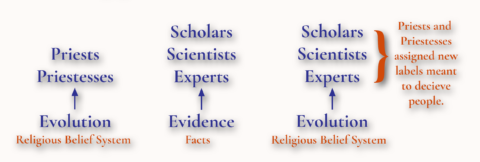
We define scholars, scientists and experts as people who base their conclusions upon solid, reliable evidence. But we have illustrated that this is not the case. Their conclusions are based on their religious belief system called the Theory of Evolution which is not statistically possible. This is a fact. They are promoting a belief system that isn’t true using labels meant to instill confidence in their opinions. This is deception. It is our responsibility to hold these men and women accountable and demand to see the evidence that supports their conclusions. We must ask questions rather than blindly accept their opinion because they have been labelled an “expert”. We also must learn to trust the evidence we can see with our own eyes and hear with our own ears.
Download this Article here