
111-7 Hebrew’s Inherited His Language
And there came one that had escaped, and told Abram the Hebrew; for he dwelt in the plain of Mamre the Amorite, brother of Eshcol, and brother of Aner: and these were confederate with Abram.
If an Intelligent Designer divided the nations by language, we would expect Him to preserve His Language in one of the families of the earth. The family chosen by the Intelligent Designer of the Hebrews was the line of “Eber”. We would expect to see evidence linking the Hebrew people with the Language of Yahuah Elohiym. We have already seen evidence of these links in the modern-day English language. “Eber” is linked to “Over” in spelling and definition.
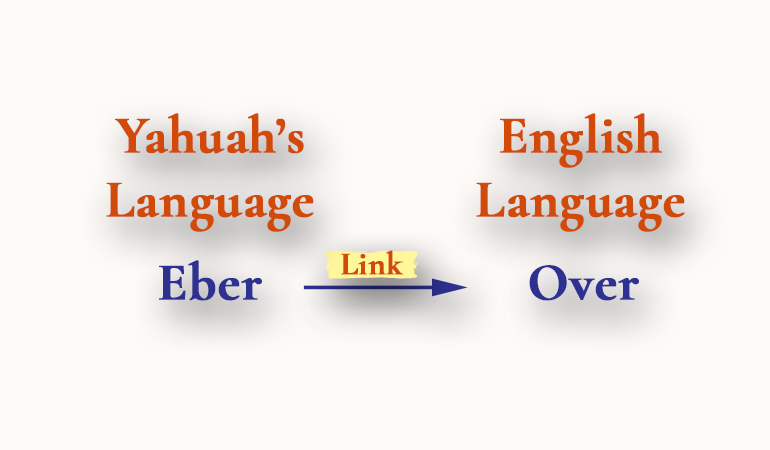
This is undeniable evidence. We can see this for ourselves with our own eyes. The English language has been directly influenced by the Language of Yahuah Elohiym.
“Eber” is a term used to describe “Abram” before he became “Abraham”. This passage is telling us that he was a descendant of “Eber”, the father of the Hebrews. This incident occurred after the languages were confused.
And there came one that had escaped, and told Abram the Hebrew; for he dwelt in the plain of Mamre the Amorite, brother of Eshcol, and brother of Aner: and these were confederate with Abram.
The underlying Hebrew in this passage does not necessarily phonetically translate this as “Hebrew”. The letter “hey” colored in black is a prefix meaning “the”. This is better translated as “Abram the Ebriy” which is the plural form of “Eber”. Here are both words in the modern and the ancient pictographic language.
העברי
YRB[H
“Hebrew” or “The Eber”
The letters highlighted in red are identical to the name, “Eber”. They also contain the letters, “ayin, beyt and resh” and in the same order. “Eber” is the beginning of the “Hebrews” as a people. Testimony says that Eber had two sons: Peleg and Yoqtan.
And unto Eber were born two sons: the name of one was Peleg; for in his days was the earth divided; and his brother’s name was Yoqtan.
In the days of Peleg, the earth was divided. This is likely a reference to the Tower of Babel when Yahuah confused the languages as described in the following passage.
And Yahuah came down to see the city and the tower, which the children of men were building. And Yahuah said, Behold, the people are one, and they have all one language; and this they begin to do: and now nothing will be restrained from them, which they have imagined to do. Go to, let us go down, and there confound their language, that they may not understand one another’s speech. So, Yahuah scattered them abroad from there upon the face of all the earth: and they stopped to build the city.
People at this time were speaking the same language which was the Language of Eden. Yahuah confounded the languages and divided them so they could not understand one another. The Hebrews retained the Language spoken in Eden.
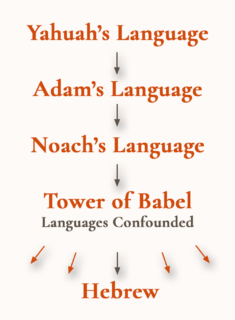
The first name in the Word of Yahuah that is NOT of Hebrew origin is “Nimrod” according to scholars. Concordances, lexicons and dictionaries claim this name is likely of foreign origin. Nimrod came from the line of Cham (Ham) and is not from the line of Eber. Therefore, he is not a “Hebrew”
And Cush begat Nimrod: he began to be a mighty one in the earth. He was a mighty hunter before Yahuah: wherefore it is said, Even as Nimrod the mighty hunter before Yahuah. And the beginning of his kingdom was Babel, and Erech, and Accad, and Calneh, in the land of Shinar.

Nimrod is the founder of Babel where the languages were divided. His name provides evidence that new languages had formed at this time. However, evidence illustrates that the Language of Eden was retained through the line of Eber and Abraham specifically. We also have evidence that Abram who was later called Abraham communicated with Yahuah.
Now Yahuah had said unto Abram, You get out of your country, and from your kindred, and from your father’s house, unto a land that I will show you: And I will make of you a great nation, and I will bless you, and make your name great; and you shall be a blessing: And I will bless them that bless you, and curse him that curses you: and in you shall all families of the earth be blessed. So, Abram departed, as Yahuah had spoken unto him; and Lot went with him: and Abram was seventy and five years old when he departed out of Haran.
The names “Abram” and “Abraham” are of Hebrew origin which also illustrates that the language of Eden was preserved through Abraham, the Hebrew. Spoken and written languages were handed down from father to son all the way to the Prophet Moshe and the House of Yashar’El during the time of the first exodus. Testimony illustrates that Yahuah and the Prophet Moshe understood one another’s speech.
And when Yahuah saw that he turned aside to see, Elohiym called unto him out of the midst of the bush, and said, Moshe, Moshe. And he said, Here am I. And he said, Draw not near here: put off your shoes from off your feet, for the place whereon you stand is set-apart ground.
They were able to communicate and understand one another. They were speaking the same language and had the same vocabulary. The House of Yashar’El also heard Yahuah speaking from the mountain. They understood His speech which means they also spoke the same language as Yahuah.
And all the people saw the thunderings, and the lightnings, and the noise of the trumpet, and the mountain smoking: and when the people saw it, they removed, and stood afar off. And they said unto Moshe, You speak with us, and we will hear: but let do not Elohiym speak with us, lest we die.
Yahuah spoke the Ten Messages (Commandments) with His own Voice and in His own Language because He knew the people would understand Him. We have an example illustrating that Yahuah interacts with people using His own language. In the following passage, a Hand appeared and wrote a message on the wall.
In the same hour came forth fingers of a man’s hand, and wrote over against the candlestick upon the plaster of the wall of the king’s palace: and the king saw the part of the hand that wrote. Then the king’s countenance was changed, and his thoughts troubled him, so that the joints of his loins were loosed, and his knees smote one against another. The king cried aloud to bring in the astrologers, the Chaldeans, and the soothsayers. And the king spoke, and said to the wise men of Babylon, Whosoever, shall read this writing, and shew me the interpretation thereof, shall be clothed with scarlet, and have a chain of gold about his neck, and shall be the third ruler in the kingdom. Then came in all the king’s wise men: but they could not read the writing, nor make known to the king the interpretation thereof.
This “Hand” came from Someone, somewhere. It wrote on a stone wall which is similar to the writing on the stone tablets during the time of the Prophet Moshe (Moses). In this situation, the King of Babylon and all of his wise men could not read the writing or interpret it. They spoke a different language than our Creator. They had a different vocabulary than our Creator. Yahuah did not write the message in the language of the King. Yahuah wrote the message in His Language. The Prophet Dani’El was a Hebrew. He was the only one who could read the writing and interpret the message:
Then was Dani’El brought in before the king. And the king spoke and said unto Dani’El, Are you that Dani’El, which are of the children of the captivity of Yahudah, whom the king my father brought out of Jewry? I have even heard of you, that the spirit of the elohiym is in you, and that light and understanding and excellent wisdom is found in you. And now the wise men, the astrologers, have been brought in before me, that they should read this writing, and make known unto me the interpretation thereof: but they could not show the interpretation of the thing: And I have heard of you, that you can make interpretations, and dissolve doubts: now if you can read the writing, and make known to me the interpretation thereof, you shall be clothed with scarlet, and have a chain of gold about your neck, and shall be the third ruler in the kingdom. Then Dani’El answered and said before the king, Let your gifts be to yourself, and give your rewards to another; yet I will read the writing unto the king, and make known to him the interpretation.
Dani’El was a Hebrew. He had learned the Language of Yahuah and was able to read the writing on the wall. He understood Yahuah’s Vocabulary and was able to interpret the message for the King. It was a message from Yahuah to the King of Babylon, but Yahuah did not write the message in the King’s language.
Let’s consider this situation using a modern-day example. If we approach a King from another country in his court, we cannot expect him to speak using our language. We bring an interpreter that can communicate our message to the King in his own language. Likewise, Yahuah Elohiym is King over Heaven and Earth. He is not subservient to the King of Babylon. Yahuah is not subservient to us. We are subservient to Him. We cannot expect Him to know and speak our language. He probably does but we cannot place this expectation upon Him.
Most of our languages today are impure and corrupted. How can the Most Set-Apart Creator of the Universe, Yahuah Elohiym, allow an impure and corrupted language to be uttered with His lips? It is highly unlikely. If we want to communicate with Yahuah, it is best if we learn His Language. Prophecy does say that Yahuah will restore a pure language in the earth so that people may call upon Him:
For then will I turn to the people a pure language, that they may all call upon the name of Yahuah, to serve him with one consent.
Which language is Yahuah Elohiym going to restore to His people?
He will use His own Language, which has a distinct Alephbet that occurs in a particular order. He has His own Vocabulary, defining His Words from His Perspective. His Language originated in the Garden of Eden for mankind in the very beginning. His Language is the Language of Eden and was in use before any Hebrews came into existence. The Hebrews inherited the Language of Yahuah and it has been handed down through-out the generations.
Evidence in Historical Geography:
We have further evidence of “Hebrews” or “Ebers” in Geography. In Spain, there is a river called the “Ebro” which exists to this day. “Ebro” is phonetically similar to the name “Eber”. Here is a map of the rivers in Spain. The river “Ebro” is in the north. We have placed the words side-by-side to show their similarities.
Ebro
Eber
These words are closely related to one another as illustrated. Spain and Portugal also used to be called the “Iberian Peninsula”. Here is a map illustrating this:
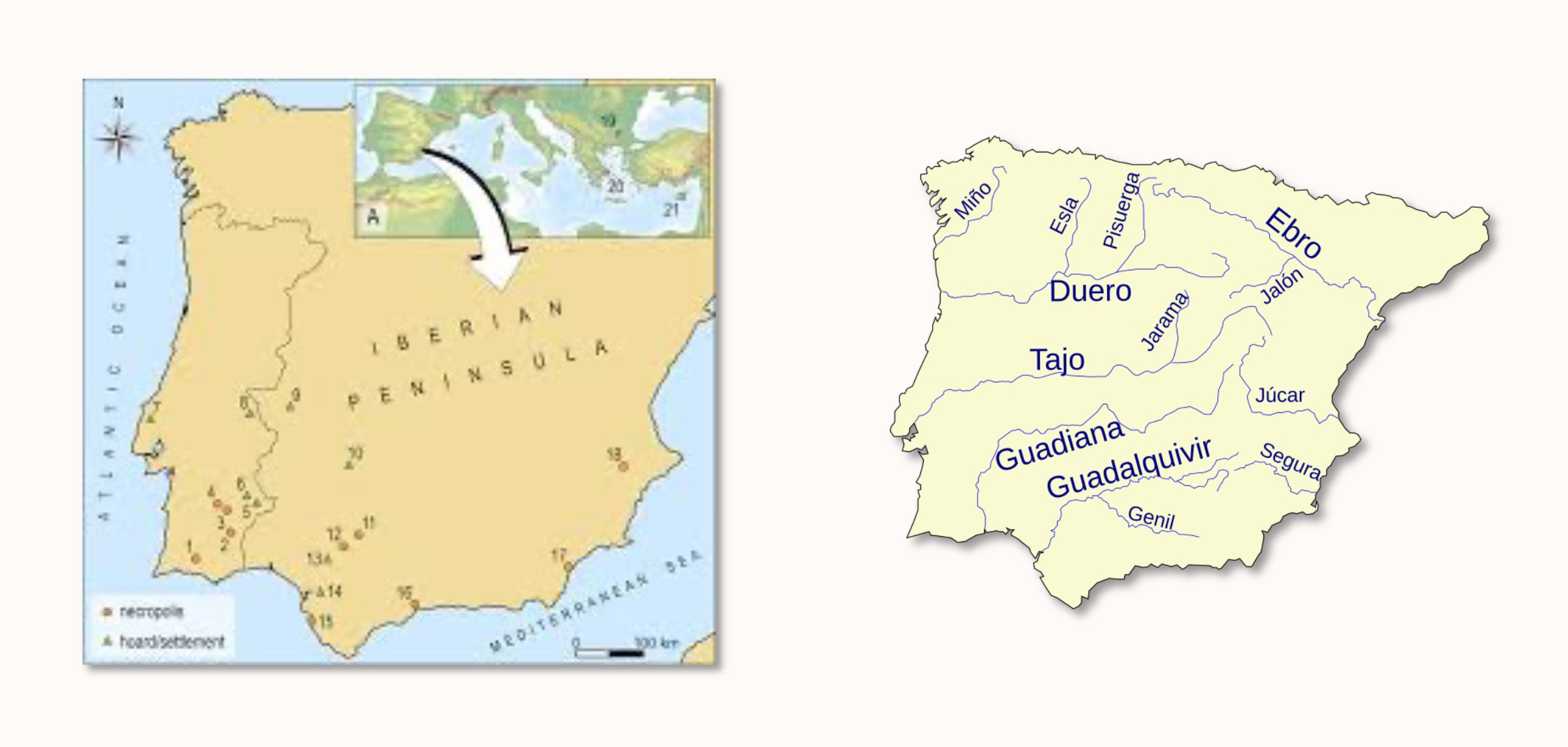
The base word “Iber” and “Eber” are also very close phonetically. Here they are side-by-side:
Iberian
Eber
Ebro
All three of these words are also closely related to one another. This land is “beyond” the land of promise. It is on the other side. Hebrews “crossed-over” to this land from the land given to Yashar’El.
Testimony does say the ten lost tribes had moved to the north of the land of Yashar’El.
Go and proclaim these words toward the north, and say, Return, you backsliding Yashar’El, says Yahuah; and I will not cause my anger to fall upon you: for I am merciful, says Yahuah, and I will not keep anger forever.
The Iberian Peninsula is north of the land of Yashar’El. There is also an area in Asia that was also called “Iberia” which is also north from the land. Here is a map of the region found at the following link https://en.wikipedia.org/wiki/Kingdom_of_Iberia:
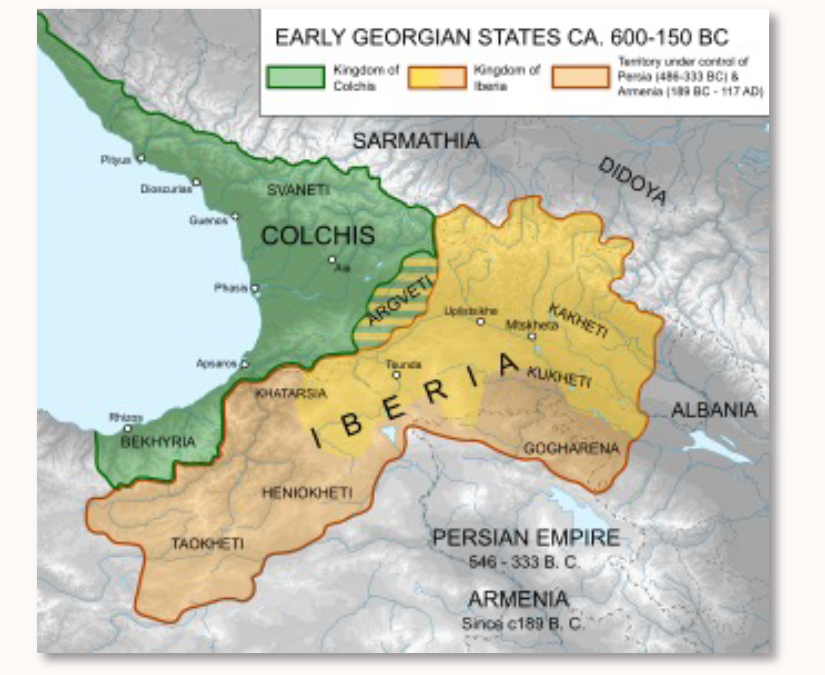
The prophet Yirmeyahu (Jeremiah) prophesied to the north where most of the House of Yashar’El had migrated before the Assyrian captivity. We see evidence of the name, “Eber” present in the names, “Ebro” and “Iberia”. Testimony from the Assyrian records state they carried away 27,290 people.
This number includes men, women and children. If we divide this number by a family of four. We get 6,822 men. Just nine years earlier, the House of Yashar’El slew 120,000 men from the tribe of Yahudah in one day and carried away 200,000 captives. It is highly unlikely that this could be accomplished by 6,822 men. Here is the testimony:
Wherefore Yahuah his Elohiym delivered him into the hand of the king of Syria; and they smote him, and carried away a great multitude of them captives, and brought them to Damascus. And he was also delivered into the hand of the king of Israel, who smote him with a great slaughter. For Pekah the son of Remaliah slew in Yahudah a hundred and twenty thousand in one day, which were all valiant men; because they had forsaken Yahuah Elohiym of their fathers. And Zichri, a mighty man of Ephraim, slew Maaseiah the king’s son, and Azrikam the governor of the house, and Elkanah that was next to the king. And the children of Yashar’El carried away captive of their brethren two hundred thousand, women, sons, and daughters, and took away much spoil from them, and brought the spoil to Samaria.
It is apparent that many families from the House of Yashar’El migrated north out of the land before the Assyrian invasion. They knew the Assyrians would eventually conquer their territory and that they were a fierce army. It seems like a prudent thing to do to protect one’s own family. We have further evidence that land had become vacant prior to the final Assyrian captivity, when the lions were attacking those who had been sent there to resettle the area.
And so, it was at the beginning of their dwelling there, that they feared not Yahuah: therefore, Yahuah sent lions among them, which slew some of them. Wherefore they spoke to the king of Assyria, saying, The nations which you have removed, and placed in the cities of Samaria, know not the manner of the Elohiym of the land: therefore, he has sent lions among them, and, behold, they slay them, because they know not the manner of the Elohiym of the land.
The presence of the lions is evidence that the land had been vacated by people. This is also confirmed in the following testimony:
I will not drive them out from before you in one year; unless the land becomes desolate, and the beast of the field multiply against you. By little and little I will drive them out from before you, until you be increased, and inherit the land.
If there are no people, the wild animals are not kept at bay. They would multiply and overtake the land. This is evidence that many people from the Northern Kingdom of Yashar’El migrated out of the land before the final Assyrian conquest in 722 BCE (Before Common Era).
The Hebrews named places and things using their language where they settled. Here is another example of Hebrew influence. The word “Brit-ish” is a compound word based on two Hebrew words: Bryt and Ish. Together, they mean “covenant man” in Hebrew. Here are both words in the ancient Hebrew pictographic language:
YITRB
Bryt (Covenant)
FYA
Ish (Man)
This would lead us to believe that the Brit-ish and their descendants are “Hebrews”. They are descendants of the patriarch, Eber and most likely descendants of the ten lost tribes from the Northern Kingdom of Yashar’El. Languages are transferred from father to son throughout every generation. These examples provide evidence of the Hebrew language being preserved by Hebrews.
Evidence from the Time of Yahusha (Jesus):
Ya’akob (James), the brother of Yahusha (Jesus), wrote a letter in the Greek writings. Ya’akob addressed his letter “to the twelve tribes that are scattered abroad”.
Ya’akob, a servant of Elohiym and of the Adonai Messiah Yahusha, to the twelve tribes which are scattered abroad, greeting.
From his perspective, the twelve tribes were known by the followers of Yahusha. Messiah Yahusha also says that he came for the “lost sheep of the House of Yashar’El”.
But he answered and said, I am not sent but unto the lost sheep of the House of Yashar’El.
During his ministry, Messiah Yahusha primarily stayed in Northern Yashar’El. He did not travel below Yerushalayim (Jerusalem) because that was Edomite territory. The Edomites were the offspring of Esau, the brother of Ya’akob (Jacob). However, Yahusha sent Shaul of Tarsus (Paul) to complete the mission he had started. Here are the words of Messiah given to Ananias regarding Shaul of Tarsus:
But Adonai [Yahusha] said unto him, Go your way: for he is a chosen vessel unto me, to bear my name before the Gentiles, and kings, and the children of Yashar’El: For I will shew him how great things he must suffer for my name’s sake.
Shaul of Tarsus was sent to the children of Yashar’El. Here is a map showing the journeys of Shaul of Tarsus (Paul). He constantly traveled north and west into areas known as Asia and Europe today which is where the lost ten tribes of Yashar’El migrated. Here is a map of his journeys.
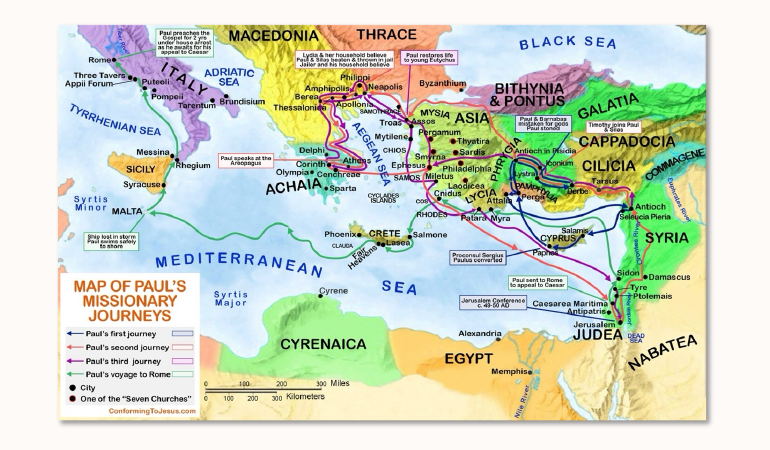
He did not go anywhere south of Yerushalayim (Jerusalem) either. He went north where Yirmeyahu (Jeremiah) prophesied to the House of Yashar’El. This is evidence showing the migration of the Northern Kingdom of Yashar’El to Asia and Europe. Much more evidence has been documented by Steven Collins in his book, The “Lost” Ten Tribes of Israel Found! He has listed his references in the back of his book which allows people to do their own research and observe the evidence for themselves. It is a dense book full of evidence.
We have demonstrated a common thread from the patriarch, Eber, to the ministry of Shaul of Tarsus (Paul). This is evidence that cannot be refuted. This shows a link from the original ancient Hebrew pictographic language to the Hebrew people and their migration patterns in the earth.
Download this Article here