111-3 “Language” Defined
And the whole earth was of one language, and of one speech.

When we hear the word “language,” we think of a system of words composed in a particular order spoken by a community of people who use language to communicate with one another. Some examples include English, French or Portuguese. When English speaking people hear people talking in French, the words are foreign to them.
They do not know the words they are speaking or their definitions. They don’t know the particular sentence order used by that language. This creates a barrier to communication.
French-speaking people cannot understand what English people are saying and the English-speaking people cannot understand what the French are saying. Thoughts, feelings, experiences and knowledge cannot be effectively communicated between someone who speaks English and someone who speaks French. Speaking different languages creates a barrier between them that makes it difficult to communicate with one another. Simply, “language” is verbal communication used to send messages between two or more individuals. So, when I think about language and an Intelligent Designer, I ask myself the following question:
Why would an Intelligent Designer create mankind
without the ability to communicate with Him or each other?
It is true that languages are complex systems but our Intelligent Designer is intelligent; He is far more intelligent than mankind. The same would be true of alien beings. Why would they create mankind without the ability to communicate with them? Do engineers create robots that speak a different language than the engineer themselves? They may program their robot to speak many different languages but one of them will be the engineers own language. He or she would want to communicate with their creation.
If our Intelligent Designer “programmed” us to speak and write His language, then we ought to be able to see evidence of this language’s influence upon all cultures whether it is the Father of the Hebrew people or aliens. The evidence will reveal His identity and we accomplish this through the study of language. In this study, we are going to define “language” and its components. This will lay a foundation for the remaining studies in this series.
The Oxford English Dictionary defines “language” the following way:
The system of spoken or written communication used by a particular country, people, community, etc., typically consisting of words used within a regular grammatical and syntactic structure; https://www.oed.com/dictionary/language_n?tl=true
This is a straight-forward definition of “language” that fits within the perceptions of most people in this day and age. Each language has a set of characters with an associated sound assigned to that character. This creates the “spoken” and “written” language. The character produces the written language and the sound produces the spoken form of the language. The English language calls this an “Alphabet”. In Hebrew, it is an “Alephbet”. These labels are very similar to one another. “Alpha” and “aleph” are the first letters in the Greek and Hebrew language respectively. “Bet” is the second letter in each of these languages. Each letter is a character written in a particular way with a sound attached to it. Here is the English alphabet using capital letters. The letters in red are the vowels and the letters in black are consonants.
A B C D E F G H I J K L M N O P Q R S T U V W X Y Z
These characters are combined with their associated sounds to form words which can be written and/or spoken. Here are two examples of three letters used to form two different words:
DOG GOD
These two words use the same exact letters but they occur in a different order. Definitions are assigned to each of these words and this is called a “vocabulary”. People in English-speaking communities know the definitions assigned to each of these words and are able to send messages back-and-forth between one another. The same is true in every other language.
Then, words are put together in a particular sequence to form a sentence which expresses a thought, idea, experience, or emotion. Each language uses a particular grammatical structure that is commonly understood by everyone who exists in that language group. For example, the following sentence in English does not make sense because it does not comply with the order of sentence structure common in the English language:
Over the dog fence the jumped.
The words are identifiable but the sentence is not, because it does not follow the grammatical order unique to the English language. Here is a sentence using the same exact words in a different order:
The dog jumped over the fence.
This sentence provides a much clearer picture in our mind because it is spoken and written in the order that is most familiar to us who speak English. The message is effectively communicated.
In the Hebrew language, the sentence structure is arranged differently. Here is a sentence in modern Hebrew. People who speak English cannot read these words unless they know the “Alephbet” in the Hebrew language and their associated sounds. We cannot hear the message being communicated by these words.
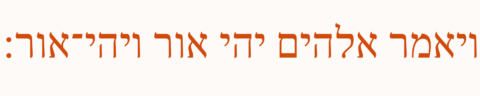
This sentence in its original order is literally translated the following way into the English language:
And He said, Mighty One, he was light and he be light.
This particular order does not make sense to us in the English language but it makes perfect sense to a person speaking Hebrew. In Hebrew, the action was stated first followed by the one doing the action.
- The phrase “And He said” is the action. A male figure is speaking or saying something.
- The phrase “Mighty One” is the one who is doing the speaking and He is a male because the action is being completed by a male.
Here is the difference in word order in Hebrew compared to English.
“And He said, Mighty One…” (Hebrew)
“And Elohiym said…” (English)
Instead of using the pronoun “He,” the subject who is speaking has been placed where that pronoun was in the Hebrew sentence. Here is an illustration showing how the Hebrew sentence order is changed to the English sentence order:
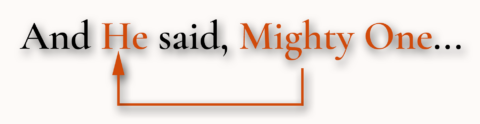
We know the Mighty One in this passage is a male because the verb form used in the Hebrew sentence uses a pronoun referring to a male. The verb is telling us that it is an action being completed by one male figure. Translators have to make this adjustment when translating Hebrew into English. The Hebrew sentence does not follow English grammatical structure when producing word order in their sentences. Translators choose the best English words for the underlying Hebrew words to convey the original intended meaning and they put the words in an order that English-speaking people can better understand. Youngs Literal Translation of the Bible preserves some of the original word order in the Hebrew.
and God saith, ‘Let light be;’ and light is.
Here is the same passage in the King James Version of the Bible:
And God said, Let there be light: and there was light.
The English word order makes more sense to English-speaking people and the Hebrew order makes more sense to Hebrew-speaking people. These are examples of grammatical characteristics in different “languages”. The following excerpt is a more detailed explanation of “language”.
Language, be it spoken, signed, or written, has specific components: a lexicon and grammar. Lexicon refers to the words of a given language. Thus, lexicon is a language’s vocabulary. Grammar refers to the set of rules that are used to convey meaning through the use of the lexicon (Fernández & Cairns, 2011). For instance, English grammar dictates that most verbs receive an “-ed” at the end to indicate past tense.
Words are formed by combining the various phonemes that make up the language. A phoneme (e.g., the sounds “ah” vs. “eh”) is a basic sound unit of a given language, and different languages have different sets of phonemes. Phonemes are combined to form morphemes, which are the smallest units of language that convey some type of meaning (e.g., “I” is both a phoneme and a morpheme). We use semantics and syntax to construct language. Semantics and syntax are part of a language’s grammar. Semantics refers to the process by which we derive meaning from morphemes and words. Syntax refers to the way words are organized into sentences (Chomsky, 1965; Fernández & Cairns, 2011).
We apply the rules of grammar to organize the lexicon in novel and creative ways, which allow us to communicate information about both concrete and abstract concepts. We can talk about our immediate and observable surroundings as well as the surface of unseen planets. We can share our innermost thoughts, our plans for the future, and debate the value of a college education. We can provide detailed instructions for cooking a meal, fixing a car, or building a fire. The flexibility that language provides to relay vastly different types of information is a property that makes language so distinct as a mode of communication among humans. https://pressbooks-dev.oer.hawaii.edu/psychology/chapter/language/
This explanation is technical but it serves to illustrate the complex nature of “language” unique to mankind. The author of this article says that a phoneme is a basic sound unit of a given language. Here is a simple example of phonemes:
- The letter “D” makes a “D” sound
- The letter “O” makes an “O” sound
- The letter “G” makes a “G” sound
Phonemes are combined to form morphemes. When we combine the D-O-G sounds together, we form the morpheme, “DOG”. Morphemes are words. If these same sounds are placed in a different order, it produces a different word with a completely different meaning as in G-O-D. They use the same letters but it forms a different word that communicates a different mental image in the mind of the English-speaking individual. The same is true in other languages.
Lexicons include the word as they appear using the characters in the original language’s alphabet. The lexicon defines the words as they are understood in the original language. For example, Hebrew lexicons list the words in the Hebrew language and defines them from a Hebrew perspective. Lexicons provide the vocabulary of the Hebrew language. The same is true of Greek lexicons. Let’s consider an example using the Hebrew language. Here is the sentence in the English with reference numbers from Strong’s Exhaustive Concordance of the Bible.
And the whole earth was of one language [H8193], and of one speech [H1697].
Here is the entry for the underlying Hebrew word translated as “language” from Biblehub.com:
saphah: Lip, language, edge, shore, bank
Original Word: שָׂפָה
Part of Speech: Noun Feminine
Transliteration: saphah
Pronunciation: sah-fah’
Phonetic Spelling: (saw-faw’)
KJV: band, bank, binding, border, brim, brink, edge, language, lip, prating, ((sea-))shore, side, speech, talk, (vain) words
NASB: lips, edge, speech, bank, brim, language, babbling
Word Origin: [probably from H5595 (סָפָה – swept away) or H8192 (שָׁפָה – bare) through the idea of termination]
1. the lip (as a natural boundary)
2. (by implication) language
3. (by analogy) a margin (of a vessel, water, cloth, etc.)
This lexicon provides the word using the Hebrew characters; it provides the pronunciation of the word; it shows how its commonly used grammatically; and it provides a definition for the word in the Hebrew language. Based on this definition, this word can be translated as band, bank, binding, border, brim, brink, edge, language, lip, prating, ((sea-)) shore, side, speech, talk, (vain) words. The general meaning of the word is the lip, language or margin.
Archeology has uncovered an ancient Hebrew script found on artifacts that use “pictures” for its characters. The top row is the modern Hebrew characters and the bottom row includes the ancient Hebrew pictographic letters discovered in Archaeology.

The Ancient Hebrew Lexicon of the Bible written by Jeff A. Benner defines Hebrew words using the ancient Hebrew pictographic language which can convey a different perspective than standard Hebrew lexicons used in research. Mr. Benner defines the Hebrew word translated as “language” the following way:
HPF ( fem., שפה / sa-phah ) Translation: LIP Definition: The rim or edge of the mouth or other opening. Language, as spoken from the lips. Alternate Translations: edge KJV Translations: lip, bank, brim, edge, language, speech, shore, brink, border, prating, vain Strong’s Hebrew #: h.8193
The picture of each letter is related to the meaning of the word. Mr. Benner provides the word as it appears in the ancient Hebrew pictographic language as well as the way it appears in the modern Hebrew. He provides a definition and the English words used to translate this Hebrew word. Each character in the word has an associated sound attached to it and a definition. This is uncharacteristic of any other language in the world.
- The letter “shin” or F has a “Sh” sound and sometimes “S” sound. It is a picture of two front teeth.
- The letter “pey” or P has a “P” or “F” sound. It is a picture of a mouth.
- The letter “hey” or H has the “aH” sound. It is a picture of a man with his arms raisedtrying to get someone’s attention.
Letters in the English language do not have definitions. Letters in the modern Hebrew do not have definitions. Letters in the Greek language do not have definitions. We cannot take meanings from the individual letters themselves and put them together to form a word that means something similar to the letters being used. However, this is possible in the ancient Hebrew pictographic language.
For example, the letter “pey” is a picture of a mouth (P) so we know that this word is related to the mouth or lips as Mr. Benner suggests in his definition. The lips form the edge of the mouth. When someone forms words, the lips turn in many different ways and shapes. This is how it is related to “language”. The banks of a river form the “edge” of the river like the lips form the edges of the mouth. Borders are “edges” of a country or property. The shore is the “edge” of the sea. This is how these terms are inter-related to one another and why this word can be translated many different ways. The Ancient Hebrew Lexicon of the Bible has pieced together the meanings of the Hebrew words used in the Word of our Father, from an ancient Hebrew mindset which is different than English-speaking or even modern Hebrew-speaking people.
Definitions assigned to words change over time through the influences of the community and immigration of peoples who use different languages and have different cultural practices. The same word thousands of years ago may have a different meaning than it does today. Translations into the English language may have based the definition of a Hebrew word on a lexicon that used definitions from a different period of time than when the Hebrew documents were originally written. This would result in a translation that does not thoroughly convey the original intended meaning of the message. For example, the Hebrew word for “language” in Bereshith 11:1 is the same Hebrew word translated as “shore” in the following passage with the same reference number in Strong’s Exhaustive Concordance of the Bible:
That in blessing I will bless you, and in multiplying I will multiply your seed as the stars of the heaven, and as the sand which is upon the sea shore [H8193]; and your seed shall possess the gate of his enemies;
Here are the Hebrew words side-by-side. The black letter in the first word is the letter “hey” and the black letter on the second word is the letter “tav”.
HPF
Saphah H8193 (language)
TPF
Saphat H8193 (shore)
In Hebrew, the letter “hey” on the end of a word will convert to the letter “tav” due to grammar rules in Hebrew. So, these are the same Hebrew words translated differently. In modern Hebrew, “saphah” means language or lip. However, the word used for seashore is “chof” in modern Hebrew. Language and definitions shift over time. We cannot necessarily completely rely upon the definitions of words in modern Hebrew to define words used by the Prophet Moshe (Moses) because they may not truly convey the original intended meaning of the message written.
The definition of “language” from a Hebrew perspective is much more simplistic than the definitions provided from modern-day examples. It is defined as “turning of the lips” according to Jeff A. Benner which is a true statement. We twist and contort our lips to produce different sounds to form words and sentences. This is a “concrete” definition characteristic of all ancient Hebrew words.
Another Hebrew word related to the modern concept of “language” is the word translated as “speech” in Bereshith (Genesis) 11:1. The Ancient Hebrew Lexicon of the Bible defines the underlying Hebrew word the following way.
RBD ( masc., דבר / da-var ) Translation: WORD Definition: An arrangement of words, ideas or concepts to form sentences. A promise in the sense of being “ones word.” An action in the sense of acting out an arrangement. A plague as an act. A matter or thing, as words also have substance in the Hebrew mind. Alternate Translations: matter; thing KJV Translations: word, thing, matter, act, chronicle, saying, commandment Strong’s Hebrew #: h.1697
The Hebrew word “debar” is an arrangement of words in a particular order that convey a message that can be understood by someone else. This is more in alignment with our English definition of “language” or “sentences”. In a previous example, we illustrated a sentence that said, “over the dog fence jumped”. The order of the words produced gibberish or babel in this sentence because it does not make sense. When we rearranged the order of the same exact words, it produced a different picture in our mind that was clear: “the dog jumped over the fence”. “Debar” is the process of placing words in a particular order that makes sense. Here is an example:
And he was there with Yahuah forty days and forty nights; he did neither eat bread, nor drink water. And he wrote upon the tables the words [H1697] of the covenant, the ten commandments [H1697].
“Debar” is used twice in this passage. It is translated as “words” and “commandments”. The Hebrew word typically translated as “commandment” is “mitzvot” and not “debar”. When we read the Ten Commandments in Shemoth (Exodus) 20:1-17, there are more than ten words in the Hebrew and the English and there are more than ten sentences. However, there are “ten” ideas or concepts conveyed in this passage in a carefully arranged order that communicates a message. “Debar” from an ancient Hebrew perspective is more than a single word based on the context of the passage in Shemoth (Exodus) 34:28. For example, the following passage is one of the “ten” ideas or concepts:
Remember the Shabbat day, to keep it set-apart. Six days shall you labor, and do all your work: But the seventh day is the Shabbat of Yahuah your Elohiym: in it you shall not do any work, you, nor your son, nor your daughter, your manservant, nor your maidservant, nor your cattle, nor your stranger that is within your gates: For in six days Yahuah made heaven and earth, the sea, and all that in them is, and rested the seventh day: wherefore Yahuah blessed the Shabbat day, and hallowed it.
There are 91 words and six sentences in this passage in the English language. In Hebrew, there are 54 words and four sentences. But all of these combined include one “debar”. This would almost be like a “paragraph” in the English language which is a group of sentences that convey one idea. The words in this paragraph were placed in an order that conveyed a message communicated to the people who lived during the time of the Prophet Moshe (Moses). The Ten Commandments are technically not commandments from a Hebrew perspective. They are “Ten Messages” or “Ten Complete Ideas” or Ten Concepts”. They are not technically speaking, “Ten Commandments” because the underlying Hebrew word is “debar” and not “mitzvot”.
In summary, “languages” are sounds produced by the lips turning in different ways and in specific sequences to produce words with a common definition understood by the one speaking and the one listening. “DOG” and “GOD” use the same letters but occur in a different order. The speaker and the listener must have an understanding of the definitions of both words in order to comprehend the message being spoken. People who speak different languages have a barrier between them that makes it difficult to communicate with one another. If an English-speaking individual asks a French-speaking individual to pick-up sugar at the store, the Frenchman cannot comprehend the message and will not pick-up sugar at the store for the Englishman. There is a barrier between them.
Like our article titled, The Value of Statistics, it is important to establish concepts before using them to prove a point. We are going to use language to determine the identity of our Intelligent Designer. So, it is necessary for us to lay a foundation for understanding important principles and concepts.
Download this Article here