111-6 What is a “Hebrew”?
The children of Shem; Elam, and Asshur, and Arphaxad, and Lud, and Aram. And the children of Aram; Uz, and Hul, and Gether, and Mash. And Arphaxad begat Salah; and Salah begat Eber.
In this series of studies, we are using language to identify our Intelligent Designer. We are using the Intelligent Designer of the Hebrew people to illustrate HOW the language of an Intelligent Designer can be observed among cultures from the very beginning to the present day. We have shown a link between the languages of Yahuah, Adam, Noach (Noah), Abraham and Moshe (Moses) by showing evidence that Yahuah has effectively communicated with each one. We are also using the ancient Hebrew pictographic language to decipher meanings of words in the Hebrew texts of Bibles and Tanakhs. We have accomplished this in three essential steps:
- We determine the meanings of the individual letters themselves found in the Hebrew word.
- We combine those definitions to determine the overall meaning of the word;
- We validate and verify the definition within the context of the Hebrew writings.
This evidence proves that the Hebrew writings of Moshe (Moses) were written in the ancient Hebrew pictographic language originally and that the Hebrew language itself came from this Alephbet. We have provided evidence that this language written and spoken existed at the time of the Prophet Moshe (Moses) from evidence found at the Serabit El-Khadim Egyptian mining site.
Technically, Yahuah is not a “Hebrew” so His Language could not really be called “Hebrew”. His Language is spoken and written BY the Hebrew people. It was preserved in their lineages. In this study, we are going to show a common thread related to the Language of the Intelligent Designer of the Hebrew people using reliable, credible evidence by defining the word “Hebrew” itself.
Yahuah created Adam to speak His Language. Adam and Chavah (Eve) taught this language to their offspring and their sons and daughters taught it to their offspring. Ten generations later, Noach (Noah) was born. He was also taught the Language of our Creator. In this testimony, Yahuah is giving instructions to Noach.
And Elohiym said unto Noach, The end of all flesh is come before me; for the earth is filled with violence through them; and, behold, I will destroy them with the earth. Make you an ark of gopher wood; rooms shall you make in the ark, and shall pitch it within and without with pitch. And this is the fashion which you shall make it of: The length of the ark shall be three hundred cubits, the breadth of it fifty cubits, and the height of it thirty cubits. A window shall you make to the ark, and in a cubit shall you finish it above; and the door of the ark shall you set in the side thereof; with lower, second, and third stories shall you make it. And, behold, I, even I, do bring a flood of waters upon the earth, to destroy all flesh, wherein is the breath of life, from under heaven; and everything that is in the earth shall die. But with you will I establish my covenant; and you shall come into the ark, you, and your sons, and your wife, and your sons’ wives with you. And of every living thing of all flesh, two of every sort shall you bring into the ark, to keep them alive with you; they shall be male and female. Of fowls after their kind, and of cattle after their kind, of every creeping thing of the earth after his kind, two of every sort shall come unto thee, to keep them alive. And take you unto you of all food that is eaten, and you shall gather it to you; and it shall be for food for you, and for them. Thus did Noach; according to all that Elohiym commanded him, so did he.
Noach (Noah) heard and understood the instructions given by Yahuah because he did exactly what he was instructed to do. He understood Yahuah’s language. Noach taught his sons to speak, read and write in this language. Then, they taught their sons and so forth. Testimony says that Shem, the son of Noach (Noah), begat Arphaxad who begat Salah who begat Eber, the father of the Hebrew people.
The children of Shem; Elam, and Asshur, and Arphaxad, and Lud, and Aram. And the children of Aram; Uz, and Hul, and Gether, and Mash. And Arphaxad begat Salah; and Salah begat Eber [H5677].
“Eber” is the root of the word, “Hebrew”. Following is the name “Eber” as it appears in the above passage in modern Hebrew as well as the ancient pictographic Hebrew language. We have included the corresponding English letters from the name “Eber”. They appear backwards because Hebrew is read from right to left.
עבר
RB[
RBE
We are going to define this word using the ancient Hebrew pictographic language and verify it with the context of passages in which it occurs. The Hebrew word, “Eber” includes the letters “ayin, bet and resh” in that order. “Jeff Benner does not define names specifically in The Ancient Hebrew Lexicon of the Bible but he does define the roots that form them. The three-lettered root that forms the name, “Eber” is defined the following way:
RB[ ( masc., עבר / ey-ver ) Translation: OTHER.SIDE Definition: As being across from this side. Edenics: over; ford – with the exchange of the f and b; ferry KJV Translations: over, pass, through, go, away Strong’s Hebrew #: h.5676
RB[ ( common, עבר / ah.b.r ) Translation: CROSS.OVER (V) Definition: To pass from one side to the other; to go across a river or through a land; to transgress in the sense of crossing over. KJV Translations: over, pass, through, go, away Strong’s Hebrew #: h.5668, h.5674 Strong’s Aramaic #: a.5675
RB[ עבר Definition: The crossing over or passing through a land or water to gain access to the side beyond. Relationship to Parent: filling a land

All of these are the same word. There are three different reference numbers in Strong’s Exhaustive Concordance of the Bible for this same word: H5674 and H5676. “Eber” describes someone who has crossed-over to the other side. Most Hebrew words are based on a two-lettered root.
All words that come from that root are related in meaning because they use the same “pictures” to define them. The two-lettered root of this word is defined by The Ancient Hebrew Lexicon of the Bible written by Jeff A. Benner as:
RB ( masc., בר / bar) Translation: GRAIN Definition: A seed or fruit of a cereal grass. The grain and the field as a place for growing grain. Relationship to Root: Grains grown in fields were used for meal to make flour as well as feed for livestock. The stalks of the grains were burned to make potash for making soap. What is cleaned with soap becomes white or bright. Edenics: barley – a grain; beer – made from grain; boar – as fat; barn – grain storage; pure – as clean with soap with an exchange for the p and b KJV Translations: corn, wheat, field Strong’s Hebrew #: h.1250 Aramaic Definition: In Aramaic this word means a “field” as the place of grain. Strong’s Aramaic #: a.1251
RB בר Action: Feed, Fly, Fatten, Divide, Eat, Kneel, Thrust, Kneel Object: Grain, Soap, Wing, Pit, Fat, Meat, Palace, Warrior, Cypress, Sword, Knee Abstract: Covenant, PrevailDefinition: The plant families of grains such as wheat and barley have a cluster of seeds at the top of the stalk called “heads”. These grains were used for food for both man and livestock. Ancient Hebrew: The pictograph B is a picture of a tent but also represents the family which resides inside the tent. The R is a picture of a head. Combined these have the meaning of “family of heads”.
We can see this definition in the pictographic language. But how does grain relate to the concept of “crossing over”? Let’s investigate further by defining the individual letters in the word ourselves.
- The “ayin” is a picture of an eye. This letter is a reference to the anything that can be done with the eye, physically or spiritually. This letter means “see, watch, shade, know or knowledge, perceive”. The English letter “O” is derived from this letter. The letter “ayin” most likely was originally an “O” sound.
- The “beyt” is a picture of a nomadic tent meaning “house, family or inside”. The family lives “inside” the tent or house. Grains of the same type are in the same “plant family”.
- The letter “resh” is the profile of a man’s head. This is pretty obvious. The “resh” means the head of man, chief, first, top, beginning, inheritor. Grains produce a stalk with seeds at the top. The grain is the “head” of the stalk or the “top”. We can see the concept of a “family of heads” or a “family of men and women” who reside inside the tent. This definition can apply to the heads of grains or the heads of a family.
Here are the pictures associated with the ancient Hebrew pictographic language:

In its most basic sense, these words mean “see family of heads”. This could be a reference to grains across the way or seeing other people prospering in the lands across the way.
Our English word “over” is linked to “Eber”. This link is called an “Edenic Connection”. It demonstrates a direct connection to the language spoken in the Garden of Eden. The patriarch Eber was the fourteenth generation from Adam. In modern-Hebrew, the letter “beyt” can have a “B” or a “V” sound. Here is an illustration illustrating the connection between “Eber” and the English word “Over”:
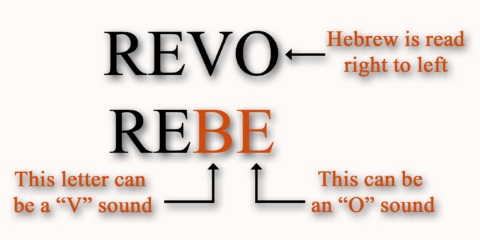
Essentially, these words are the same in English and Hebrew and they have the same meaning as well. Etymonline provides the etymology of the English word “over”:
Over (prep., adv.)
Old English ofer “beyond; above, in place or position higher than; upon; in; across, past; more than; on high,” from Proto-Germanic *uberi (source also of Old Saxon obar, Old Frisian over, Old Norse yfir, Old High German ubar, German über, Gothic ufar “over, above”), from PIE root *uper “over.” https://www.etymonline.com/search?q=over
The English word “over” has a similar definition as the Hebrew word “Eber”. We have also provided a chart showing the relationship between the letter “ayin” and the English letter “O”. The English language is based upon the Greek alphabet. Modern English shows a direct link to the Language of Eden. https://www.ancient-hebrew.org/ancient-alphabet/ayin.htm
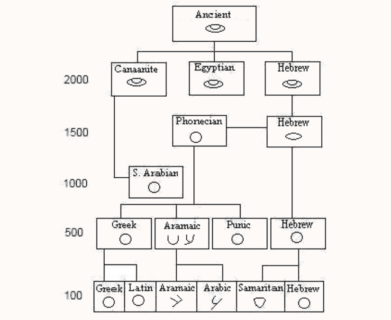
Ancient Hebrew is very concrete. “Eber” has the following meaning based on the ancient Hebrew pictographic language:
See Family of Heads: a man could see grains beyond that could feed his flocks so he crosses over to the other side with his flocks. They had depleted the fields where they were and were hungry. Once they got to the other side, they ate, filled their bellies and were content.
This concept is related to the root word for “Noach”. The Ancient Hebrew Lexicon of the Bible said “Noach” could be defined as, “The shepherd would guide his flock to a place of water. Here is water for drinking as well as green grass for pasturing. Once the flock arrives, they are free to rest after the long journey. A guided journey to a place of rest. A sigh of rest.” https://www.ancient-hebrew.org/ahlb/nun.html#5118
“Noach” guided his flock to the “other side” of the flood. The violence in the earth had been quelled. The “family of heads” were able to rest and graze safely. On the Ark, Noach literally carried the “family heads” of every species. (Bereshith/Genesis 6:9-9:16).
Likewise, Moshe (Moses) guided his flock to the “other side” of the Red Sea during the exodus from Egypt. Their enemies had been destroyed. The “family of heads” were able to rest and live safely on the other side. (Shemoth/Exodus 14:1-31).
Yahusha (Joshua) Son of Nun guided his flock to the “other side” of the Yarden (Jordan) River into the land of promise. The “family of heads” ate the “family of heads” or “grains” on the other side of the Yarden River. The “family of heads” inherited the land of promise and lived safely on the other side for a period of time. (Yahusha/Joshua 3:1-4:24). Here is a passage regarding this event that uses the Hebrew word “Eber”:
And Yahusha said unto them, Pass over [H5674] before the ark of Yahuah your Elohiym into the midst of Yarden, and take up every man of you a stone upon his shoulder, according to the number of the tribes of the children of Yashar’El:
These three events establish a pattern. All of them involved “crossing over” a body of water to a place of safety and rest.
- Crossing over the flood waters that consumed the whole earth
- Crossing over the Red Sea to the other side
- Crossing over the Yarden River to the land of promise
The Hebrew word “Eber” could also mean the following:
Know Inside Man: Testimony says Yahuah lives inside the Garden of Eden. We live on the outside of the Garden of Eden. The “ayin” can mean something that is known in the mind or perceived by the spiritual eye. Testimony says the “Spirit” from Yahuah dwells inside of a man or woman.
Then Shemuel took the horn of oil, and anointed him in the midst of his brethren: and the Spirit of Yahuah came upon David from that day forward. So, Shemuel rose up, and went to Ramah.
And I will come down and talk with you there: and I will take of the Spirit which is upon you, and will put it upon them; and they shall bear the burden of the people with you, that you bear it not yourself alone.
When the Spirit from Yahuah dwells inside an individual, He “knows” them. The inside man is with the Spirit of Yahuah Elohiym. They are together. This means the inside man has “crossed-over” to the other side and is with Yahuah. Here is an illustration:
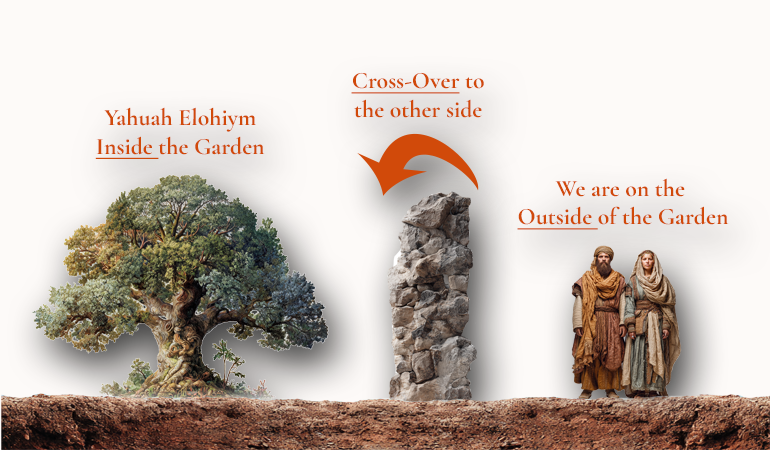
The Garden of Eden is a place of delight and abundant in food. Testimony also says that it contains the Tree of Life which allows one to live forever. The Presence of His Spirit inside a man or woman is the evidence that one has successfully “crossed-over” to the other side. The “spiritual” manifestation occurs first followed by the physical manifestation. Consider the following testimony from Shaul of Tarsus (Paul):
But if the Spirit of him that raised up Yahusha from the dead dwell in you, he that raised up Messiah from the dead shall also quicken your mortal bodies by his Spirit that dwells in you.
We know that there is a chasm that separates people from Yahuah. This is alluded to in the following testimony:
Then said Yahusha again unto them, I go my way, and you shall seek me, and shall die in your sins: where I go, you cannot come.
For Yahuah will pass through [cross over H5674] to smite the Egyptians; and when he sees the blood upon the lintel, and on the two side posts, Yahuah will pass over the door, and will not suffer the destroyer to come in unto your houses to smite you.
The Hebrew word translated as “pass-through” is the Hebrew word “Eber” which means “cross-over to the other side”. Here are four occurrences of “Eber” in the Hebrew writings that confirm this definition.
Until Yahuah have given rest unto your brethren, as well as unto you, and until they also possess the land which Yahuah your Elohiym has given them beyond [H5676] Yarden: and then shall you return every man unto his possession, which I have given you.
And Yahusha said, Alas, O Adonai Yahuah, why have you at all brought this people over [H5674] Yarden, to deliver us into the hand of the Amorites, to destroy us? Would to Elohiym we had been content, and dwelt on the other side [H5676] Jordan!
Woe to the land shadowing with wings, which is beyond [H5676] the rivers of Ethiopia:
This word describes places on the other side of a river, beyond the river or over the Yarden (Jordan) river. It is the action of going over to the other side. It also describes an individual who has crossed-over the chasm and is dwelling with Yahuah on the other side. In the resurrection, the Spirit of Yahuah Elohiym who dwells in them will resurrect them back to life. At this point their physical bodies can “cross-over” to the other side.
All definitions of “Eber” aim to preserve life. It is this idea of crossing-over from a less-desirable place to a place that is much more desirable. It is a place of comfort, rest and delight. It is a place where people are preserved from their enemies or violence. The definition from the ancient Hebrew pictographic Alephbet is in alignment with the context of scripture.
So far in this series, we have defined the following words using the ancient Hebrew pictographic Alephbet: Noach, Adam, Ketub and Eber. We have been able to piece together the definitions of each one using the pictographic letters. We have verified the meanings of these words with the context of scripture.
For example, if the ancient Hebrew pictographic letters illustrated the Hebrew word “Eber” meant “hit,” we could place the word “hit” in the place where the word “Eber” occurs and we could see that it clearly would not fit the context of the passage. Here is an example in a passage we quoted previously.
- And Yahusha said, Alas, O Adonai Yahuah, why have you at all brought this people hit [H5674] Yarden, to deliver us into the hand of the Amorites, to destroy us? Would to Elohiym we had been content, and dwelt on the hit [H5676] Jordan! (Yahusha/Joshua 7:7)
This passage does not make sense using the word “hit”. We would know that the Hebrew word “Eber” did not originally mean “hit” when the Prophet Moshe wrote this account. We would have to come to the conclusion that the ancient Hebrew pictographic language was not the language spoken by the Prophet Moshe or our Intelligent Designer. However, this is not the case. The definitions obtained by reviewing the ancient pictographic letters fit within the context of every Hebrew word we have defined thus far. This is the case over and over again.
Each one of these Hebrew words that we have defined is a single witness verifying that ancient Hebrew pictographic language was the written language used by the Prophet Moshe to write his accounts. This is further verified by carvings in the Serabit El-Khadim mining site dated to 1446 BCE (Before the Common Era). Words in our own modern-day languages are linked to these letters written in those caves and even definitions have been preserved. This is solid reliable evidence that we can see with our own eyes.
Download this Article here