111-8 The Influence of His Language
For then will I turn to the people a pure language, that they may all call upon the name of Yahuah, to serve him with one consent.
The Hebrew word “Eber” is related to the English word “Over”. They have the same definition and the letters are virtually the same. This illustrates a link to modern English nations. The letter “O” in the English language is directly associated with the letter “ayin” which looks like an eye: [. This is evidence in and of itself that the language of Yahuah Elohiym has influenced the Nations to this very day. However, there is more. Each instance is an eyewitness proving His influence on the nations.
The letters in the modern-day Hebrew Alephbet have changed their form over the years but they have retained their order and most of their sounds. The ancient Hebrew pictographic language adheres to a term called “acrophony”. It is defined by Wikipedia the following way:
Acrophony (/əˈkrɒfəni/; Ancient Greek: ἄκρος, romanized: akros, lit. ’uppermost’ + φωνή phone ‘sound’) is the naming of letters of an alphabetic writing system so that a letter’s name begins with the letter itself. For example, Greek letter names are acrophonic: the names of the letters α, β, γ, δ, are spelled with the respective letters: άλφα (alpha), βήτα (beta), γάμμα (gamma), δέλτα (delta).
The paradigm for acrophonic alphabets is the Proto-Sinaitic script and the succeeding Phoenician alphabet, in which the letter A, representing the sound [ʔ], is thought to have derived from an Egyptian hieroglyph representing an ox, and is called ‘ox’, ʾalp, which starts with the glottal stop sound the letter represents. The second letter of the Phoenician alphabet is bet (which means ‘house’ and looks a bit like a shelter) representing the sound [b], and from ālep-bēt came the word “alphabet”. https://en.wikipedia.org/wiki/Acrophony
The ancient pictographic Hebrew is also called the “Proto-Sinaitic Script” as mentioned in this article. The first letter mentioned in the name of the ancient Hebrew pictographic language is the character it represents and the sound. For example, the first letter of the Hebrew Alephbet is the “aleph” or “al”. In Hebrew it looks like the picture below:
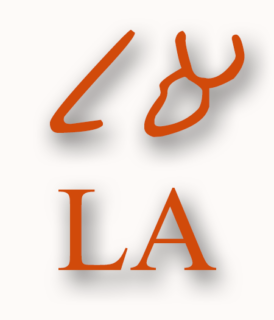
The “aleph” is associated with the “A” sound and the “lamed” is associated with the “L” sound. The first letter is the “aleph” so the name represents the picture of the ox-head: A. Its sound is like our letter “A”. In modern Hebrew, this letter is not pronounced and does not have a sound. Why have a letter if it does not carry a sound?
The Masoretes are group of Jewish leaders who created a system for pronouncing the words based on their perspective. They have placed vowel markings on words in the form of dots and dashes to assist with pronunciation. They instituted these vowel markings in the sixth century CE, so this letter is now pronounced with the vowel points placed on the word by the Masoretes as in the Hebrew word “Elohiym”. In ancient Hebrew, it was most likely pronounced as “Alohiym” in alignment with the “A” sound.
The Hebrew Alephbet contains 22 letters. The top row are the modern-day Hebrew letters and the bottom row are their corresponding pictographic Hebrew letters:

Hebrew is read right to left which is the opposite direction in the English language. So, the beginning of the Alephbet is on the far right and the end is on the far left. The first letter of the Hebrew Alephbet is “aleph” as previously stated. Here is the letter in the modern and ancient pictographic language.
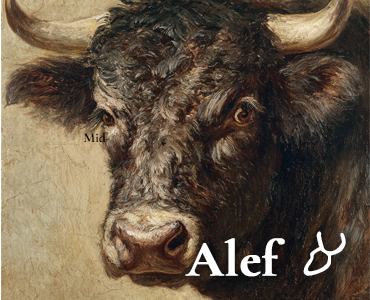
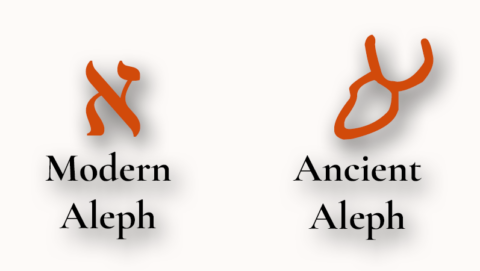
The ancient pictographic letter, “aleph,” is clearly the head of an ox. The pictographic letter looks like the English letter “A” inverted and the letter “O” has a dot in the middle. It is obvious by this example that the English language was derived from the ancient Hebrew pictographic language.
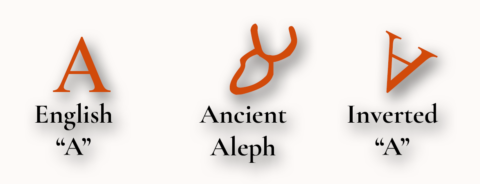
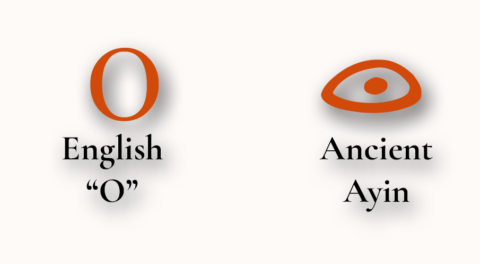
Based on these evidences, someone could draw a conclusion that the English nations are Hebrews and perhaps part of the ten lost tribes of Yashar’El. The similarities between the English Alphabet and the Hebrew Alephbet are not a coincidence. Let’s consider this for a moment. The House of Yashar’El migrated north right before the Assyrian captivity in 722 BCE (Before the Common Era).
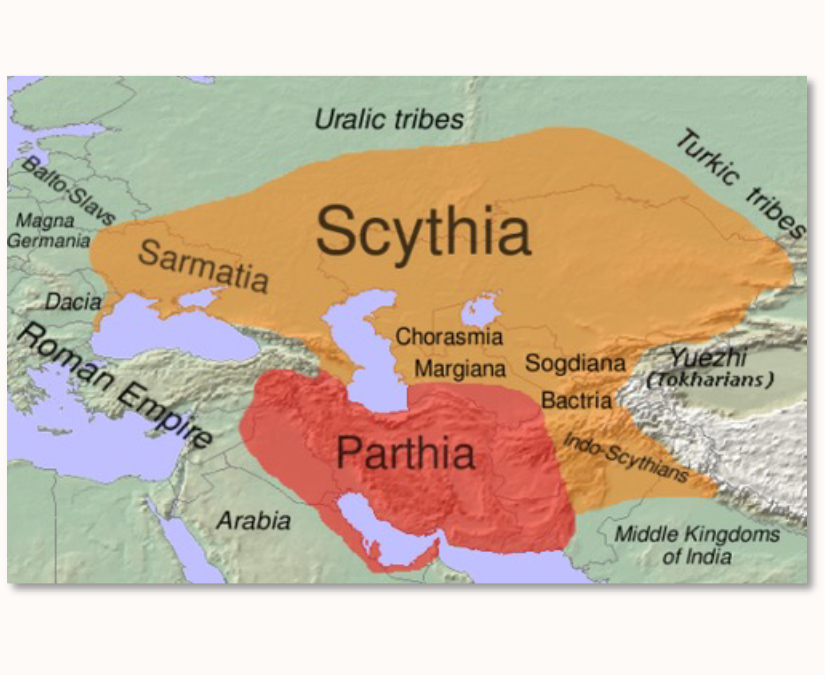
The Scythians were a group of nomadic people that appeared in the area on the map in the 8th and 7th centuries. This would be between 800-700 BCE which is the same time as the migration of the Northern House of Yashar’El. Here is an excerpt from Britannica to confirm these findings:
Scythian, member of a nomadic people, originally of Iranian stock, known from as early as the 9th century BCE who migrated westward from Central Asia to southern Russia and Ukraine in the 8th and 7th centuries BCE. https://www.britannica.com/topic/Scythian
The assumption that they were “Iranian” is conjecture. The name “Scythia” comes from “Saka” or “Sacae” which is based on the Hebrew name, Yitzhak (Isaac). “Sarmatia” located on the map is similar to “Samaria”. The Scythian region is the same area called “Iberia” in Asia which we reviewed previously.
The Greeks also had a notable change during the time of Yashar’El’s migration north. It was in 8th century when the Greeks adopted the Phoenician Alephbet which is identical to the ancient Hebrew pictographic Alephbet.
In the 8th century at the latest but probably much earlier, the Greeks borrowed their alphabet from the Phoenicians in the framework of their commercial contacts. The Phoenician alphabet had separate signs for the Semitic consonants, but the vowels were left unexpressed. The list of Semitic consonants was adapted to the needs of Greek phonology, but the major innovation was the use of five letters with the value of vowels—α (a), ε (e), ι (i), ο (o), υ (u). The earliest datable inscriptions, both from approximately 725 BCE, come from Athens (the Dipylon vase) and the colony of Ischia in the Tyrrhenian Sea (the so-called Nestor’s cup). https://www.britannica.com/topic/Greek-language/The-Greek-alphabet
The English language is adopted from the Greek language which is why our letters look so similar to the ancient Hebrew pictographic language. The Greek language was based on the ancient Hebrew pictographic language from the 8th century forward. We are told that the Greeks adopted the Phoenician Alephbet which was and is a Semitic language. Historians cannot explain why the Greeks adopted this Alephbet.
Let’s consider an example for a moment. A father awakens one morning and says to his family, we are going to speak Phoenician now and use their Alephbet. His family are accustomed to speaking their native tongue and it was the language passed down from one generation to another. Favorite books were likely written in their native tongue. Family documents and keepsakes were likely preserved in their original language. Why would a culture suddenly abandon their native tongue to adopt a different language and Alephbet?
The Greek language was adopted by cultures all over the world because they were conquerors and enforced the Greek language and culture upon the local people. The local people learned the Greek language out of necessity. We do not have any record of the Phoenicians conquering the Greeks, thereby imposing their language upon the Greeks. Perhaps there was a mass migration of people who flooded the Greek territories who did speak Phoenician? The Assyrian captivity of the House of Yashar’El began around 740 BCE and ended in 722 BCE. The Greeks adopted the Phoenician Alephbet in 770-750 BCE approximately. Is this a coincidence?
We have a modern-day example in the United States of a mass migration of people changing the language of an area. The primary language in Miami, Florida right now is Spanish, not English. This transition happened with a mass migration of Spanish-speaking people from Cuba and other Latin American countries into the Miami area. Here is an excerpt explaining this adoption of the Spanish language of this area.
Spanish roots trace back to waves of immigration from Latin America and the Caribbean. The turning point came when the 1959 Cuban Revolution saw thousands of exiled Cubans arrive as refugees in Miami. This created a strong foundation for Spanish as the dominant language of the city. Later immigrants from other countries such as Venezuela, Colombia, Nicaragua, and Argentina reinforced this growing population and made Spanish an integral part of Miami’s culture.
Compared to other cities in the United States where immigrant languages are phased out over generations, Miami’s Spanish persists due to continuous immigration. The continuous influx of individuals keeps the language up to date and widespread among all socioeconomic levels. https://www.sparklymaidorlando.com/blog/why-does-miami-have-a-lot-of-spanish
In other cities in the United States, the languages spoken by immigrants phased-out. The people adopted the English language because a majority of the population are English. The immigration of Spanish-speaking people outnumbered the English-speaking people in the Miami area causing a shift in the primary language of the area. The immigration of the Northern Kingdom of Yashar’El must have dwarfed the Greek population forcing the adoption of the Hebrew/Phoenician language upon them by necessity. We understand that this is circumstantial evidence. However, it is a plausible explanation for the Greek adoption of the Hebrew language. Here is the bottom line:
The English alphabet originated from the ancient Hebrew pictographic language.
Determining the reasons why this occurred are debatable. It just seems like a far-fetched claim that a culture would make a unanimous decision together to change the language they had used for hundreds of years if not thousands to the Phoenician language. It is hard to learn a new language. It does not come naturally. We typically learn a new language out of necessity, not just because we woke up one morning and decided to do so. To undergo a feat like this, the whole population would have to agree to the change. People generally don’t like change and will resist it as long as possible until it becomes “necessary” for them to do so. For example, if people go to the store in Miami and want to buy toilet paper, they have to learn the Spanish word for “toilet paper”. In Miami it is necessary to learn to speak Spanish in order to function well in that society. This has been my observations and experiences working with people.
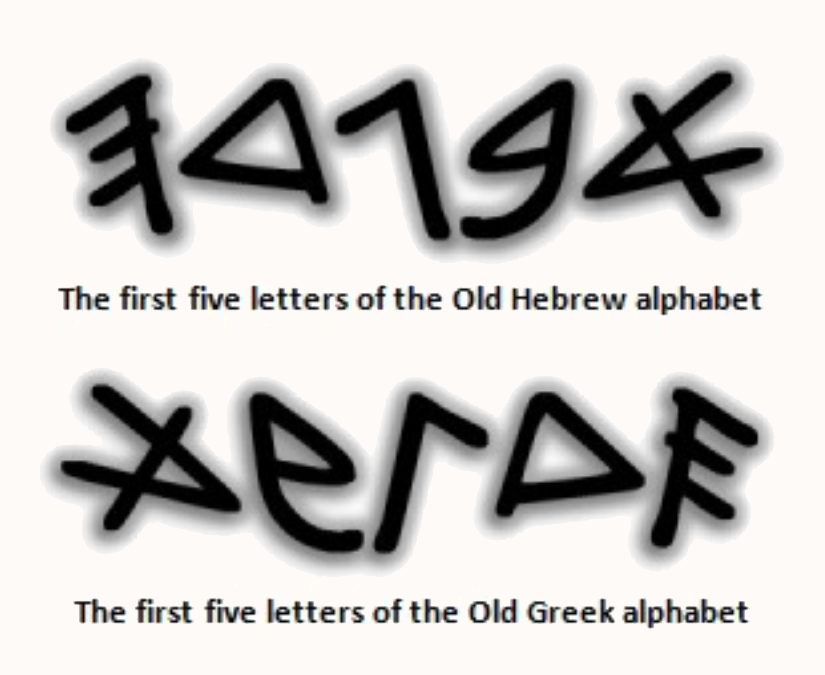
Here are the first five letters of the “Old Hebrew” Alphabet and the first five letters of the “Old Greek” Alphabet. They are identical except for the direction in which they are read.
We have already illustrated the ancient Hebrew pictographic letter “aleph” with the English letter “A”. It is a picture of an ox-head and means “Strong”. It also means two oxen yoked together with the shepherd’s staff. The older ox trains the younger ox to do the work of the ox.
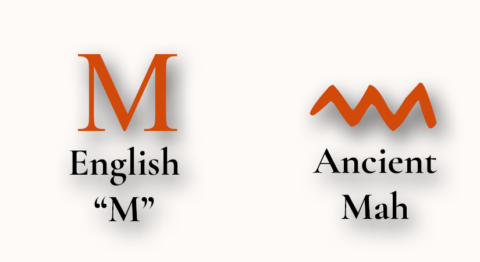
The letter “mem” or “mah” is the 13th letter of the modern and ancient Hebrew pictographic Alephbet. The letter “mah” is a picture of water or waves on the sea. The ancient pictographic letter looks like the English letter “M” which is also the 13th letter of the English Alphabet. The letter in English is called “em” which is very similar to “mem”. Here they are side-by-side. We can clearly see remnants of this original language system handed down from father to son in the English language to this day

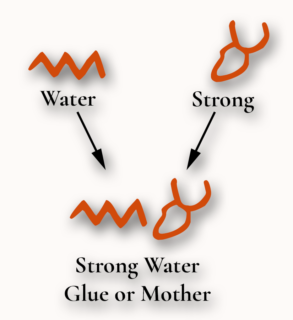
When the definitions of the ancient pictographic letters are combined, they form the word “AM” which would be pronounced “Ah-m”. The definition of this word in its simplest form would be “strong water”. This is a reference to “glue” or “mother” as she is the glue that holds the family together. The definition of the word is related to the function of the mother.
In the English language, we use the word “mom” which is very close to the modern-day name for this letter, “mem”. Sometimes we use the word “ma” which is closely related to the name of the ancient pictographic name for this letter, “mah” and is how the word could be read backwards. However, the definitions of the original Hebrew letters have been lost in the English language because the English language has undergone revisions through the generations. The same is true in other languages as well. However, no revisions were made prior to the ancient Hebrew pictographic language. The definitions of the individual letters, themselves, can be combined to provide the definitions of the actual words used in the Word of Yahuah. This means the letters and the words were created at the same exact time. Here is a simplistic illustration:
Here is the actual word used in the Hebrew writings of scripture:
Therefore, shall a man leave his father and his mother [WMA], and shall cleave unto his wife: and they shall be one flesh.
We have included the Hebrew word in the ancient Hebrew pictographic letters in parentheses. Here is the word as it appears in the text in modern and ancient Hebrew.
אמו
WMA
The letter in black is the letter “vav” or “waw” and it is a suffix on the end of the word which means “his”. This word is translated as “his mother.” She is the strong glue that holds the family together or the “strong water”. The context of Bereshith (Genesis) 2:24 validates the meaning of this Hebrew word from an ancient Hebrew perspective. The writings of Moshe (Moses) were originally written in the ancient Hebrew pictographic language because the ancient Hebrew definition fits within the context of the passage. Here is a passage written by King David using the same Hebrew word.
By you have I been holden up from the womb: you are he that took me out of my mother’s [WMA] bowels: my praise shall be continually of you.
The context of the passage is talking about the womb of King David’s mother. Here is the Hebrew word as it appears in the text in modern and the ancient Hebrew pictographic language.
אמי
YMA
The letter in black is a suffix. It is the letter “yod” and it is translated as “my”. This passage is translated as “my mother” who is the strong glue that holds the family together. Women have wombs. The passage is talking about King David in the womb of his mother. The context of the passage validates the meaning of this word from an ancient Hebrew perspective. This proves that this was the language used to write these documents.
The letter “aleph” and “mah” are a two-lettered root used as a foundation to build longer words. The meaning of the two-lettered root is linked to these longer words. It is a common thread. The Ancient Hebrew Lexicon of the Bible written by Jeff A. Benner defines this two-lettered root the following way:
MA אם Action: Bind Object: Glue, Mother, Arm, Tribe, Pillar Abstract: Firm Definition: Glue was made by placing the hides and other animal parts of slaughtered animals in a pot of boiling water. As the hide boiled, a thick sticky substance formed at the surface of the water. This substance was removed and used as a binding agent.Ancient Hebrew: The pictograph A represents strength. The M is water or any other liquid. Combined these pictographs mean “strong liquid”.
“Strong liquid” is a binding agent that holds things together. This is the role of a mother which is based on this two-lettered root. The Ancient Hebrew Lexicon of the Bible defines it the following way:
MA ( fem., אם / eym ) Translation: MOTHER Definition: A female parent. Maternal tenderness or affection. One who fulfills the role of a mother. Relationship to Root: The arm that holds things together. The arm is seen as glue that encircles and holds together. A cubit was the length of the arm from elbow to fingertip. The mother of the family is the one who binds the family together by holding in her arms and by the work of her arms. KJV Translations: mother, dam Strong’s Hebrew #: h.0517
The mother uses her arms to cuddle and nurture children. She holds them tight and doesn’t let them go very easily. The Hebrew word for “cubit” is related to this word because it was the length of a forearm. The word “amen” is said at the end of prayers is related to this Hebrew word family. It uses the two-lettered root with the addition of the letter “nun” which means “continuance”. It is like something glued together. Firm. The Ancient Hebrew Lexicon of the Bible defines “amen” the following way:
NMA ( common, אמן / a.m.n ) Translation: SECURE (V) Definition: Solidly fixed in place; to stand firm in the sense of a support. Not subject to change or revision. Alternate Translations: support (when written in the hiphil [causative] form) KJV Translations: believe, assurance, faithful, sure, establish, trust, verify, steadfast, continuance, father, bring up, nurse, stand, fail Strong’s Hebrew #: h.0539 Strong’s Aramaic #: a.0540
Things that are glued together are more secure than those things that are just held together or tied together. Also, once things are glued together, it is much harder to separate them if not impossible. For example, a child bears characteristics of both mother and father. The genetic material from the mother and father were merged together with a very powerful glue so-to-speak and it is impossible to separate them. Separating them would destroy the child. The child is the representation of the “cleaving” that occurs between a husband and a wife when they become one. The child is the evidence of their bond together. We can see the relationship between these words and they can be verified with the context of passages found in the scriptures and other ancient Hebrew writings.
Let’s consider another example. In the ancient Hebrew pictographic language, the Hebrew word “Elohiym” comes from the two-lettered root, “EL” or “AL”. The Ancient Hebrew Lexicon of the Bible defines it the following way:
LA אל Action: Yoke, Guide, Swear Object: Ox, Oak, Yoke Abstract: Strength, Oath, Learn Definition: The yoke is understood as a “staff on the shoulders” (see Isaiah 9:4) in order to harness their power for pulling loads such as a wagon or plow. Hence, the two pictographs can also represent “the ox in the yoke”. Often two oxen were yoked together. An older, more experienced ox would be teamed up (yoked) with a younger, less experienced ox. The older ox in the yoke is the “strong authority” who, through the yoke, teaches the younger ox. Ancient Hebrew: The pictograph A is a picture of an ox head and also represents its strength. The L is a picture of a shepherd staff and also represents the authority of the shepherd. Combined these two pictographs mean “the strong authority” and can be anyone or thing of strong authority.
This root word means “strong authority”. We have already discussed the letter “aleph’ in the previous section. The second letter in this two-lettered root is “lamed” and it is a picture of an upside-down shepherd’s staff. Here is an illustration of the “lamed” in modern and ancient Hebrew with the English letter “L”.
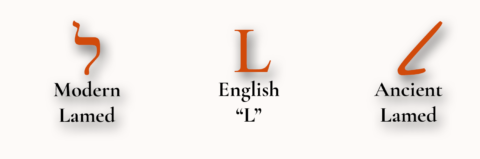
The English letter “L” is identical to the ancient Hebrew pictographic language. If the pictographic letters represent the Language of Eden, then it is clearly evident that the English language was derived from this pure language belonging to our Creator. Just in this lesson, we have shown marked similarities between the English language in use today and the ancient Hebrew pictographic language used by the Prophet Moshe (Moses) and King David.
The “lamed” is a symbol of a shepherd’s authority over his sheep. He used his staff to hook around the necks of his sheep to draw them in closer. He used it to guide them and corral them together. He would use the staff to yoke an older ox together with a younger ox in an effort to train the younger ox to do the work as directed by the older ox.
The two letters together in the ancient pictographic language also represent the crown of a King and his scepter. The horns on the ox are like the points on a crown. The scepter is the shepherd’s staff of authority. Here is an illustration:
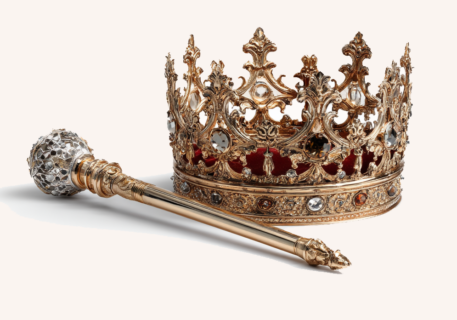
Kings exercise great authority in the earth. ALL leaders throughout time and in most cultures were characterized by a crown or head-dress and a scepter as symbol of his authority. Here are passages associating “horns” with “kings”
The ram which you saw having two horns [H7162] are the kings of Media and Persia.
And the ten horns [H7162] out of this kingdom are ten kings that shall arise: and another shall rise after them; and he shall be diverse from the first, and he shall subdue three kings.
The underlying Hebrew text is the word translated as “horns”. However, they could have been rays of light that looked like “horns”.
And it came to pass, when Moshe came down from mount Sinai with the two tables of testimony in Moshes’ hand, when he came down from the mount, that Moshe did not know that the skin of his face shone [horns H7160]; while he talked with him. And when Aahron and all the children of Yashar’El saw Moshe, behold, the skin of his face shone [horns H7160]; and they were afraid to come near him.
Here is another passage confirming that this Hebrew word means “horns”:
And you shall make the horns [H7161] of it upon the four corners thereof: his horns [H7161] shall be of the same: and thou shall overlay it with brass.
Here are some examples of leaders wearing headpieces and holding a scepter:
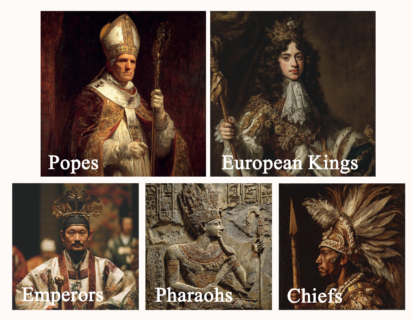
The ancient Hebrew pictographic letters are present in every picture above and in every culture to this very day. The pictures of these rulers provide evidence of the original language used by our Creator. They are a common thread in every culture throughout time. These pictures provide substantial evidence proving that the word “EL” or “AL” was the Source Language for ALL cultures. This also provides conclusive evidence that the identity of our Intelligent Designer is Yahuah Elohiym, the Elohiym of the ancient Hebrews. Each one of these Kings is a witness and there are literally multitudes of pictures, reliefs, sculptures and carvings that stand as a witness. Each one is a picture of the letter “aleph” and the letter “lamed”. The meaning has also been preserved because these are all associated with Kings who exercise great authority. They are “strong authorities” or “mighty ones” in the earth.
Based on this evidence, the ancient Hebrew pictographic language is the Language of Eden; it is the Language of our Creator, Yahuah Elohiym which has existed as long as He has existed. Yahuah Elohiym has a mouth. He speaks words. He has communicated with mankind since the very beginning. The evidence provided in these studies will only strengthen our case. This research is planting the seeds of restoration for His original pure language as prophesied in Tzephanyah (Zephaniah) 3:9.
Download this Article here