111-1 The Value of Statistics
You are my witnesses, says Yahuah, and my servant whom I have chosen: that you may know and believe me, and understand that I am he: before me there was no Elohiym formed, neither shall there be after me.

Statistics is a discipline in Mathematics which can be calculated and are unbiased. Numbers do not lie. The discipline of statistics evaluates the probability of an event occurring by random chance. Rolling dice is a perfect example often used to illustrate statistics and probability. When we toss the die on the table, there are six possibilities because there are six sides to a die.
People have one chance in six to roll a two because the number two is one of six options. It can be expressed as 1/6 in a fraction.
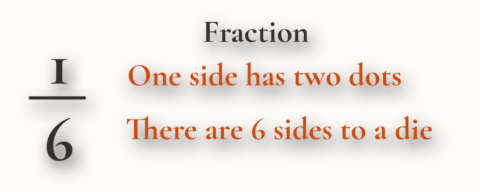
When we divide 1 by 6, we get .1667 which is about 17%. We have a 17% chance of rolling a two.

If we flip a coin, we have two possibilities because there are only two sides: heads or tails. This fraction can be expressed as ½ which is 50%. The probability of our coin landing on the ground with the head facing up is more probable than us rolling a die and having the side with two dots appear facing-up. With the coin, there are only two options and not six. When there are fewer options, there are more favorable odds of receiving desired results.
Now, let us consider a lottery example. The following excerpt provides the statistical probability of winning the lottery with Powerball and Mega Millions:
Your chance of taking home the top prize is tiny. The odds in any lottery are about one in 300 million. That’s about 1 in 292.2 million for Powerball and 1 in 302.6 million for Mega Millions. https://www.nbcbayarea.com/news/national-international/what-increases-chance-lottery-win/3408041
The odds are essentially the same between both of these lotteries. The fraction could be represented the following way: 1/300,000,000. When we do the division on a calculator, this is the number we get. We have included the answer in scientific notation as well.
0.00000000333… or 3.33 x 10⁻⁹
The odds of winning either one of these lotteries is very tiny when compared to flipping a coin. Winning the lottery is a very tiny fraction of 1%. Whereas flipping the coin and having it land heads-up is 50%. Based on this mathematical evidence, winning the lottery is a rare event but not entirely impossible. Many people do not play the lottery because they consider these odds as something nearly impossible which includes myself. This may prompt us to ask the following question.
In mathematics, what odds make an event statistically improbable?
Emile Borel was a brilliant French Mathematician born in the late 1800’s. He introduced the concept of “practical impossibility”. Giancarlo Sanchez wrote an article titled, The Line Between Improbable and Impossible: Émile Borel’s Practical Impossibility. He explains Borel’s concept (emphasis added):
French mathematician Émile Borel introduced the concept of practical impossibility, which helps distinguish between events that are just extremely unlikely and those that are, for all intents and purposes, impossible within the physical universe. As a pioneer in probability theory and measure theory, his work was foundational for 20th-century mathematics. https://gianksp.com/the-line-between-improbable-and-impossible-%C3%A9mile-borels-practical-impossibility-c7c0dca469ec
Giancarlo Sanchez continues in his article and explains the process Emile Borel used to come to these conclusions. It is technical but is widely accepted in Mathematics.
Émile Borel defined practical impossibility by examining the fundamental limits of the universe. He considered two key properties: the number of atoms (around 1080) and the smallest measurable unit of time, Planck time (with approximately 5.39 × 1044 Planck intervals in a single second, resulting in 10⁶³ intervals since the Big Bang). These values represent the maximum number of physical opportunities for events to occur, assuming every atom in the universe could participate in a potential event at every moment. Multiplying these gives a theoretical limit of 10143 possible events over the universe’s entire lifespan. Borel set the threshold for practical impossibility at 1 in 1050, a probability far below what can be physically realized, ensuring that such events have no realistic chance of ever occurring. He used these cosmic limits to establish a clear distinction between improbable events — such as winning the lottery — and practically impossible events, like randomly picking a specific atom in the cosmos which surpasses even the universe’s capacity for chance interactions. This framework provides a robust way to evaluate what can and cannot happen within the constraints of time and space. https://gianksp.com/the-line-between-improbable-and-impossible-%C3%A9mile-borels-practical-impossibility-c7c0dca469ec
The probability of an event “never” happening is expressed as zero in statistics. However, certain numbers dictate that an event is highly improbable. According to Borel the probability of an event that will likely never happen is 10-50. Here is a comparison between this number quoted by Borel and our chances of winning Powerball or Mega Millions.
0.0000000000000000000000
00000000000000000000000
000001 (10-50)
an Event that will likely NEVER happen
OR
0.00000000333… (10-9)
Winning Powerball or Mega Millions
Borel did not say that an event with these statistical odds would never happen. He is saying that it is highly improbable. If anyone has had the opportunity to play a lottery, they can grasp the impossible nature of an event happening with a probability of 10-50. From my observations and experiences, winning one of these major lotteries is an extremely rare event but it is significantly more probable than something with a probability of 10-50. These examples put things into perspective.
Here is another one. The odds of getting struck by lightning in the United States each year is 1 in a million. This is expressed in the following fraction: 1/1,000,000. Here are the statistics comparing lightning strikes with winning the lottery:
o.ooooo1 or 1 x 10⁻⁶
Being struck by lightning
OR
0.00000000333… (10-9)
Winning Powerball or Mega Millions
People have a higher probability of being struck by lightning than they do winning Powerball or Mega Millions. This illustrates that winning the lottery has a very low probability of happening yet people still play it, hoping to win. The odds of getting in a car accident is 1 in 366 for every 1000 miles driven. This is expressed in a fraction of 1/366.
0.00273224044 or 2.73 x 10⁻³
Getting in a car accident
OR
0.00000000333… (10-9)
Winning Powerball or Mega Millions
People have a much higher risk of getting into a car accident than they do winning the Powerball lottery or getting struck by lightning. However, it is still less than 1% but it is more likely to occur if people are drivers or those who drive a lot more miles. What do you suppose would happen if the number was greater than 10-50 like 10-100? This number would look like this:
0.0000000000000000000000
00000000000000000000000
00000000000000000000000
00000000000000000000000
0000001 (10-100)
This number is really Impossible
0.0000000000000000000000
00000000000000000000000
000001 (10-50)
Highly Improbable according to Emile Borel
0.00000000333… (10-9)
Winning Powerball or Mega Millions
If 10-50 represents an event that would likely never happen, then 10-100 would surely be an event that would never happen as well. Comprehending the magnitude of these numbers is very challenging. When we examine the probability of actual life events and relate them to these numbers, we can capture a glimpse of what these number mean. The probability of winning the Powerball lottery is an example. When comparing these numbers to one another, it becomes very apparent that events with a greater probability of 10-50 will not occur. This is something we can see with our own eyes.
- Have you ever won Powerball or Mega Millions?
- Have you ever been struck by lightning?
- Have you been in a car accident?
Personally, I have never won any lottery and I have never been struck by lightning. I have been in a car accident but the probability of this happening is much higher especially when driving more than a thousand miles per year. Many of us can relate to these experiences which are possible events that can occur in one’s life but are extremely rare.
We are going to use statistics in this particular series and wanted to give people time to digest these concepts before proceeding. Numbers don’t lie and are unbiased. An event is either possible, impossible or highly improbable. Would you bet money on an event happening or not happening with a probability of 10-50? These are not good odds. Don’t take the bet!
Many people do not trust their own judgment. They don’t trust what they see with their eyes and hear with their ears. When I write out these numbers for myself, I can see that an event with a probability of 10-50 is likely never going to happen. I don’t have that much confidence to play the lottery because the odds are so small. However, winning the lottery is so much more likely than an event with a probability of 10-50. If a scholar wants to argue that something with that probability can occur, go ahead. However, the credibility of that scholar has to be questioned. Are they saying this because they want to continue to justify and believe a particular way? People are welcome to believe what they want to believe but it is dishonest to use one’s scholarship to manipulate and influence others to believe what they believe. Learn to trust yourself!
Download this Article here