
14-1 Perfection
And when Abram was ninety years old and nine, Yahuah appeared to Abram, and said unto him, I am the Almighty Elohiym; walk before me, and you be perfect. And I will make my covenant between me and thee, and will multiply thee exceedingly.

In our society, the concept of “perfection” is this idea of “never making a mistake”. Dancers practice their dances over and over until they can perform it without any mistakes. Musicians practice their songs over and over until they can perform it without any mistakes. Athletes practice over and over to win competitions.
If we make a mistake or fail to win the competition, we have missed our target and may feel like a failure.
When we think of this definition of “perfection,” and apply it to the Laws of our Father written by the Prophet Moshe, we think He expects us to obey ALL of His Laws perfectly. We think that we are failures if we accidentally make a mistake and transgress one of His Laws. If we make a mistake, we will instantly be struck by lightning. Does this really reflect the perspective of our Father?
With this mindset, if we are incapable of obeying His Laws perfectly, then why bother even trying to obey His Laws. We have been taught that the only individual who has ever fully obeyed ALL of the Laws of Yahuah is Messiah Yahusha Ben David. Somehow, we believe he had this special ability that caused him to obey the Laws perfectly without making any mistakes. We have been taught that his righteousness or his obedience to the Laws of our Father is a blanket that hides our sins from the eyes of Yahuah. When He looks down at us, He sees the righteousness of our Messiah covering us and does not see the sins we are still committing under this shroud or blanket. Is this the truth? Does this even make sense?
We are dynamic beings. We are moving, thinking and doing all of the time even when we are sleeping. Our words impact people. They can produce a positive response or a negative one. For example, I tell my sister, “I hate you!” These words are like a dart that hurts her heart. It may make her cry. She feels pain because of the words I spoke. Did the righteousness of Messiah Yahusha prevent my sister from feeling pain and crying because of the words I spoke? Did the righteousness of Yahusha prevent our Father from hearing the words I spoke to my sister? No, it did not. My words hurt another individual and it is my words that will resolve the situation.
Here is another example. A man hits his wife and causes a bruise. She experiences pain and is gripped with fear. She is saddened and may even cry because of this abuse. Did the righteousness of Messiah Yahusha prevent this woman from being bruised? Did Yahusha’s obedience prevent her from feeling pain or crying? Does the righteousness of Messiah Yahusha prevent her from being afraid of her husband? Does his righteousness prevent our Father from seeing what this man has done to his wife? No, it does not. This man’s actions hurt an individual that he was meant to protect and it is his actions that can resolve the situation.
Messiah Yahusha cannot do it for us. The Set-apart Spirit cannot do it for us. We did the transgressions causing the harm so we must do the actions to bring healing to the harm. Here is the truth:
The righteousness of Messiah Yahusha does not absolve us of accountability.
We are accountable and responsible for every word spoken and every deed done. Everything we say and do directly affects everyone in our sphere of influence. Our Father sees and hears everything. He knows our hearts and thoughts. We cannot hide from Him. Our best course of action under these circumstances is to accept responsibility for our own words and deeds and bring restitution for the harm we have done. It is best to be transparent and honest with ourselves, with others and with our Father in Heaven. Adam and Chavah tried to “hide” from our Father in the very beginning.
And they heard the sound of Yahuah Elohiym walking in the Garden in the cool of the day: and Adam and his wife hid themselves from the presence of Yahuah Elohiym amongst the trees of the garden. And Yahuah Elohiym called unto Adam, and said unto him, Where are you? And he said, I heard your sound in the garden, and I was afraid, because I was naked; and I hid myself.
When we feel exposed or naked, we want to hide ourselves. We want to cover the exposed part of ourselves. It is uncomfortable. Transparency is uncomfortable. In our minds, we comfort ourselves by telling ourselves this lie that the righteousness of Messiah Yahusha “hides” our sins from the eyes of Yahuah. This is like Adam and Chavah covering their nakedness with fig leaves.
And the eyes of them both were opened, and they knew that they were naked; and they sewed fig leaves together, and made themselves aprons.
We cannot cover our wrongdoing with fig leaves. We cannot cover our unrighteousness with the righteousness of Messiah Yahusha. As we have illustrated, his righteousness does not prevent the negative impact of our sins committed against Yahuah or others. We STOP the negative effects of our words and actions by no longer committing the sins. We make decisions to STOP hurting Yahuah and to STOP hurting other people. We attempt to FIX our wrongdoing. This is the act of repentance and offering restitution to heal the harm we have done to Yahuah and others.
When we hurt Yahuah and hurt other people, that wound or pain from our words and actions still exists even though we have STOPPED doing the wrong. The guilt for our wrongdoing hangs above our heads until we seek forgiveness and provide restitution. The guilt never goes away as long as we continue to commit the transgressions. Here is an illustration.
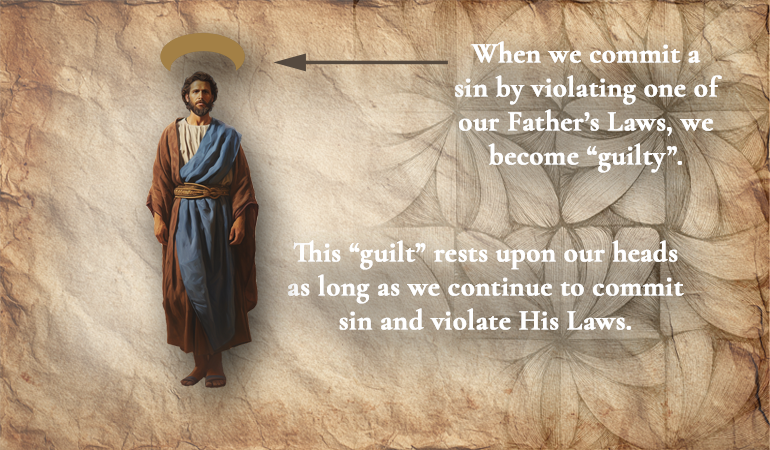
The ONLY way this guilt can be removed is through repentance and restitution.
The blood of Messiah Yahusha does not remove our guilt. Messiah Yahusha does not possess our bodies and force us to STOP committing the transgressions. Even the sin sacrifice in the sacrificial system cannot remove this guilt.
- We remove this guilt by STOPPING the harmful behavior.
- We remove this guilt by providing RESITTUTION for the wrong we have committed.
When I STOP telling my sister that “I hate her,” then I have STOPPED any further harm to her heart. When a man STOPS beating his wife, he has STOPPED any further harm to her physically, mentally and emotionally. In order to restore the relationship, we must exert efforts to provide some sort of restitution to those we have harmed. This aids the healing process. The greater the harm, the more restitution is required.
The blood of Messiah Yahusha does not undo the harm we have done. Messiah Yahusha does not possess our bodies and make us provide restitution. We have to choose for ourselves to provide restitution of our own freewill for the wrongs we have committed.
The reality is that all of us have hurt Yahuah. We have all hurt other people. We say stupid things and cross the line in our relationships with our words and actions. But we have the power to bring resolution to these situations as well. We can restore relationship by choosing to STOP the harmful behavior and offering restitution to restore relationship.
“Perfection” in the eyes of our Father is NOT “never making a mistake”. “Perfection” in His eyes is doing the best we can by not harming others and by providing restitution when we do make mistakes. The Laws of our Father provide a remedy for inadvertent transgressions of His Laws.
And if any one of the common people sin through ignorance, while he does somewhat against any of the commandments of Yahuah concerning things which ought not to be done, and be guilty; Or if his sin, which he has sinned, come to his knowledge: then he shall bring his offering, a kid of the goats, a female without blemish, for his sin which he has sinned. And he shall lay his hand upon the head of the sin offering, and slay the sin offering in the place of the burnt offering. And the priest shall take of the blood thereof with his finger, and put it upon the horns of the altar of burnt offering, and shall pour out all the blood thereof at the bottom of the altar. And he shall take away all the fat thereof, as the fat is taken away from off the sacrifice of peace offerings; and the priest shall burn it upon the altar for a sweet savor unto Yahuah; and the priest shall make an atonement for him, and it shall be forgiven him.
If an individual provides this gift, the priest will make atonement for him or her and it will be forgiven.
The guilt for this sin is removed from the individual.
This process requires humility. We must be able to admit that we were wrong and accept responsibility for our sins. If we cast blame upon someone else, then we are not admitting that we committed the error. Someone else made us do it. It is someone else’s fault and they are the ones who needs to STOP the behavior.
How can the scapegoat STOP the behavior that WE are actually committing?
If we are incapable of admitting error and accepting responsibility for the harm we have caused then we cannot ask for forgiveness because in our eyes we did not do anything wrong. This is called pride. Here is an illustration:
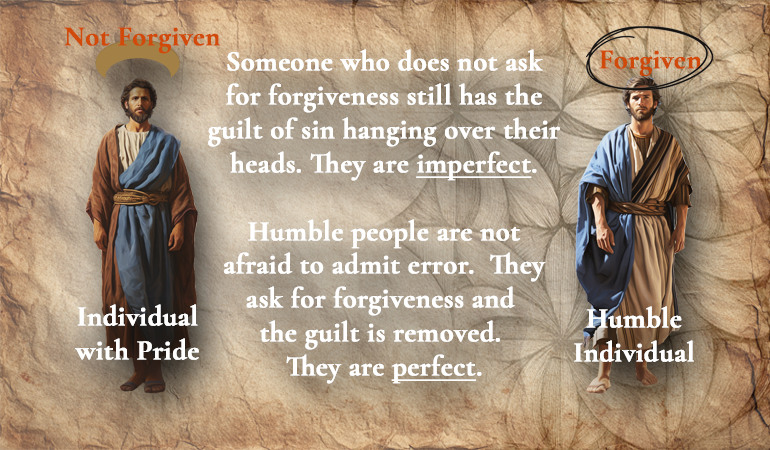
Prideful people think they have done nothing wrong. They refuse to see that their own words and behavior are hurting another individual. They refuse to see that their own words and behavior are hurting Yahuah. Because they do not see the behavior or words as wrong, they continue to do them which causes more harm to Yahuah and individuals. If they continue to do the harmful behaviors and speak the harmful words, the guilt is still hanging over their heads in the eyes of Yahuah. They are not providing restitution; they are still harming others. This individual is NOT perfect in the eyes of Yahuah.
“Perfection” requires humility, accountability and responsibility.
- We must admit that we have committed a wrong. This requires humility. (Confess our wrong)
- We must STOP harming others immediately by STOPPING the harmful behavior. We are the only ones who has the power to STOP committing the wrong. (Repentance)
- We must seek the forgiveness of those we have wronged with humility and genuine sincerity. (Forgiveness)
- We must offer restitution to those we have wronged in an effort to correct the harm we have done. (Restitution)
These are the actions absolutely necessary in order to remove the guilt over our heads. Messiah Yahusha cannot do this for us. WE must do these actions. When we read the Law in Vayiqra (Leviticus) 4:27-31, we can clearly see that the Law does NOT require the sacrifice of an innocent man or woman to remove our guilt. A clean animal without blemish is completely sufficient. This in direct contradiction to the following testimony in the letter to the Hebrews.
For it is not possible that the blood of bulls and of goats should take away sins. (Hebrews 10:4)
Sin has never been taken away with the sacrificial system. The only way sin is STOPPED is if we choose to STOP committing the sin ourselves through the act of repentance and restitution as we have illustrated.
This statement in the Letter to the Hebrews is a LIE.
The animal presented as an offering is a representation of us. We are that animal being sacrificed. The offering is a “clean” animal. This means that we must be “clean” when presenting this offering. The animal is to be “without blemish” which means we must be “without blemish”. We are that animal presented in the sacrificial system. It does not represent Messiah Yahusha. It represents us and the state we need to be before an animal sacrifice would be offered in our stead. It is a representation of us killing our own fleshly desires that led to the transgression we have committed.
The Hebrew word “without blemish” is “tamiym” and it is the same word translated as “perfect” in the following passage:
And when Abram was ninety years old and nine, Yahuah appeared to Abram, and said unto him, I am the Almighty Elohiym; walk before me, and you be perfect [H8549]. And I will make my covenant between me and thee, and will multiply thee exceedingly.
Is our Father referring to this generation’s definition of “perfection” or is He referring to His definition of “perfection”? This testimony tells us that before our Father would enter into this covenant with Abram, Abram was required to walk before Yahuah and “be perfect” or “tamiym”. When presenting an offering to Yahuah, we must also be “tamiym” or “perfect”. The Ancient Hebrew Lexicon of the Bible written by Jeff A. Benner defines “tamiym” and its root the following way:
MYMT ( masc., תמים / ta-mim) תמימה ( fem., תמימה) Translation: WHOLE Definition: Free of wound or injury; free of defect or impairment; having all its proper parts or components. KJV Translations: without blemish, perfect, upright, without spot, uprightly, whole, sincere, complete, full Strong’s Hebrew #: h.8549
MT ( masc., תם / tam) Translation: MATURE Definition: Having completed natural growth and development. An upright and correct nature. KJV Translations: perfect, undefiled, plain, upright Strong’s Hebrew #: h.8535
MT (תם) Action: Fill, Seal Object: Whole, Double, Orphan, Signet Abstract: Amazed, MatureDefinition: An overfilling or overflowing. One who is mature and upright as one who is overfilled with integrity.
Someone who is “tamiym” is upright, mature and overflowing with integrity. This is the state an individual must acquire in order to enter into covenant with Yahuah or to present a sacrifice to Him. The context of the following passage further defines “tamiym” as well from the perspective of our Father. It is translated as “undefiled”.
ALEPH. Blessed are the undefiled [H8549] in the way, who walk in the Law [Torah] of Yahuah.
People who are “tamiym” obey the Laws of Yahuah written in the Torah by the Prophet Moshe. This is confirmed in the following testimony which tells us that Abraham obeyed the Torah of Yahuah.
Because that Abraham obeyed my voice, and kept my charge, my commandments, my statutes, and My Laws [Torah].
Abraham was “tamiym” in the eyes of Yahuah. Because he was “tamiym,” Yahuah was willing to enter into covenant with him. They were “equally yoked” with one another because they observed the same Laws and had the same culture. Our Father and Messiah Yahusha cannot enter into covenant with someone who is not equally yoked with them. It is against the Law to do so.
Take heed to yourself, lest you make a covenant with the inhabitants of the land where you go, lest it be for a snare in the midst of you: But you shall destroy their altars, break their images, and cut down their groves: For you shalt worship no other mighty one: for Yahuah, whose name is Zealous, is a zealous Elohiym: Lest you make a covenant with the inhabitants of the land, and they go a whoring after their mighty ones, and do sacrifice unto their mighty ones, and one call you, and you eat of his sacrifice; And you take of their daughters unto your sons, and their daughters go a whoring after their mighty ones, and make your sons go a whoring after their mighty ones.
Yahuah abides by His own Laws. Messiah Yahusha abides by the Laws of his Father. If Yahuah does not permit His people to enter into covenant with people who disobey His Laws, He also CANNOT enter into covenant with people who disobey His Laws. Messiah Yahusha is not permitted to enter into covenant with people who disobey the Laws of Yahuah written by the Prophet Moshe either because of this Law. He said the following:
Whosoever therefore shall break one of these least commandments, and shall teach men so, he shall be called the least in the kingdom of heaven: but whosoever shall do and teach them, the same shall be called great in the kingdom of heaven.
Messiah Yahusha is the GREATEST in the Kingdom of Yahuah. He is standing to the right hand of our Father. This means that he obeyed ALL of the Laws of Yahuah written by the Prophet Moshe and teaches others to do the same to this very day. This is what Yahusha has taught me. Messiah Yahusha abides by the Laws spoken in Shemoth (Exodus) 34:12-16. So, in order to enter into covenant with Messiah Yahusha AND Yahuah Elohiym, we must become “tamiym” by obeying ALL of the Laws of Yahuah written by the Prophet Moshe. This requires us to have humility, accountability and take responsibility for our transgressions.
When we present an offering to Yahuah, we must also be “tamiym”. This means that we must be obedient to ALL of the Laws of Yahuah written by the Prophet Moshe in the Torah. If we have committed a sin, we have violated a Law of Yahuah. In this state, we are no longer “tamiym” in His eyes.
How can we present an offering to Him without being “tamiym”?
Tehillah (Psalm) 119:1 tells us that those who are “tamiym” walk in the Law of Yahuah. In order to present an acceptable offering to Yahuah, we must be walking according to His Laws. This tells us that we must repent from our sins prior to presenting an offering to Him. We must STOP the transgression and make restitution to others before we present an offering. Messiah Yahusha confirms this in the following testimony:
Therefore, if you bring your gift to the altar, and there remember that your brother has ought against you; Leave your gift there before the altar, and go your way; first be reconciled to your brother, and then come and offer your gift.
King David confirms this as well.
For you do not desire sacrifice; else would I give it: you delight not in burnt offering. The sacrifices of Elohiym are a broken spirit: a broken and a contrite heart, O Elohiym, you will not despise. Do good in your good pleasure unto Tziyon: build the walls of Yerushalayim. THEN shall you be pleased with the sacrifices of righteousness, with burnt offering and whole burnt offering: THEN shall they offer bullocks upon your altar.
According to this testimony, the concept of “tamiym” includes a “broken spirit and a broken and contrite heart”. We must be sorrowful for the wrongs we have committed and STOP committing them before any sacrifice on the altar would be accepted by our Father. This requires humility, accountability and taking responsibility for the wrongs we have committed. When we STOP committing the sin, we are “walking in the Laws of Yahuah” and have become “tamiym” before presenting our gift to Him. This is a necessary step. Testimony clearly illustrates that we can be forgiven of our sins without presenting an offering to Yahuah in the Temple:
Seek Yahuah while he may be found, call upon him while he is near: Let the wicked forsake his way, and the unrighteous man his thoughts: and let him return unto Yahuah, and he will have mercy upon him; and to our Elohiym, for he will abundantly pardon.
And it came to pass in the fourth year of Jehoiakim the son of Yoshiyahu king of Yahudah, that this word came unto Yirmeyahu from Yahuah, saying, Take you a roll of a book, and write therein all the words that I have spoken unto you against Yashar’El, and against Yahudah, and against all the nations, from the day I spoke unto you, from the days of Yoshiyahu, even unto this day. It may be that the house of Yahudah will hear all the evil which I purpose to do unto them; that they may return every man from his evil way; that I may forgive their iniquity and their sin.
If my people, which are called by my name, shall humble themselves, and pray, and seek my face, and turn from their wicked ways; THEN will I hear from heaven, and will forgive their sin, and will heal their land.
Our sins can be forgiven without presenting an offering. This is the necessary step in order to receive forgiveness and atonement through the sacrificial system. ALL three of these testimonies tell us that it is necessary for us to STOP committing the sin if we want to be forgiven by our Father. We must STOP causing harm to others. From the perspective of our Father, His Laws written by the Prophet Moshe prevent people from causing harm to Him and to others.
Yahuah cannot allow people who continue to harm others to enter into His Kingdom and Messiah Yahusha is in full support of this position.
Because forgiveness and atonement are obtained in the sacrificial system, this tells us that the individual must STOP committing the sin before presenting his or her gift on the altar.
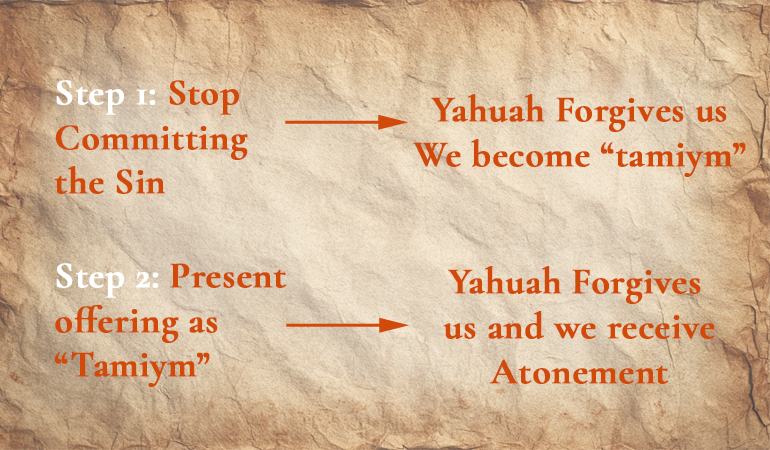
If we fail to complete Step 1, the clean animal in Step 2 has perished senselessly. It did not and cannot provide atonement for our sin because we are still committing the sin. We are not “tamiym”. This is the main issue discussed in Yeshayahu (Isaiah) 1.
Some people believe that Messiah Yahusha is a sacrifice for sin. If this is the case, then his sacrifice cannot atone for our sins unless we repent from our sins first. The Law says that we must become “tamiym” before we can receive forgiveness and atonement in any sacrifice for sin. If Messiah Yahusha were a sacrifice for sin, people would still need to STOP the harmful behavior through repentance and restitution. People erroneously think that they can continue to practice sin by harming others and our Father if they simply believe Messiah Yahusha is a sacrifice for their sins. This is a lie. Sacrifices for sin do not provide forgiveness or atonement unless we actually STOP committing the sins and seek our Father’s forgiveness.
This truth provides one more piece of evidence revealing that Messiah Yahusha is NOT a sacrifice for our sins. We are still accountable for every sin that we have ever committed. The only way guilt for sin is removed from our heads is to STOP committing the sins and seek our Father’s forgiveness with genuine sincerity. We must seek the forgiveness of those we have transgressed as well.
The Law NEVER requires the blood from an innocent man to atone for our sins.
In fact, the blood from an innocent man defiles the land.
So, you shall not pollute the land wherein you are: for blood it defiles the land: and the land cannot be cleansed of the blood that is shed therein, but by the blood of him that shed it.
Shedding the blood of an innocent man brings guilt upon the land and the individuals who participated in killing him. It does not remove guilt.
Why would our Father require blood from an innocent man to atone for sins or to ratify a covenant when it is a grievous sin to shed innocent blood?
The Law does not require blood from an innocent man or woman to atone for our sins. Clean animals without blemish are sufficient. This is what the Law clearly says.
And if he bring a lamb for a sin offering, he shall bring it a female without blemish. And he shall lay his hand upon the head of the sin offering, and slay it for a sin offering in the place where they kill the burnt offering. And the priest shall take of the blood of the sin offering with his finger, and put it upon the horns of the altar of burnt offering, and shall pour out all the blood thereof at the bottom of the altar: And he shall take away all the fat thereof, as the fat of the lamb is taken away from the sacrifice of the peace offerings; and the priest shall burn them upon the altar, according to the offerings made by fire unto Yahuah: and the priest shall make an atonement for his sin that he has committed, and it shall be forgiven him.
This text says that the priest will make atonement for him and his sin will be forgiven. Atonement and forgiveness are accomplished with an unblemished female lamb or goat. Nowhere does it say that blood from an innocent man or woman is required for atonement or forgiveness… NOT EVER.
“Perfection” or “tamiym” in the eyes of Yahuah is obedience to ALL of His Laws written in the Torah by the Prophet Moshe. If we violate one of His Laws, we repent from our sin. We STOP doing the sin which causes harm to Yahuah and to others. We humble ourselves and ask for His forgiveness with a contrite heart. We humble ourselves and ask for the forgiveness from others. Because we have STOPPED committing the sin or doing the harm, we are in alignment with ALL of His Laws once again. We are “tamiym”. We can present a sacrifice and enter into covenant with Yahuah Elohiym and Messiah Yahusha.
This is similar to a relationship between a husband and wife. Perhaps the husband says something hurtful to his wife. She is sad and cries because of the pain he caused with his words. Do they end their relationship because of this transgression? Unlikely. The husband would typically repent of his behavior and seek her forgiveness with sincerity. His wife sees that he is genuine. Perhaps, he brings her flowers or takes her out to dinner in effort to make restitution. She forgives him and relationship is restored. Is this a guarantee that they will not experience this kind of situation again? Anyone who has ever been married or in a serious relationship knows and understands that both husbands and wives will hurt one another and have misunderstandings throughout their relationship.
Likewise, our Father does not end His relationship with us if we accidentally transgress one of His Laws. We STOP the behavior that hurts Him and seek His forgiveness with a humble and contrite heart. He will see our sincerity and forgive us. The sacrificial system is one method of restitution that He has provided to restore relationship with Him. But we can offer other means of restitution as well. We can offer ourselves to Him as “living sacrifices” in service to Him. We are in a relationship with Him. We will make mistakes along the way. Our mistakes do not END our relationship with Him unless we commit sins worthy of death. This is also true in a marital relationship as well. Oftentimes the sin of adultery will end a marriage between a husband and wife. There are always limits to the amount of harm we can inflict upon another.
“Perfection” in the eyes of our Father is NOT “never making a mistake”. It is a genuine effort to walk in the Ways of our Father by obeying His Laws written in the Torah. The Law makes provisions for our mistakes. Therefore, it is very easy to Walk in our Father’s Ways and obey ALL of His Laws. “Perfection” is a essentially a walking in a state of “Being Forgiven”. In order to achieve this state of existence, we must repent from ALL of our sins and actively repent from them when we make mistakes. As we learn His Ways and walk with Him, it becomes easier to do over time. When we walk in His Ways, we are walking in His righteousness and we have no need to hide. We no longer have guilt hanging over our heads and are in right standing with Him. This is “perfection” in the eyes of Yahuah.
In order to escape judgement at the end of the age, we must attempt to remove the guilt hanging over our heads. This is necessary for us to enter into covenant with Yahuah and Messiah Yahusha which also provides protection in the wrath poured upon the nations. In marital relationships, husbands are not obligated to provide shelter, protection, food and clothing for those who are not his wife. The same is true of our Father in Heaven. He is not obligated to provide shelter, protection, food and clothing to those who are not in covenant with Him. Repentance from our harmful behaviors is absolutely necessary with subsequent restitution.
Download this Article here
