541-2 Yom Teruah: Remember
Speak unto the children of Yashar’El, saying, In the seventh month, in the first day of the month, you shall have a Shabbat, a memorial of blowing of Teruah, a set-apart gathering.
Yom Teruah is an Appointed Time established by Yahuah Elohiym on the first day of the seventh month. It begins the moment the first light of the waxing sliver of the moon is observed just after sunset in Yerushalayim (Jerusalem). Yahuah says that “Yom Teruah” is His Appointed Time. In order to determine the purpose of this Appointed Time, we must view things from His perspective and not our own. He says that “Yom Teruah” is a memorial. The Hebrew word translated as “memorial” is “zikron”.
And Yahuah spoke unto Moshe, saying, speak unto the children of Yashar’El, saying, In the seventh month, in the first day of the month, shall you have a Shabbat, a memorial [H2146] of Teruah [H8643], a Set-apart Miqra. You shall do no servile work therein: but you shall offer an offering made by fire unto Yahuah.
When we think of a “memorial,” we picture a day in which we remember fallen soldiers. Or we celebrate our independence. Memorials from our perspective are markers that help us remember a special event that occurred in our life whether good or bad. Grave stones remind us of our loved ones who have perished. Wedding rings remind us of the special day we got married.
What is a “memorial” from the perspective of Yahuah Elohiym?
Yom Teruah is a “memorial” of some event that is significant to Yahuah. The Hebrew word underlying “memorial” is “zikron” pronounced “zik-rone” and it is defined by The Ancient Hebrew Lexicon of the Bible written by Jeff A. Benner as:
NWRKYZ ( masc., זיכרון / zikh-ron ) Translation: REMEMBRANCE Definition: A recalling of a past event. Also, an action based on a past event. KJV Translations: memorial, remembrance, record Strong’s Hebrew #: h.2146 Aramaic Spelling: דיכרון Strong’s Aramaic #: a.1799
The two-lettered root of the Hebrew word “zikron” contains the letters “kaph” and “resh”. The Ancient Hebrew Lexicon of the Bible defines it as:
RK (כר) Action: Dig, Dance, Remember, Know Object: Bowl, Hollow, Farmer, Pit, Furnace, Male, Fissure Abstract: Wrong, Prepare, Memorial Definition: The palm as hollowed out. A digging. Ancient Hebrew:The pictograph K is a picture of the palm of the hand, the R is a picture of the head of a man. Combined these mean “palm of man”.
They represent the cupped palm of a man. The three-lettered root has the addition of the letter “zayin” or “zan” which is an agricultural instrument used to harvest food. It is the first letter in this Hebrew word as well. The Ancient Hebrew Lexicon of the Bible defines the letter “zan” or “zayin” as:
NZ (זן) Action: Harvest, Hear, Feed Object: Mattock, Harvest, Whore, Food Abstract: Balance, Whoredom Definition: One of the many agricultural tools was a hoe or mattock. This implement had a wide blade for cutting a plant stalks at the roots. The crops were harvested for a supply of foods, which were stored in jars. Ancient Hebrew: The pictograph Z is a picture of an agricultural cutting implement such as the mattock or hoe. The N is a picture of a seed. Combined these mean “mattock of the seed”.

When we put these letters together, we see “food in the palm of the hand”. It is the responsibility of the husband and father to provide food for his house. This is alluded to in the following passage:
If he take him another wife; her food, her raiment, and her duty of marriage, shall he not diminish.
Husbands are solely responsible to provide food and clothing to his household. This includes physical food as well as spiritual food. He is to teach his children the Ways of our Father. This is discussed in the Shema in Debarim (Deuteronomy) 6:4-9. The man of the house is responsible to tell his family about Yahuah and convey past events from his generation to the following generation. He is feeding his family. He is nourishing them. This is why this three-lettered root is also translated as “male”. It is not describing the appearance of a “male” but it is describing his function within the family. The Ancient Hebrew Lexicon of the Bible defines it the following way:
RKZ ( masc., זכר / za-khar ) Translation: MALE Definition: Being the gender who begets offspring. One who acts and speaks for the family. KJV Translations: male, man, child, mankind, him, ram Strong’s Hebrew #: h.2145 Aramaic Spelling: דכר Strong’s Aramaic #: a.1798
“Zikron” is the action of “recalling a past event or an action” and it is the responsibility of the husband and father to recall these events. It is the responsibility of the man who speaks on behalf of the family, to recall important past events. It is his responsibility to accurately pass down these events to future generations so they can be remembered. On this particular Day, the head of the house is to discuss the significance of “Yom Teruah” accurately to all future generations.
The purpose of Yom Teruah is to remember a significant past event in the eyes of Yahuah.
The prophet Moshe (Moses) and Malakiy (Malachi) provide examples of things to be remembered. These are two other occurrences with “zikron” highlighted in orange.
And this day shall be unto you for a memorial [#H2146]; and you shall keep it a Feast to Yahuah throughout your generations; you shall keep it a Feast by an ordinance forever.
In context, this is a reference to Pesach (Passover) which is an event to be remembered like Yom Teruah. It is a period of time to recall the great exodus from Egypt.
And you shall observe this thing for an ordinance to you and to your sons forever. And it shall come to pass, when you be come to the land which Yahuah will give you, according as he has promised, that you shall keep this service. And it shall come to pass, when your children shall say unto you, What mean you by this service? That you shall say, It is the sacrifice of Yahuah’s Passover, who passed over the houses of the children of Yashar’El in Egypt, when he smote the Egyptians, and delivered our houses. And the people bowed the head and worshipped.
In this particular Appointed Time, our Father clearly describes the details we are to remember about Pesach (Passover). The prophet Malakiy (Malachi) was also commanded to write about events happening in his time in a scroll to “remember” … to recall this past event as illustrated in the following instructions.
Then they that feared Yahuah spoke often one to another: and Yahuah hearkened, and heard it, and a book of remembrance [#H2146] was written before him for them that feared Yahuah, and that thought upon his name. And they shall be mine, says Yahuah of hosts, in that day when I make up my jewels; and I will spare them, as a man spares his own son that served him. Then shall you return, and discern between the righteous and the wicked, between him that served Elohiym and him that served him not.
These two events provide context for the definition of “zikron”. However, when we read the context of passages referring to “Yom Teruah”, we are not provided any details of the things we are to remember or recall.
Oftentimes, we seek understanding from the Jewish people and their practices. We make an assumption that they have a special insight into the Ways of our Father and that their practices have been done for thousands of years. We assume they have preserved the ancient ways in their beliefs and practices.
Rabbinic Judaism celebrates “Yom Teruah” as “Rosh HaShanah” which is translated as “the beginning of the new year”. However, in Shemoth 23:16, the context of the passage says that Sukkot (the Feast of Tabernacles) marks the “end of the year”.
Three times you shall keep a Feast unto me in the year. You shall keep the Feast of Unleavened Bread: (you shall eat unleavened bread seven days, as I commanded you, in the time appointed of the month Abib; for in it you came out from Egypt: and none shall appear before me empty:) And the Feast of Harvest [Shavuot], the First-fruits of your labors, which you have sown in the field: and the Feast of Ingathering [Sukkot], which is in the end of the year, when you have gathered in your labors out of the field. Three times in the year all your males shall appear before Adonai Yahuah.
This Feast occurs after Yom Teruah in the seventh month beginning on the 15th day of the seventh month. Yom Teruah is highlighted in blue and Sukkot is highlighted in orange in this list.
- Shabbat on the seventh day of the week
- Pesach (Passover)
- Matzah (Unleavened Bread)
- Reshith (First-Fruits)
- Shavuot (Oaths or Pentecost)
- Yom Teruah (Feast of Trumpets or Shouting) (Judaism says it is New Year’s Day)
- Yom Kippur (Day of Atonement)
- Sukkot (Feast of Tabernacles) (End of Year Shemoth 23:16)
- Shemini Atzeret (Eighth Day)
From the perspective of Judaism, the year begins on Yom Teruah but the Word of Yahuah says the year ends twenty days later? This does not make sense based on the Words of our Father. If there is going to be transition from one year to another, it seems Shemini Atzeret would be the appropriate day to establish this practice when the Feast of Sukkot has ended. Shemini Atzeret is the eighth day after the seven days of Sukkot.
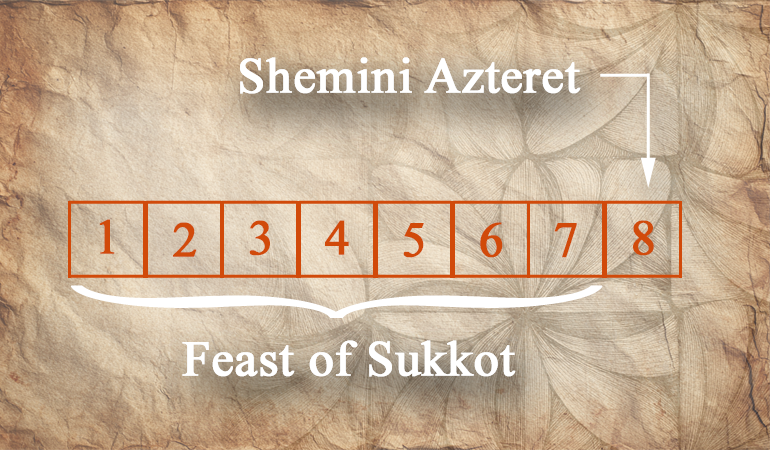
If the Feast of Sukkot is the “end of the year” from the perspective of our Father, then the “eighth” day after Sukkot would actually mark the beginning of the new year and not Yom Teruah.
Testimony in the Word also says that “beginning of the year” for Yahuah occurs in the Spring right before Pesach (Passover) in the first month of the year.
And Yahuah spoke unto Moshe and Aahron in the land of Egypt, saying, This month shall be unto you the beginning [H7218] of months: it shall be the first month of the year [H8141] to you.
Pesach (Passover) occurs in the Spring in the FIRST month of the year in Yahuah Elohiym’s reckoning of time. From the “perspective” of Yahuah Elohiym, the “beginning of the year” is the FIRST day of the “FIRST” month which is in the Spring and not the Fall. This would lead us to the following question:
Is a “year” in our Father’s Kingdom only seven months?
This is the way a year appears in our Father’s method of reckoning time based upon His Word:
- The FIRST day of the FIRST month is the “head” of the year. This occurs in the Spring.
- The Feast of Sukkot (Tabernacles) marks the END of the year in the seventh month. This occurs at the END of Summer.
The “year” follows the same pattern as a “day”. The first day of Spring symbolizes the sunrise and the last day of Summer represents sunset. Months 8-12 represent the “night-time” portion of the year which includes Fall and Winter. Here is an illustration.

Our Father’s Appointed Times only occur during the “Day” portion of a year and most of the Babylonian holidays occur during the “Night” portion of the year. Our Father’s Appointed Times are the special occasions for the children of Light and the Babylonian holidays are the special occasions for the children of Darkness.
The “date” for the daily cycle changes at sunset for a Day. When people gather to scan the sky for the first visible sliver of the moon each month, the moment they see it, the “date” changes. This establishes the pattern for every day thereafter. This is an established pattern that confirmed in the Creation account. Darkness existed first at the beginning of creation and then came the Light.
And the earth was without form, and void; and darkness was upon the face of the deep. And the Spirit of Elohiym moved upon the face of the waters. And Elohiym said, Let there be light: and there was light.
Here is the established pattern:
- Darkness existed first, then the Light came into the Darkness.
- The Kingdom of Darkness occurs first, THEN the Kingdom of Light ruled by our Messiah will come afterwards.
- We begin our day under the Kingdom of Darkness, THEN we go to sleep which is symbolic of the first death. In the morning at Son-rise, we awaken to a new Day. This is the resurrection where we will be ruled by the Kingdom of Light.
The “year” follows the same pattern. The count for the year shifts after Sukkot. The numbers assigned to the months are not reordered because the “head” of the year is in the Spring in our Father’s reckoning of time but the “year’ shifts from one year to another in the eighth month. Here is an illustration comparing it to the Day:

The count for the New Year for our Father begins in the eighth month which is symbolic for “new beginnings”. Shemini Atzeret is the Day right after Sukkot (Tabernacles). The Hebrew word “Shemini” means “eight”.
Also in the fifteenth day of the seventh month, when you have gathered in the fruit of the land, you shall keep a feast unto Yahuah seven days: on the first day shall be a Shabbat, and on the eighth day shall be a Shabbat.
This would mark the shift from one year to another in the yearly count. It is a Shabbat as well. Based on this evidence, “Yom Teruah” is not “Rosh HaShanah”. The “head” of the year is the first day of the first month in the Spring and begins with the barley harvest and Pesach (Passover).
If “Yom Teruah” is not Rosh Hashanah, then what does it represent? The context of the passage does not elaborate on this subject and apparently the event was not passed down from one generation to another by men representing Yahuah Elohiym. It is as if it has been forgotten and vanished from our memories. If we cannot remember the event, how can we actually honor “Yom Teruah” according to His commandment? This requires further investigation.
Download this Article here
