543-2 Sukkot for the Nations
And Yahuah spoke unto Moshe, saying, Speak unto the children of Yashar’El, saying, The fifteenth day of this seventh month shall be the Feast of Sukkot for seven days unto Yahuah.
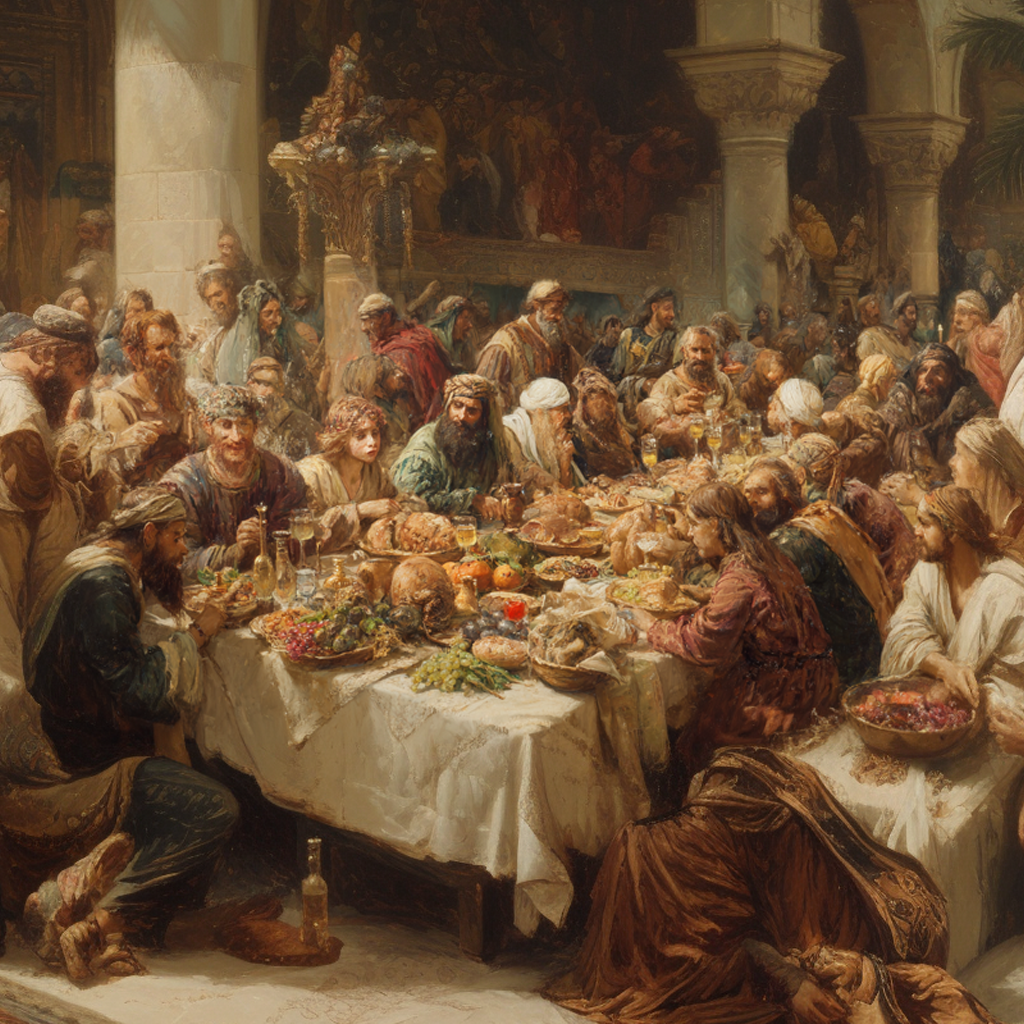
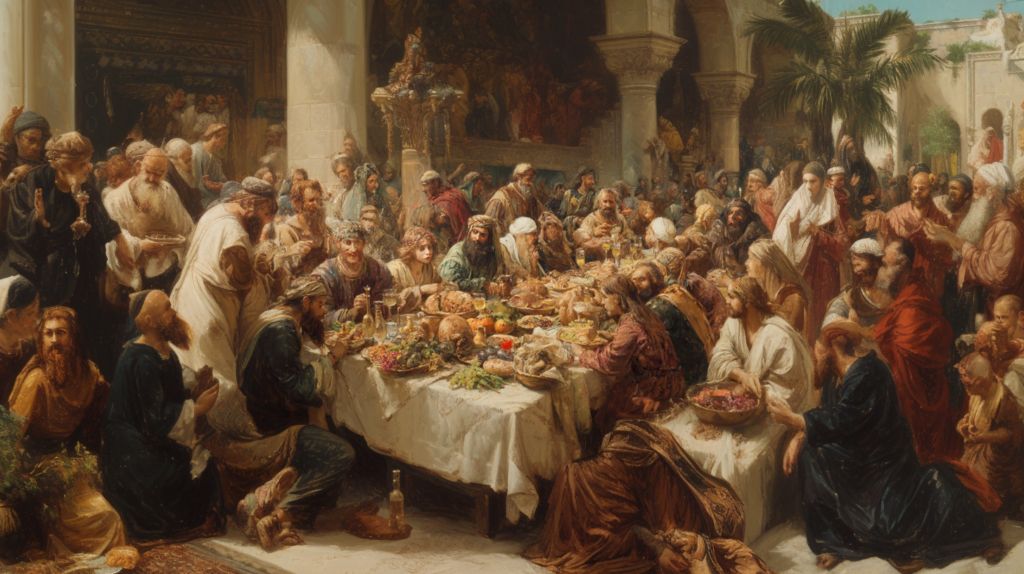
“Sukkot” often referred to as the “Feast of Tabernacles” is a Feast and an Appointed Time established by our Father in Heaven. When we think of “feasts,” we think of large amounts of really good food, gatherings of many people and a festive atmosphere just like the image to the left. It can involve games, dancing and fellowship.
Is this the purpose of this particular Feast or is there more to the story? Remember…
This is our Father’s Feast.
Why did Yahuah establish this Feast and what does it mean? Why is it important to Him? These are the questions we need to answer.
The Appointed Times of our Father were established at the foundation of Creation on the fourth day. The Hebrew word “moediym” in this passage is often translated as “seasons,” but it actually should be translated as “Appointed Times”. The first version is the way it is translated in the King James Bible and the second version has been corrected.
And Elohiym said, Let there be lights in the firmament of the heaven to divide the day from the night; and let them be for signs, and for seasons [H4150], and for days, and years:
And Elohiym said, Let there be lights in the firmament of the heaven to divide the day from the night; and let them be for signs, and for Appointed Times [H4150], and for days, and years:
When reading this passage in an English translation of our Father’s Word, we would not see that the “Appointed Times” of our Father were established in the very beginning of Creation. We are told that they are “seasons”. The Hebrew word “moediym” in Bereshith (Genesis) 1:14 is the same exact Hebrew word used in the following passage translated as “feast” in the King James Bible.
And Yahuah spoke unto Moshe, saying, speak unto the children of Yashar’El, and say unto them, concerning the Feasts [H4150] of Yahuah, which you shall proclaim to be set-apart meetings, even these are My Feasts [H4150].
If we use “Appointed Times,” we would clearly see an association between Bereshith (Genesis) 1:14 and Vayiqra (Leviticus) 23:1-2.
And Yahuah spoke unto Moshe, saying, speak unto the children of Yashar’El, and say unto them, concerning the Appointed Times [H4150] of Yahuah, which you shall proclaim to be set-apart meetings, even these are My Appointed Times [H4150].
Relying solely upon English translations of our Father’s Word can cause us to misunderstand and misinterpret His original intended message to His people. Seeing this association between Bereshith 1:14 and Vayiqra 23:1-2 leads us to the following question:
What “Appointed Times” were established by the sun, moon and stars?
Were these “Appointed Times” a reference to Christmas, Easter and Halloween? No, these are NOT the “Appointed Times” created by our Father in the beginning. They are manmade institutions used to replace His Appointed Times. Most of us have been taught that the “Appointed Times” mentioned in Vayiqra (Leviticus) 23 had not been established until the covenant was given at Mount Sinai by the Prophet Moshe. Did our Father actually create these Appointed Times when He gave the House of Yashar’El the covenant at Mount Sinai or did He already create them in the beginning and was just telling the House of Yashar’El what they were? For example, the Shabbat on the seventh day was addressed first in Vayiqra 23.
Six days shall work be done: but the seventh day is the Shabbat of rest, a set-apart convocation; you shall do no work therein: it is the Shabbat of Yahuah in all your dwellings.
Did this Law in Vayiqra 23 establish the beginning of the Shabbat on the seventh day? No, we see evidence that this Appointed Time was firmly established as a sign on the seventh day of Creation.
And on the seventh day Elohiym ended his work which he had made; and he rested on the seventh day from all his work which he had made. And Elohiym blessed the seventh day, and set it apart: because that in it he had rested from all his work which Elohiym created and made.
In Vayiqra (Leviticus) 23:1-2, Yahuah Elohiym is telling us His Appointed Times that were created on the fourth day. He did NOT create them at this moment in time. He is telling the House of Yashar’El what they are. Here is the list of our Father’s Appointed Times in Vayiqra 23.
- Shabbat on the seventh day of the week
- Pesach (Passover)
- Matzah (Unleavened Bread)
- Reshith (First-Fruits)
- Shavuot (Oaths or Pentecost)
- Yom Teruah (Feast of Trumpets or Shouting)
- Yom Kippur (Day of Atonement)
- Sukkot (Feast of Tabernacles)
- Shemini Atzeret (Eighth Day)
Messiah Yahusha confirms this understanding when he said the following regarding the seventh day Shabbat.
And he said unto them, The Shabbat was made for man, and not man for the Shabbat: Therefore, the Son of man is Master also of the Shabbat.
When we examine the creation account, everything created prior to the creation of man was made FOR mankind. The land, plants, birds, fish, sun, moon… all were created for man’s benefit. Since the Appointed Times were established on the fourth day, Shabbat was created FOR man and not the other way around. This tells us that the Appointed Times listed in Vayiqra 23 were created or established on the fourth day of Creation.
We have further evidence to substantiate this position. In the beginning, Qayin (Cain) and Abel were presenting offerings to Yahuah. How did they know what to do? What were they acknowledging in our Father’s Kingdom? Were they actually celebrating one of the Feasts of Yahuah based on their offerings? Here is the testimony provided by Yahuah.
And in process of time it came to pass, that Qayin brought of the fruit of the ground an offering unto Yahuah. And Abel, he also brought of the firstlings of his flock and of the fat thereof. And Yahuah had respect unto Abel and to his offering: But unto Qayin and to his offering he had not respect. And Qayin was very wroth, and his countenance fell.
Abel presented female goats or sheep. This is what the underlying Hebrew tells us. Female sheep or goats are used when a common man sins against Yahuah. They can also be used in the Shalom or Peace offerings. They can also be used in Thanksgiving offerings. Because Abel presented more than one, it was not a sacrifice for a personal sin. Shalom or Peace offerings were commonly presented during Feasts as Thanksgiving offerings. The meat was eaten by the Priests as well as the family of the one presenting the sacrifice. It was like a family barbeque. Perhaps Abel slaughtered more than one to share the meat with others on this special occasion. Here is the evidence for the Shalom offering.
And if his oblation be a sacrifice of shalom offering, if he offer it of the herd; whether it be a male or female, he shall offer it without blemish before Yahuah.
Qayin (Cain) presented the “fruit of the ground” which is a significant clue. This type of offering was only presented on First-fruits during the Feast of Matzah (Unleavened Bread), the Feast of Shavuot (Oaths) and the Feast of Sukkot. This evidence illustrates that Qayin and Abel were observing one of these three Feasts in Bereshith (Genesis) 4:3-5. The Hebrew word translated as “fruit” in this passage is most often associated with “fruit” produced by trees or vines. Here are a couple of examples:
And your strength shall be spent in vain: for your land shall not yield her increase, neither shall the trees of the land yield their fruits [H6529].
For the seed shall be prosperous; the vine shall give her fruit [H6529], and the ground shall give her increase, and the heavens shall give their dew; and I will cause the remnant of this people to possess all these things.
The Ancient Hebrew Lexicon of the Bible written by Jeff A. Benner defines “pari” translated as “fruit” the following way.
YRP ( masc., פרי / pe-ri) Translation: PRODUCE Definition: Agricultural products, especially fresh fruits and vegetables. The harvested product of a crop. Edenics: fruit, also other fruits with a “pr” such as pear and apricot KJV Translations: fruit, fruitful, bough, reward Strong’s Hebrew #: h.6529
It has an Edenics connection to the English words “pear” and “apricot” which are both fruits produced on trees. However, offspring and grain can also be defined by this term as well.
And he will love you, and bless you, and multiply you: he will also bless the fruit [H6529] of your womb, and the fruit [H6529] of your land, your grain, and your wine, and your oil,the increase of your cattle, and the flocks of your sheep, in the land which he swore unto your fathers to give you.
The “fruit” of the ground in this passage includes grain, grapes and olives. Both grapes and olives produce ripe fruit at the end of Summer which is the same time as Sukkot (Tabernacles). This does not provide conclusive proof that Qayin (Cain) brought fruit from trees or vines in Bereshith (Genesis) 4:3-5. These are the three Feasts that require people to present the first-fruits of their harvests.
- Feast of Matzah: Barley
- Feast of Shavuot: Wheat
- Feast of Sukkot: Fruits like grapes and olives
The Law written by Moshe instructs us not to attend these Feasts “empty-handed”. Qayin (Cain) and Abel were adhering to these instructions as well.
Three times in a year shall all your males appear before Yahuah your Elohiym in the place which he shall choose; in the Feast of Matzah, and in the Feast of Shavuot, and in the Feast of Sukkot: and they shall not appear before Yahuah empty: Every man shall give as he is able, according to the blessing of Yahuah your Elohiym which he has given you.
Qayin (Cain) and Abel did not appear before Yahuah “empty-handed”. However, Qayin’s offering wasn’t acceptable in the eyes of Yahuah. Abel brought his best but Qayin did not. Our Father does not accept offerings that are corrupted based on the following testimony.
For from the rising of the sun even unto the going down of the same my name shall be great among the Gentiles; and in every place incense shall be offered unto My Name, and a pure offering: for My Name shall be great among the heathen, says Yahuah Tzavaot. But you have profaned it, in that you say, The table of Yahuah is polluted; and the fruit thereof, even his meat, is contemptible. You said also, Behold, what a weariness is it! and you have snuffed at it, says Yahuah Tzavaot; and you brought that which was torn, and the lame, and the sick; thus you brought an offering: should I accept this of your hand? says Yahuah. But cursed be the deceiver, which has in his flock a male, and vows, and sacrifices unto Adonai a corrupt thing: for I am a great King, says Yahuah Tzavaot, and My Name is dreadful among the heathen.
Our Father is consistent and His Laws are eternal. The men mentioned in this passage were committing the same transgression as Qayin (Cain) did in the very beginning. They were not presenting the best of their flocks to Yahuah. Likewise, Qayin was not presenting the best of his produce from the land. He gave inferior fruits to Yahuah. Therefore, Yahuah did not accept Qayin’s offering. Based on testimony, Qayin knew what he needed to do to present an acceptable offering to Yahuah.
And Yahuah said unto Qayin, Why are you angry? and why is your countenance fallen? If you do well, shall you not be accepted? and if you do not do well, sin lies at the door. And unto you shall be his desire, and you shall rule over him.
Qayin knew the Laws of our Father. He knew what he needed to do to be accepted by Yahuah. This provides further evidence that the Laws of our Father existed in the very beginning. We have a study titled, The Torah Existed in the Beginning, that discusses the evidence proving the Law existed in the very beginning. It is likely, His Laws have existed as long as He has existed.
Our Father operates according to the earth’s harvest cycles. In His reckoning of time, it is extremely important to ensure the first Feast of the year is observed when the Barley is mature and ready to reap. This ensures that the timing for the remaining Feasts are in sync with their associated harvests. Therefore, it is imperative that witnesses examine the Barley fields before establishing the first month of the year.
- We must present mature Barley before Yahuah on First-Fruits during the Feast of Matzah
- We must present mature Wheat before Yahuah on the Feast of Shavuot.
- We must present ripened grapes and olives on the Feast of Sukkot.
We do not want to approach Yahuah “empty-handed”. When the Feast of Matzah is established, then the rest of the harvests will also be in sync with our Father’s Appointed Times. Testimony tells us that the Feast of Matzah (Unleavened Bread) and the Feast of Shavuot (Oaths) are specifically reserved for the House of Yashar’El.
And Yahuah said unto Moshe and Aahron, This is the ordinance of the Pesach: There shall no stranger eat thereof: But every man’s servant that is bought for money, when you have circumcised him, then shall he eat thereof. A foreigner and a hired servant shall not eat thereof. In one house shall it be eaten; you shall not carry forth ought of the flesh abroad out of the house; neither shall you break a bone thereof. All the congregation of Yashar’El shall keep it. And when a stranger shall sojourn with you, and will keep the Pesach to Yahuah, let all his males be circumcised, and then let him come near and keep it; and he shall be as one that is born in the land: for no uncircumcised person shall eat thereof.
The Feast of Shavuot occurs in the third month of the year and is the Feast when the Covenant at Mount Sinai was given to the House of Yashar’El.
In the third month, when the children of Yashar’El were gone forth out of the land of Egypt, the same day came they into the wilderness of Sinai. For they were departed from Rephidim, and were come to the desert of Sinai, and had pitched in the wilderness; and there Yashar’El camped before the mount. And Moshe went up unto Elohiym, and Yahuah called unto him out of the mountain, saying, Thus, shall you say to the house of Ya’aqob, and tell the children of Yashar’El; You have seen what I did unto the Egyptians, and how I bare you on eagles’ wings, and brought you unto myself. Now, therefore, if you will obey my voice indeed, and keep my covenant, then you shall be a peculiar treasure unto me above all people: for all the earth is mine: And you shall be unto me a kingdom of priests, and a set-apart nation. These are the words which you shall speak unto the children of Yashar’El.
The Feast of Sukkot (Tabernacles) is a Feast designated for the nations. People from the nations can become a part of the House of Yashar’El and participate in the other two Feasts. They become a part of the House of Yashar’El when they are circumcised in heart and flesh with willing obedience to the Laws of Yahuah given in the covenant at Mount Sinai. When the Kingdom of Yahuah is established in the earth by our Messiah, the Prophet Zekaryah tells us the nations will be required to attend the Feast of Sukkot or Tabernacles.
And it shall come to pass, that every one that is left of all the nations which came against Yerushalayim shall even go up from year to year to worship the King, Yahuah of hosts, and to keep the Feast of Sukkot.
The Torah and Prophets provide our Father’s plan to restore His original order in the earth back to the way it was in the very beginning before Adam and Chavah sinned. Because Qayin (Cain) and Abel are not from the House of Yashar’El, we can conclude that the Feast they were observing was Sukkot or Tabernacles. It is a Feast specifically reserved for all of mankind and not just the House of Yashar’El. It was honored by Qayin and Abel in the beginning and will be honored by the nations when order is re-established in the earth by our Messiah.
- Qayin and Abel celebrated the Feast of Sukkot
- The Nations will be celebrating the Feast of Sukkot
The prophecy in Zekaryah (Zechariah) is a restoration of our Father’s original order. Why were Qayin (Cain) and Abel celebrating the Feast of Sukkot? Why is this particular Feast important to the nations? It is a Feast to be observed by the House of Yashar’El but we also came from the line of Adam. Some of us are from the nations and have been grafted into the House of Yashar’El. We ALL originally came from the first Adam. The offspring of Adam are to celebrate the Feast of Sukkot. Here are the instructions in the Law:
Also, in the fifteenth day of the seventh month, when you have gathered in the fruit of the land, you shall keep a Feast unto Yahuah seven days: on the first day shall be a Shabbat, and on the eighth day shall be a Shabbat. And you shall take you on the first day the boughs of goodly trees, branches of palm trees, and the boughs of thick trees, and willows of the brook; and you shall rejoice before Yahuah your Elohiym seven days. And you shall keep it a Feast unto Yahuah seven days in the year. It shall be a statute forever in your generations: you shall celebrate it in the seventh month. You shall dwell in booths [H5521] seven days; all that are Yashar’Elites born shall dwell in booths [H5521]: That your generations may know that I made the children of Yashar’El to dwell in booths [H5521], when I brought them out of the land of Egypt: I am Yahuah your Elohiym.
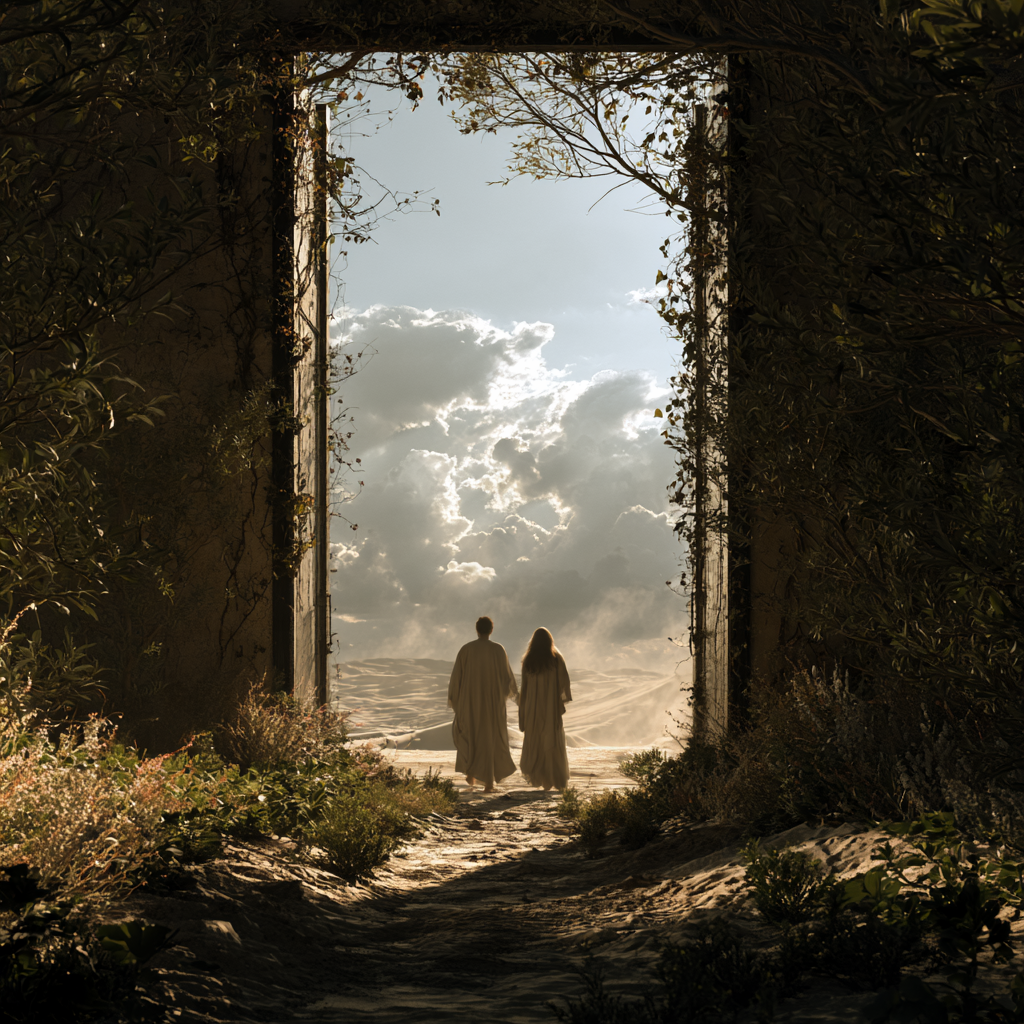
We are instructed to dwell in “booths” for seven days because Yahuah made Yashar’El dwell in booths when He brought them out of the land of Egypt. But He also made Adam and Chavah dwell in booths when He removed them from the Garden of Eden in the beginning.
They were living in the House of Yahuah in the Garden of Eden. They sinned and were removed into the wilderness outside the Garden of Eden.
Therefore, Yahuah Elohiym sent him forth from the Garden of Eden, to till the ground from where he was taken. So, he drove out the man; and he placed at the east of the Garden of Eden Kerubiym, and a flaming sword which turned every way, to keep the Way of the Tree of Life.
Mankind as a collective have been dwelling in “booths” in the wilderness outside the Garden of Eden since this time. The Hebrew word translated as “booth” is “sukkah” or “sukkot” when plural. The Ancient Hebrew Lexicon of the Bible defines “sukkah” the following way:
HKWS ( fem., סוכה / su-kah) Translation: BOOTH Definition: A temporary shelter; a small enclosure; dwelling place. KJV Translations: tabernacle, booth, pavilion, cottage, covert, tent Strong’s Hebrew #: h.5521
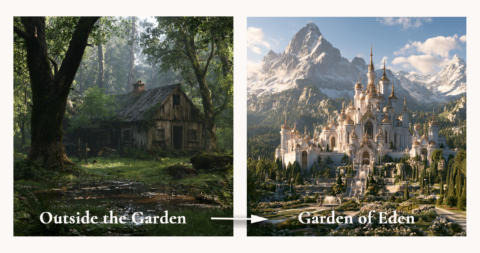
It is not a permanent “shelter”. It is “temporary” and inferior to our permanent dwellings. The first shelter Adam constructed outside the Garden of Eden was definitely inferior to the place he was dwelling in the Garden of Eden. Here is an illustration:

Every dwelling on this side of the Garden of Eden is inferior to the dwellings inside the Garden. Here is the sequence of events memorialized by the Appointed Times in the seventh month.
- Yom Teruah, first day of seventh month: Adam and Chavah sinned. Curses pronounced.
- Yom Kippur, tenth day of seventh month: Judgement commenced, Adam and Chavah cast-out of the Garden
- Chag Sukkot, fifteenth day of seventh month: Adam and Chavah constructed a temporary shelter outside the Garden of Eden to protect themselves from the elements and wild beasts.
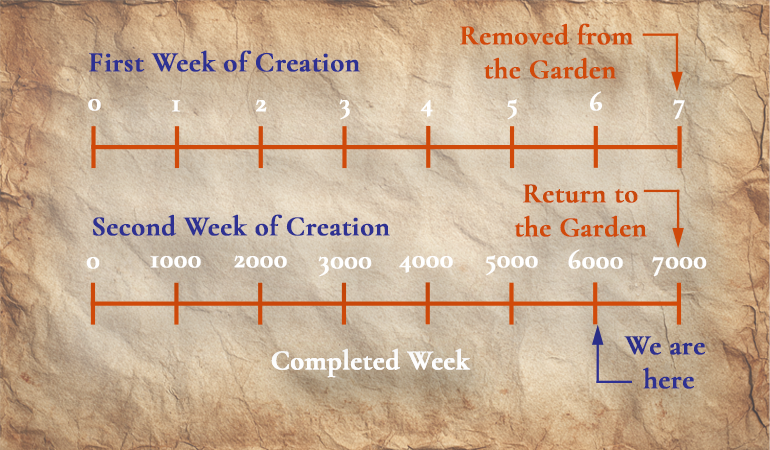
The Feast of Sukkot (Tabernacles) lasts seven days. Mankind dwells in “booths” for seven days, then they return to their permanent dwelling. Does this mean that at the end of “seven days” that mankind returns to their dwelling in the Garden of Eden?
One “day” is not necessarily a reference to a 24-hour period as we understand it in our culture. Yahuah had told Adam that he would die in the day he ate from the forbidden tree. Testimony says that Adam actually lived 930 years. This is more than one 24-hour period of time. But it is shy of one millennium. “One Day” in our Father’s reckoning of time can be “One Millennium”. If this is the case, then mankind is to dwell in “booths” for “Seven Millennium” outside the Garden and then can return to their original dwelling place in the Garden of Eden when the “seven days” are complete. Here is an illustration:
We can also apply this pattern to our bodies of flesh. Our spirits dwell in a body of flesh. It is referred to as a “tabernacle” or a “tent” in the following testimonies.
I said in the cutting off of my days, I shall go to the gates of the grave: I am deprived of the residue of my years. I said, I shall not see Yahuah, even Yahuah, in the land of the living: I shall behold man no more with the inhabitants of the world. my age is departed, and is removed from me as a shepherd’s tent: I have cut off like a weaver my life: he will cut me off with pining sickness: from day even tonight will you make an end of me.
For we know that if our earthly house of this tabernacle were dissolved, we have a building of Elohiym, a house not made with hands, eternal in the heavens. For in this we groan, earnestly desiring to be clothed upon with our house which is from heaven: If so be that being clothed we shall not be found naked. For we that are in this tabernacle do groan, being burdened: not for that we would be unclothed, but clothed upon, that mortality might be swallowed up of life.
Yea, I think it meet, as long as I am in this tabernacle, to stir you up by putting you in remembrance; Knowing that shortly I must put off this my tabernacle, even as our Messiah Yahusha has showed me. Moreover, I will endeavor that you may be able after my decease to have these things always in remembrance.
The “sukkah” is a temporary dwelling like our current physical bodies of flesh. In the resurrection, we will be given uncorrupted bodies of flesh. They will be regenerated whole and complete with no blemishes. This is also discussed by Shaul of Tarsus (Paul).
In a moment, in the twinkling of an eye, in the last trumpet, for it shall sound, and the dead shall be raised incorruptible, and we—we shall be changed: for it behooves this corruptible to put on incorruption, and this mortal to put on immortality; and when this corruptible may have put on incorruption, and this mortal may have put on immortality, then shall be brought to pass the word that has been written, ‘The Death was swallowed up—to victory;
Mankind dwells in “sukkah” for “seven days” and then can return home to their permanent dwelling. Our spirits dwelling inside our bodies of flesh will dwell in new bodies of flesh which are far more superior to the ones we have now. Here is an illustration using the houses for comparison between our current body of flesh and the new body of flesh we will receive in the resurrection.
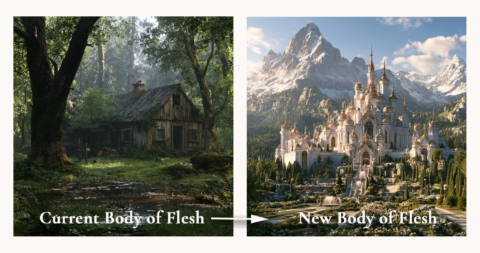
Our current body is a “temporary” shelter like a “sukkah” erected during the Feast of Sukkot. The House of Yashar’El were made to dwell in these temporary shelters when they came out of Egypt. When they entered the land of promise, they were no longer dwelling in temporary shelters. When we enter the final promised land in the resurrection which is the Garden of Eden, we will also no longer be dwelling in “temporary” shelters.
Our spirit will dwell in a new body of flesh that is much more superior and can exist for an eternity.
Our body will not age and fall apart. It will no longer be diseased, lame, blind or broken. We will be whole and complete with restored youthfulness. Our flesh will no longer be under the curses listed in Bereshith (Genesis) 3:14-24. Essentially, mankind will be living in these “temporary dwellings” for 7000 years. In Revelation, it tells us that the first resurrection occurs before the seventh millennium and the second resurrection occurs after it.
And I saw thrones, and they sat upon them, and judgment was given unto them: and I saw the souls of them that were beheaded for the witness of Yahusha, and for the Word of Elohiym, and which had not worshipped the beast, neither his image, neither had received his mark upon their foreheads, or in their hands; and they lived and reigned with Messiah a thousand years. But the rest of the dead lived not again until the thousand years were finished. This is the first resurrection. Blessed and set-apart is he that has part in the first resurrection: on such the second death has no power, but they shall be priests of Elohiym and of Messiah, and shall reign with him a thousand years.
Those in the first resurrection are not technically living in their temporary dwellings for seven days. This would only be six days. However, they are living on the earth for the last thousand years with our Messiah but will do so in their resurrected bodies. So, they are still living outside the Garden during this time. The Law says that Hebrew servants serve six years and are released in the seventh year.
And if your brother, a Hebrew man, or a Hebrew woman, be sold unto you, and serve you six years; then in the seventh year you shall let him go free from you.
This is a pattern established by our Father substantiated by testimony in the Book of Revelation. “Hebrews” are released at the end of the sixth millennium. “Hebrews” are people who have “crossed-over to the other side”. This label is not strictly a reference to bloodline children of Hebrews. This is discussed further in our study titled, What is a Hebrew? These are people who have crossed-over from the Kingdoms of this current world system to the Kingdom of Yahuah. Bloodline children who descended from Hebrews who have not crossed-over to the Kingdom of Yahuah will not be included in the first resurrection. The people in the first resurrection observe the Shabbat on the seventh day. They are practicing for their role in the Kingdom of Yahuah when our Messiah returns.
The Feast of Sukkot applies to all of mankind because everyone is going to be resurrected from the first death because of the redemption provided by Messiah Yahusha whether they are in the first or second resurrection. This is explained in the following testimony:
For since by Man came death, by Man came also the resurrection of the dead. For as in Adam ALL die, even so in Messiah shall ALL be made alive.
Everyone is going to be resurrected and receive a new body of flesh. But not everyone is going to receive eternal life. This is illustrated in the following testimony:
Marvel not at this: for the hour is coming, in the which ALL that are in the graves shall hear his voice, And shall come forth; they that have done good, unto the resurrection of life; and they that have done evil, unto the resurrection of damnation.
Qayin (Cain) and Abel are going to be resurrected from the dead because of Messiah Yahusha’s redemption. Abel will have an opportunity to live again with an eternal life in a restored body of flesh. We do not know the eternal outcome of Qayin. Perhaps he repented in the end but we do not know with certainty until the day the resurrection arrives. In this testimony, our Messiah establishes the distinguishing characteristics between these two groups of people. Those who have done good will receive eternal life and those who have done evil will receive damnation. Those who have repented from their sins will receive eternal life and those who did not will receive damnation. ALL of us have opportunity to do good and receive eternal life. Our Father had told Abraham that in him ALL the families of the earth will be blessed.
And I will make of you a great nation, and I will bless you, and make your name great; and you shall be a blessing: And I will bless them that bless you, and curse him that curses you: and in you shall ALL families of the earth be blessed.
As someone who is over 50 years old, receiving a new body of flesh that is whole and complete is an amazing gift! Having a body that is not broken, old and decaying would be a tremendous blessing. It is an extremely valuable gift. This is the free gift all of us have received from our Father through Messiah Yahusha’s redemption. However, the only way we can receive eternal life is to gain access to the Garden of Eden and the Tree of Life. We cannot enter the Garden of Eden unless we have an uncorrupted body of flesh and do not commit sin. If we commit sin in our new bodies, we have corrupted it again and cannot enter the Garden. This is why it is important for us to repent from our sins now.
Every single individual has received this gift and an opportunity to receive eternal life. We will all be resurrected and receive regenerated bodies of flesh. Abraham has truly become a great blessing to all the families of the earth. The Feast of Sukkot gives us this opportunity to show our gratitude to our Father and Messiah.
Download this Article here
