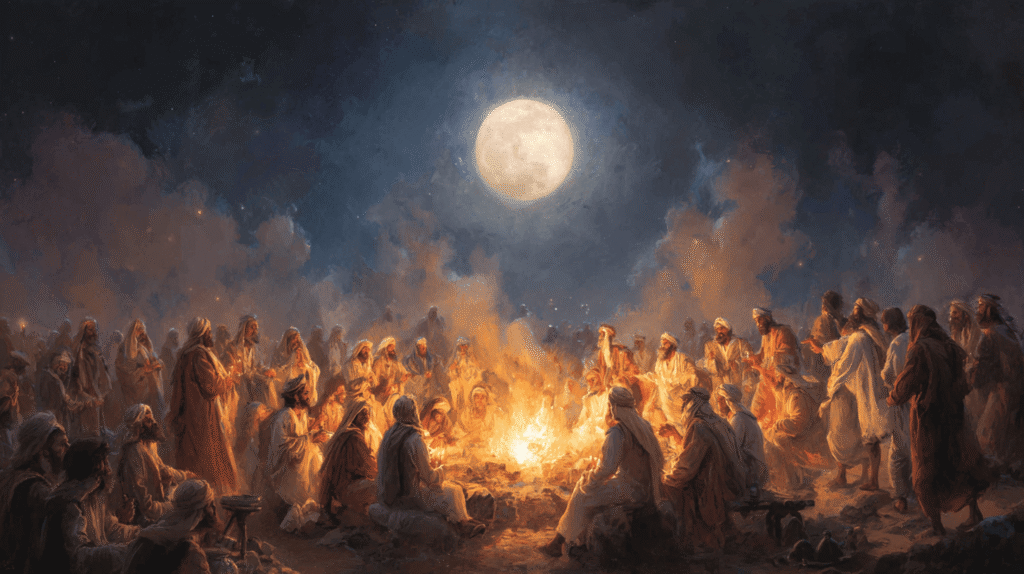
543-1 Sukkot: Determining the Day
And Yahuah spoke unto Moshe, saying, Speak unto the children of Yashar’El, saying, The fifteenth day of this seventh month shall be the Feast of Sukkot for seven days unto Yahuah.
Sukkot or the Feast of Tabernacles is one of three Feasts established by our Father and one of nine Appointed Times listed in Vayiqra (Leviticus) 23. Each Feast represents a harvest. Pesach and Matzah (Passover and Unleavened Bread) involve the harvest of Barley. It is the first grain harvested in the Spring. The Feast of Shavuot or Pentecost involves the harvest of the Wheat. Sukkot or the Feast of Tabernacles involves the harvest of all the other crops with the grape and olives mentioned in particular.
The “year” or “shanah” in our Father’s Kingdom begins in the first month and ends in the seventh month. It is the period of harvest. When the Word tells us that Noach lived 600 years or shanah, it means that he had lived 600 harvest cycles up to that point. They did not count from the day of their birth like we do in our culture. This concept is discussed in detail in our study titled, Hebrew Word Study: Shanah.
Determining the day the Feast of Sukkot begins requires us to firmly establish the first day of the seventh month which is Yom Teruah. We have discussed how to determine this day in our study titled, Yom Teruah: Determining the Day. We highly recommend reading this study prior to this particular study. In that study, we firmly established that our Father uses the moon to establish His Appointed Times. This is illustrated by King David in the following passage.
He [Yahuah] made the moon [yareach] for Appointed Times [H4150]: the sun knows his going down.
King David had the Set-apart Spirit inside him. The Set-apart Spirit inside of him would not tell him one thing and then tell someone else something different. For example, our Father would not tell King David that He uses the moon and then tell the patriarch Enoch that He uses the sun. We know King David spoke on behalf of Yahuah Elohiym and if we truly have the Set-apart Spirit inside of us, then the Set-apart Spirit will tell us the same thing. We would be in alignment with the Words spoken by King David. His testimony is clear in English and Hebrew.
Yahuah made the moon to establish His Appointed Times.
The Hebrew word for “appointed times” in Tehillah (Psalm) 104:19 is the same Hebrew word used in the following passage:
And Yahuah spoke unto Moshe, saying, speak unto the children of Yashar’El, and say unto them, concerning the Appointed Times [H4150] of Yahuah, which you shall proclaim to be set-apart meetings, even these are My Appointed Times [H4150].
Yahuah created the moon to establish His Appointed Times. The Hebrew word “kiseh” is related to the side view of a King sitting upon a throne. This is a direct reference to the first light of the waxing sliver of the moon. This is why this Hebrew word is related to the Hebrew word translated as “throne”. The moon as a sliver looks like a King sitting upon his throne.
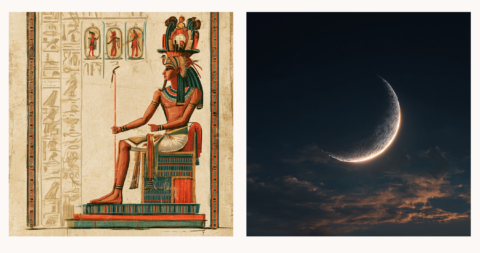
This is the first day or “head” of the month in our Father’s Kingdom. It is an announcement from the throne of Yahuah. Each phase of the waxing moon, looks like a King beginning to stand up. When the moon is full, the King is fully standing and ready to join the festivities during the Feast of Sukkot. This is discussed further in our study titled, Hebrew Word Study: Kiseh. In order to understand the original intended messages given to us in the Word of our Father, we must look through the eyes of ancient peoples who live, think and communicate differently than we do today.
Based upon this evidence, Sukkot is determined using the lunar cycle in the seventh month. In Vayiqra (Leviticus) 23, Yahuah mentions all of His Appointed Times in the following passages which include:
- Shabbat on the seventh day of the week
- Pesach (Passover)
- Matzah (Unleavened Bread)
- Reshith (First-Fruits)
- Shavuot (Oaths or Pentecost)
- Yom Teruah (Feast of Trumpets or Shouting)
- Yom Kippur (Day of Atonement)
- Sukkot (Feast of Tabernacles)
- Shemini Atzeret (Eighth Day)
“Sukkot” is on this list highlighted in orange. It is an Appointed Time of Yahuah which means the moon establishes the specific day for this Appointed Time in our Father’s Kingdom. Testimony says it is the fifteenth day of the seventh month.
And Yahuah spoke unto Moshe, saying, Speak unto the children of Yashar’El, saying, The fifteenth day of this seventh month shall be the Feast of Sukkot for seven days unto Yahuah. On the first day shall be a set-apart meeting: you shall do no servile work therein. Seven days you shall offer an offering made by fire unto Yahuah: on the eighth day shall be a set-apart meeting unto you; and you shall offer an offering made by fire unto Yahuah: it is a solemn assembly; and you shall do no servile work therein.
Also, in the fifteenth day of the seventh month, when you have gathered in the fruit of the land, you shall keep a Feast unto Yahuah seven days: on the first day shall be a Shabbat, and on the eighth day shall be a Shabbat. And you shall take you on the first day the boughs of goodly trees, branches of palm trees, and the boughs of thick trees, and willows of the brook; and you shall rejoice before Yahuah your Elohiym seven days. And you shall keep it a Feast unto Yahuah seven days in the year. It shall be a statute forever in your generations: you shall celebrate it in the seventh month. You shall dwell in booths seven days; all that are Yashar’Elites born shall dwell in booths: That your generations may know that I made the children of Yashar’El to dwell in booths, when I brought them out of the land of Egypt: I am Yahuah your Elohiym.
It begins on the fifteenth day of the seventh month in our Father’s method of reckoning time and ends on the twenty-first day of the month. We can translate Tehillah (Psalm) 104:19 the following way as it relates to Sukkot because it is an Appointed Time of our Father:
He [Yahuah] made the moon for Sukkot: the sun knows his going down.
Only three of these Appointed Times are actually considered “Feasts” in the eyes of Yahuah. The Hebrew word translated as “Appointed Times” is “moediym” and the Hebrew word translated as “Feast” in the following passage is “chag”. They are two different words with different meanings from a Hebrew perspective.
Three times you shall keep a Feast [H2287] unto me in the year. You shall keep the Feast [H2282] of Unleavened Bread: (you shall eat unleavened bread seven days, as I commanded you, in the time appointed of the month Abib; for in it you came out from Egypt: and none shall appear before me empty:) And the Feast [H2282] of Harvest, the First-fruits of your labors, which you have sown in the field: and the Feast [H2282] of Ingathering, which is in the end of the year, when you have gathered in your labors out of the field. Three times in the year all your males shall appear before Adonai Yahuah.
Yahuah reiterates these instructions in the following passage using the more familiar names we have heard:
Three times in a year shall all your males appear before Yahuah your Elohiym in the place which he shall choose; in the Feast [H2282] of Unleavened Bread, and in the Feast [H2282] of Shavuot, and in the Feast [H2282] of Tabernacles: and they shall not appear before Yahuah empty: Every man shall give as he is able, according to the blessing of Yahuah your Elohiym which he had given you.
The “Feasts” or “Chagim” are highlighted in orange. The rest of the events on this list are “Appointed Times” and NOT Feasts.
- Shabbat on the seventh day of the week
- Pesach (Passover)
- Matzah (Unleavened Bread)
- Reshith (First-Fruits)
- Shavuot (Oaths or Pentecost) (Harvest in Shemoth 23:14-17)
- Yom Teruah (Feast of Trumpets or Shouting)
- Yom Kippur (Day of Atonement)
- Sukkot (Feast of Tabernacles) (Ingathering in Shemoth 23:14-17)
- Shemini Atzeret (Eighth Day)
Here are the words, “moed and chag” side-by-side in the ancient Hebrew pictographic language:
D[WM
Moed (Appointed Time)
GX
Chag (Feast)
It is clear that these are not in the same Hebrew word family. They are different words with different meanings and with different letters. The Ancient Hebrew Lexicon of the Bible written by Jeff A. Benner defines them the following ways:
D[WM ( masc., מועד / mo-eyd ) Translation: APPOINTED Definition: A person, place, thing or time that is fixed or officially set.KJV Translations: congregation, feast, season, appointed, time, assembly, solemnity, solemn, days, sign, synagogue Strong’s Hebrew #: h.4150, h.4151
GX ( masc., חג / hhag ) Translation: FEAST Definition: A commemoration of a special event with dancing, rejoicing, and sharing of food. A ceremony of joy and thanksgiving. A festival with a magnificent meal which is shared with a number of guests. Relationship to Root: The participants of a festival would gather together and dance in a circle. KJV Translations: feast, sacrifice Strong’s Hebrew #: h.2282
An “Appointed Time” is essentially an appointment officially set and not necessarily a celebration involving festivities. A “Feast” is a special event with dancing, rejoicing and sharing food. It is like a party. “Sukkot” is an “Appointed Time” of Yahuah and a “Feast”. For example, “Yom Kippur” is an Appointed Time and called a day of affliction. It is a solemn occasion which does not involve dancing, rejoicing or sharing food. However, the Feast of Sukkot does include dancing, rejoicing and sharing of food. It is meant to be a joyous occasion. This does not mean that we cannot gather and fellowship with one another on the Appointed Times not designated as “Feasts”.
Vayikra (Leviticus) 23: 1-2 clearly states that these are Appointed Times belonging to Yahuah. These are not “Jewish Feasts”. When we celebrate these Appointed Times, we are not converting to Rabbinic Judaism. We are simply honoring the Appointed Times established by our Creator. For this reason, it is important for us to interpret these Appointed Times using the perspective of our Creator regarding His Appointed Times and not those who belong to other religious groups. If Yahuah established them, then they represent something from His Perspective and not necessarily what we think they ought to be.
The first day of the month in our Father’s reckoning of time is the first visible light from the waxing sliver of the moon. Because Yom Teruah is the first day of the seventh month, it is important for this day to be established before we can determine the Feast of Sukkot which also occurs in the seventh month.
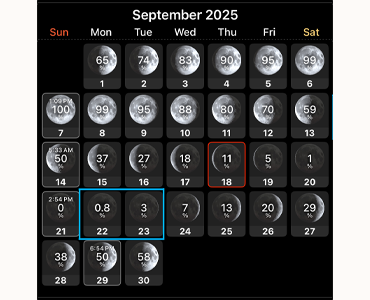
For example, the waxing sliver in the Gregorian month of September 2025 could be sighted on September 22 or 23. These are bordered in blue in the illustration. On the 22nd, the moon’s illumination was projected to be 0.8% which is a very faint sliver when viewed with the naked eye. But it is possible that someone could spot the waxing sliver.
On the 23rd, the illumination is 3% and could easily be seen with the naked eye. Yom Teruah in this particular year could have landed on either one of these days. People do not know with certainty until the evening of the 22nd when people gather to sight the waxing sliver of the moon.
In this particular year, Yom Teruah was actually declared on the evening of September 23, 2025. The rest of the Appointed Times in the seventh month are dependent upon the first day of the month. Sometimes the moon can be observed in other areas before it is observed in the land currently believed to be the State of Israel. In order to maintain unity and celebrate the Feasts together, we are to rely upon the observation of the moon over the land of promise. Testimony tells us the commandment will go forth out of Tziyon (Zion) in the future Kingdom established by our Messiah.
And many people shall go and say, Come ye, and let us go up to the mountain of Yahuah, to the House of the Elohiym of Ya’aqob; and he will teach us of his ways, and we will walk in his paths: for out of Tziyon shall go forth the Law [Torah], and the Word of Yahuah from Yerushalayim.
We can begin practicing this action now by aligning ourselves with new moon reports from those currently living in the land right now. Oftentimes, they provide photographic evidence that we can see with our own eyes. According to testimony, the promised land exists at the base of our Father’s throne.
And he [Ya’aqob] lighted upon a certain place, and tarried there all night, because the sun was set; and he took of the stones of that place, and put them for his pillows, and lay down in that place to sleep. And he dreamed, and behold a ladder set up on the earth, and the top of it reached to heaven: and behold the messengers of Elohiym ascending and descending on it. And, behold, Yahuah stood above it, and said, I am Yahuah Elohiym of Abraham your father, and the Elohiym of Yitzhak: the land whereon you lie, to you will I give it, and to your seed; And your seed shall be as the dust of the earth, and you shall spread abroad to the west, and to the east, and to the north, and to the south: and in thee and in your seed shall all the families of the earth be blessed. And, behold, I am with you, and will keep you in all places where you go, and will bring you again into this land; for I will not leave you, until I have done that which I have spoken to you of. And Ya’aqob awaked out of his sleep, and he said, Surely Yahuah is in this place; and I knew it not. And he was afraid, and said, How dreadful is this place! this is none other but the House of Elohiym, and this is the Gate of Heaven.
The Land of Yashar’El is at the base of our Father’s Gate to His House. This would be the place where the announcement for the Appointed Times would be established from our Father. If it is our desire to celebrate with Him and our Messiah, then it becomes necessary to follow the sightings of the first light from the waxing sliver from Yerushalayim (Jerusalem). It is our desire to celebrate with them and be in unity with them. Currently, there are people in the State of Israel who provide credible testimony often with photographic evidence of their sightings. Unity is possible right now. We have no viable excuses to justify our division.
Here is how we determine the first day of Sukkot. In September 2025, Yom Teruah began on the night of September 23. In order to determine the Feast of Sukkot, we count fifteen days from the evening of September 23. Here is an illustration.
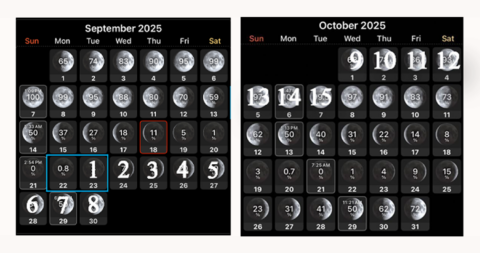
I use the lunar calendar and count “sunsets”. The Feast of Sukkot began on Gregorian date, October seventh 2025 in the evening just after sunset. It is a Feast that spans a period of seven days. The eighth day is called Shemini Atzeret and is not actually part of the Feast of Sukkot. We will discuss this Appointed Time in another study.
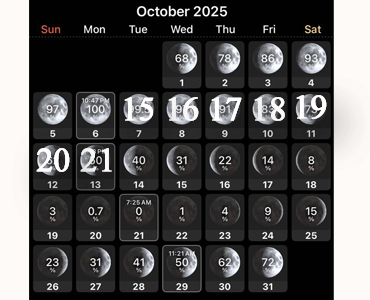
The Feast of Sukkot in 2025 began on October seventh and ended at sunset on October fourteenth. The last day of the Feast began at sunset on October thirteenth and ended at sunset on October fourteenth. The first day of Sukkot is a Shabbat in which no work is permitted. It is challenging to operate with two different calendar systems but this is what we must do while living in this current world system.
We provided much more evidence for using the first light of the waxing sliver in our study titled, Yom Teruah: Determining the Day.
Shemini Atzeret is a Shabbat as well in which no work is permitted. It begins at sunset on the twenty-second day of the month which would have started on October fourteenth and ended on October fifteenth 2025.
Download this Article here
