
121-8 Pronunciation of His Name
O give thanks unto Yahuah; call upon His Name: make known his deeds among the people.
When I hear my name, I turn my head towards the person calling my name. They grab my attention and I am listening to whatever they are trying to say. I will often answer to “Di, Dee, Diane, Anna, Dinah, and Dianna”. I will also turn my head when a child says, “Mom, Mommy, and Mother” as well as “Grandma,” especially if the voice is similar to one of my children or grandchildren. On the other end of the spectrum, I will not turn my head when someone calls, “Sally, Judy, or Molly”. If someone is trying to get my attention by calling these names, I will not turn my head because none of these verbal cues are associated with any of my names. This is true for anyone including our Father in Heaven.
Our Creator and Father is a Living Entity. He has ears to hear and a mouth to speak. He has eyes to see and a heart that feels. He is not an elohiym of wood and stone. He has a Name. If we want Him to turn His head towards us, then pronouncing His actual Name will get His attention. This is our goal. We want to grab His attention so that He will be attentive to our prayers as the following passage proclaims.
If my people, which are called by My Name, shall humble themselves, and pray, and seek my face, and turn from their wicked ways; then will I hear from heaven, and will forgive their sin, and will heal their land.
If our Father in heaven can hear then He has ears to hear. He will turn His head when He hears a rendition of His Name: “Yahuah, Yahweh, Yah or Yehovah”. He will not turn His head when He hears “Odin, Zeus or Apollo”. He does not realize people are talking to Him when these names are uttered. If He were to answer to these names, wouldn’t He be validating their use? If He answers to the name “Zeus” then people will continue to call Him by the name of “Zeus”. In this study, we are going to tackle the subject of the pronunciation of His Name based on the available evidence.
Strong’s Exhaustive Concordance of the Bible illustrates the pronunciation of His Name as “Yehovah”. Here is the entry with the pronunciation.
יְהֹוָה
yehôvâh
yeh-ho-vaw’
This is His Name as it is written in Strong’s entry in the modern Hebrew language with and without dots and dashes.
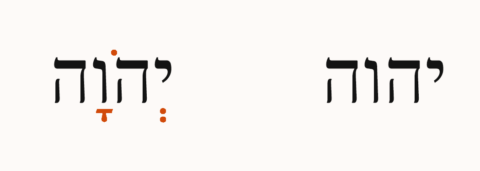
The dots and dashes represent vowel sounds such as A, E, I, O and U in the English language. The larger symbols are letters in the Hebrew alphabet and represent the consonant sounds Y, H, V, and H in the English language. In Hebrew, words are read from right to left. So, the first letter pronounced in His Name is the “yod” and it has the same sound as our “Y”. The “yod’” is highlighted in orange below.
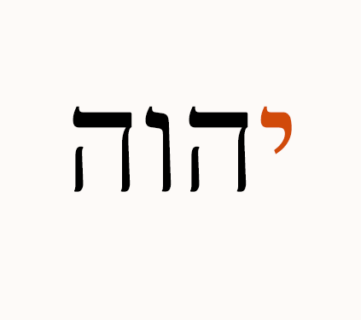
The second and fourth letter are the same and it is called a “hey” in the Hebrew language and has the “H” sound. The letter ‘hey’ is highlighted in orange.
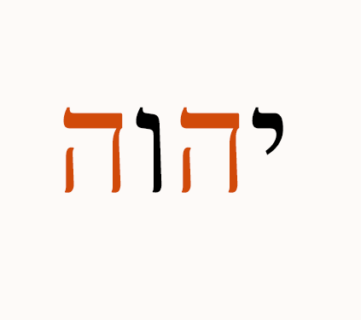
The third letter from right is the “vav” or “waw” and it has a “V” or “W” sound. The letter “vav” or “waw” is highlighted in orange.
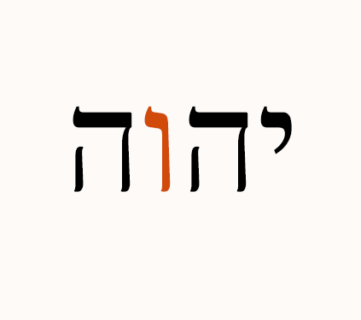
This is the reason some claim it is pronounced as “Yehovah” or “Yahweh”. The “vav” also has two vowel sounds. When a dot is located above the letter “vav”, it does not have the “V” sound. It is pronounced with a long “O” sound as in hope, soap and bloat. Here is the way it appears in the Hebrew text:

When the dot is in the middle of the “vav”, it has an “EW” sound as in moon, dune and soon. Here is the way it appears in the Hebrew text:
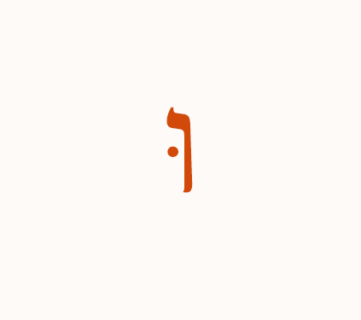
The dots and dashes were added by the Masoretes which was a group of Jewish scribes and scholars responsible for the Masoretic Hebrew texts of the Hebrew writings. All modern-day translations use the Masoretic text to translate their respective versions of the Bible. Following is an excerpt from Wikipedia regarding the Masoretes.
The Masoretes (Hebrew: בעלי המסורה, romanized: Ba’alei ha-Masora) were groups of Jewish scribe-scholars who worked from around the end of the 5th through 10th centuries CE,[1][2] based primarily in medieval Palestine (Jund Filastin) in the cities of Tiberias and Jerusalem, as well as in Iraq (Babylonia). Each group compiled a system of pronunciation and grammatical guides in the form of diacritical notes (niqqud) on the external form of the biblical text in an attempt to standardize the pronunciation, paragraph and verse divisions, and cantillation of the Hebrew Bible (the Tanakh) for the worldwide Jewish community. https://en.wikipedia.org/wiki/Masoretes#:~:text
The Masoretes existed from the 5th to the 10th century and were responsible for adding the dots and dashes to the Hebrew text in an effort to standardize pronunciation of the Hebrew words. Many of the common pronunciations of the Name of our Creator are based upon these dots and dashes. On the Ancient Hebrew Research Center website, owner and author, Jeff A. Benner, wrote an article titled, A History of the Masoretic Hebrew Texts. Following is an excerpt regarding the dots and dashes or vowel pointings.
The Hebrew texts of the Bible were originally written with only the 22 letters of the Hebrew alphabet, which only represent consonantal sounds. Examples of this type of writing can be found in the Dead Sea Scrolls. As no vowel sounds were originally included in the text, they had to be memorized.
Around the 10th Century AD, a group of Jewish scribes called Masorites, created a system of dots and dashes, called nikkudot or vowel pointings and added these to the Hebrew text. These vowel pointings served to supply the vowel sounds to the text in order to codify the pronunciation. The Masorites also included notes in the margins of the text. https://www.ancient-hebrew.org/biblical-history/a-history-of-the-masoretic-hebrew-texts.htm
The dots and dashes or vowel pointings were added around the 10th century by Jewish scribes. This particular vowel system was the Tiberian Pointing also known as Ben Asher. At the time, there were three systems: Tiberian, Babylonian and Palestinian. Jeff A. Benner wrote another article titled, Is Ancient Hebrew a Dead Language. Here is an excerpt from this article followed by the two references mentioned in the excerpt.
During the second half of the first millennium C.E., a much larger revision was undertaken: the use of indicators around consonants to represent vowels, known as “vowel points.”[9] At least three vowel pointing systems emerged: the Tiberian (ben Asher), the Babylonian, and the Palestinian.[10] These new pointing systems preserved pronunciation as understood by various groups at that time, as well as interpretations where ambiguities and debate existed. Accents were likewise added, aiding in interpretation and the liturgical reading of the text. https://www.ancient-hebrew.org/language/is-ancient-hebrew-a-dead-language.htm
[9] “The various systems of accentuation and vocalization introduced in to the text of the Bible by the Masoretes had started to develop by the about the sixth or seventh century CE” (Angel Saenz-Badillos, A History of the Hebrew Language [trans. John Elwolde; Cambridge: Cambridge University Press, 1993], 77).
[10] Bruno Chiesa, The Emergence of Hebrew Biblical Pointing: The Indirect Sources (Frankfurt: Lang, 1979), 9-16.
These three groups were not in complete agreement with interpretations or pronunciations of words in the Hebrew text of the Word. For this reason, the dots and dashes or vowel points established by the Masoretes cannot be considered the final authority or inerrant. This fact was also emphasized in Mr. Benner’s article.
Students do not need a thorough knowledge of Tiberian pointing if the goal is to read with comprehension and translate with precision. Instead, the use of Tiberian pointing should be limited to aiding students with their pronunciation, since “proper” vowel pronunciation is not necessary for translation accuracy. Finally, Tiberian pointing should be seen in a similar light as modern commentaries; i.e., as an informed opinion that, while valuable, should always be viewed with skepticism, especially when ambiguities exist in the consonantal text of the Hebrew Bible. https://www.ancient-hebrew.org/language/is-ancient-hebrew-a-dead-language.htm [26]
[26] I [Jeff A. Benner] would like to express my appreciation to Dr. Wave Nunnally for his valuable insights and critiques on this issue.
The nikkudot or vowel pointings are simply the expressions and perspectives of the Masoretes and cannot be considered authoritative. The entry in Strong’s Exhaustive Concordance of the Bible is relying upon the dots and dashes established by the Tiberian vowel pointing system who were one of three sects of Jewish scribes.
The goal of the Masoretes was to codify pronunciation of Hebrew words. However, there are two different sets of vowel points used on our Creator’s Hebrew Name which provide two different pronunciations of His Name. The first entry in Strong’s Exhaustive Concordance of the Bible is #H3068 and is pronounced “Yehovah”.
יְהֹוָה
yehôvâh
yeh-ho-vaw’
The second entry is Strong’s Exhaustive Concordance #H3069 and is pronounced “Yehovee”.
יְהֹוִה
yehôvih
yeh-ho-vee’
Here are both Hebrew Names enlarged for comparison. The Hebrew letters are the same but the dots and dashes are not the same. The presence of the dots and dashes directly effects the way the word is pronounced.
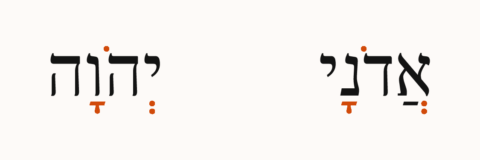
H3068 occurs 6,412 times and H3069 occurs 304 times. If the goal of the Masoretes was to codify pronunciation, why is there a difference in the pronunciation of the Name of our Creator. Which one is correct?
The Masoretes were Jewish scribes and practiced Rabbinic Judaism. In their belief system to this day, the Rabbis have a prohibition against speaking the Name of our Creator. Their goal was not to preserve the pronunciation of His Name in ways that could commonly be read by anyone reading the text. The goal was to provide a solution allowing a reader of the text to use an approved substitution in place of His Name.
When the dots and dashes or vowel pointings were added to our Creator’s Name in Masoretic text, the scribes would add the dots and dashes from the Hebrew word “Adonai” to the Name of our Creator. Following is the entry for Strong’s Exhaustive Concordance #H136 with its associated pronunciation.
אֲדֹנָי
‘ădônây
ad-o-noy’
This word is translated as “the Lord” in the following passage:
And he said, H559 Lord H136 GOD, H3069 whereby H4100 shall I know H3045 that H3588 I shall inherit H3423 it?
Because it was prohibited to utter the Name of our Creator, the dots and dashes associated with our Creator’s Name communicated to the reader to pronounce “Adonai” rather than the Name itself. In the following example, the reader would see the Tetragrammaton and pronounce “Adonai” and not our Creator’s Name.
That they may believe that [YHWH] Adonai God of their fathers, the God of Abraham, the God of Isaac, and the God of Jacob, hath appeared unto thee.
In the following example, three of the four dots and dashes are identical between “Adonai” and “Yehovah”. Those that are similar are highlighted in orange. The first word on the right is the Hebrew word for “Adonai” and the second word on the left is the Name of our Creator with the vowel points from “Adonai” #H3068 pronounced as “Ye-ho-vah”.
When people would be reading from the Hebrew text aloud, they would see the vowel points under the Name of our Creator and would say “Adonai” rather than “Yehovah”.
In the following passage, the Hebrew word “Adonai” translated as “the Lord” is next to “GOD” in all capital letters which is reference #H3069. It is also the Name of our Creator.
And he said, H559 Lord H136 GOD, H3069 whereby H4100 shall I know H3045 that H3588 I shall inherit H3423 it?
In this passage, the actual word “Adonai” is used as a title for our Creator. If the Jewish scribes placed the dots and dashes for “Adonai” around our Creator’s Name next to the Hebrew word “Adonai”, the reader would end up saying, “Adonai Adonai” which sounds a bit awkward as illustrated in the same verse below:
And he said, H559 Adonai H136 Adonai, H3069 whereby H4100 shall I know H3045 that H3588 I shall inherit H3423 it?
In order to avoid this situation, the Jewish scribes decided to use the dots and dashes associated with the Hebrew word “Elohiym” when our Father’s Name is paired with the Hebrew word “Adonai”. Following is the entry in Strong’s Exhaustive Concordance of the Bible #H430 with its pronunciation.
אֱלֹהִים
‘ĕlôhı̂ym
el-o-heem’
This word is most often translated as “God” or “gods” as illustrated in the following passage:
These H428 are the generations H8435 of the heavens H8064 and of the earth H776 when they were created, H1254 in the day H3117 that the LORD H3068 God H430 made H6213 the earth H776 and the heavens, H8064
In the following example, three of the four dots and dashes are identical as well. Those that are similar are highlighted in orange. The first word on the right is “Elohiym” in the Hebrew language with its dots and dashes. The second word on the left is the Name of our Creator with the vowel points from “Elohiym” #H3069 pronounced “Ye-ho-vee”.
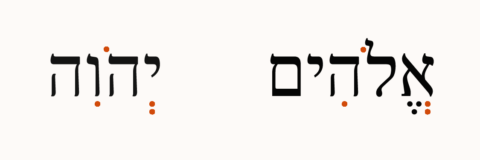
When the reader sees these vowel markings by our Creator’s Name when reading the Hebrew text, they would say, “Elohim” rather pronounce the actual Name of our Father in heaven as illustrated in Bereshith (Genesis) 15:8:
And he said, H559 Adonai H136 Elohiym [YHWH], H3069 whereby H4100 shall I know H3045 that H3588 I shall inherit H3423 it?
The Jewish scribes could not use the dots and dashes for “Elohiym” throughout the Hebrew writings either, because a reader would end up saying “Elohiym Elohiym” when reading the text as illustrated below in the following passage:
These H428 are the generations H8435 of the heavens H8064 and of the earth H776 when they were created, H1254 in the day H3117 [YHWH] ElohiymH3068 Elohiym H430 made H6213 the earth H776 and the heavens, H8064
It would be awkward to say, “Elohiym Elohiym”. In the English language, we can determine which pronunciation is being used in the underlying Hebrew. “LORD” in all capital letters is “Yehovah” which are the dots and dashes from the Hebrew word “Adonai”. “GOD” in all capital letters is “Yehovee” which are the dots and dashes for “Elohim”. Here is an illustration of both examples.
These are the generations of the heavens and of the earth when they were created, in the day that the LORD God made the earth and the heavens,
And he said, Lord GOD, whereby shall I know that I shall inherit it?
Because the word “Elohiym” is associated more often with the Name of our Creator, the number of vowel points from the word “Adonai” attached to the Tetragrammaton are significantly higher which leads an uninformed reader to conclude that “Yehovah” is the correct pronunciation of our Creator’s Name. If the Jewish scribes had a prohibition against speaking the Name of our Creator, why would they put the dots and dashes in the text to aid the reader in actually pronouncing the Name aloud? This was not their intent. The dots and dashes were a guide to the reader to help them determine when they should pronounce “Adonai” or “Elohiym” in place of our Creator’s Name.
The main reason “Yehovah” cannot be the pronunciation of our Creator’s Name involves the letter “vav” which is the third letter from the right in His Name. As a consonant, the “vav” makes a “V” sound.
The “vav” with a dot on top is a long “O” sound as in the word “hope”. The following Hebrew word is pronounced “Bo” with a long “O” sound and it means “come”. The “vav” in this instance does not have the “V” sound.
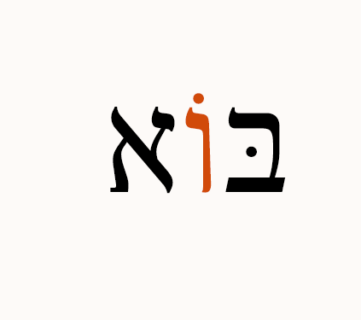
The “vav” with a dot near the belly of the letter has an “EW” sound as in the word “moon’”. The following word is “Yehudah” which is also known as “Judah”. There is no “V” sound in this word either.
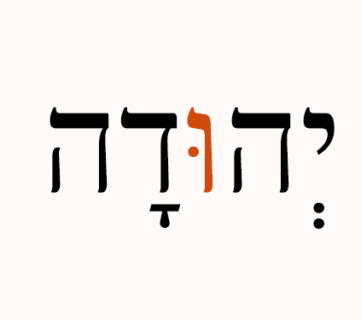
The sound produced by the “vav” is either a vowel sound or a consonant but not both. The Name of our Creator only has one “vav” so it is either pronounced as an “EW” or long “O” or the consonant “V”.
The pronunciation of “Yehovah” assigns two sounds to the letter “vav”: the long “O” sound and the “V” sound.
Ye-ho-vah
If this were the pronunciation of our Creator’s Name, there would need to be two “vavs” in His Name: one for the long “O” vowel sound and one for the “V” sound. It would look like this in the Hebrew language:
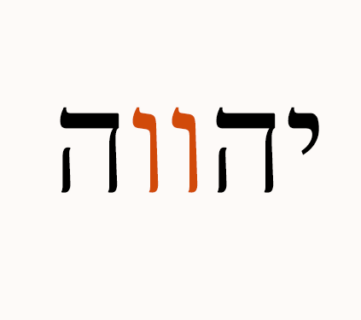
But this is not the case. His Name only has one “vav” so it is either a “V” sound, a long “O” sound or an “EW” sound. This particular discrepancy was addressed by Jeff A. Benner in a letter addressed to Nehemiah Gordon who is a Karaite Jew and noted Hebrew scholar. Dr. Gordon promotes the pronunciation of “Yehovah” and has been a significant influence in the Messianic community for adopting this pronunciation. Following is an excerpt from this letter in which Mr. Benner addresses the area of concern.
If in fact “The Name” is pronounced Yehovah, then this name must include the cholam, but we never see a double vav in “The Name” in the Dead Sea Scrolls. [The pronunciation Yehovah would be written as יְהֹוָה. If this were the pronunciation, we would expect to see it written as יהווה in the Dead Sea Scrolls, but we do not.] Based on this, my assumption has been that Yehovah (or any other form that includes the vowel “o” or “u” and the consonant “v”) could not be the pronunciation as the Dead Sea Scrolls always show only one vav and therefore can only be pronounced as the vowel “o” or “u” *OR* as the consonant “v.” https://www.ancient-hebrew.org/god-yhwh/is-the-name-of-god-pronounced-yehovah.htm
The word “cholam” is the name assigned to the letter “vav” with a dot above it which has the long “O” sound.
The Dead Sea Scrolls were ancient documents discovered between 1946 and 1956. All of the documents discovered do not contain the dots and dashes representing vowel sounds in the Hebrew texts.
If the goal of the Masoretes was to preserve the pronunciation of the Name of our Creator, they would have gathered their information from writings similar to the Dead Sea Scrolls. Mr. Benner is saying that in order for the Masoretes to place the vowel points or dots and dashes that elicit a pronunciation of “Yehovah” that the Name of our Creator would require double vavs in His Name in the Dead Sea Scrolls as illustrated below.
Mr. Benner says that the Name of our Creator does not have the double “vav” in the Dead Sea Scrolls so therefore “Yehovah” cannot be the pronunciation of our Creator’s Name. Nehemiah Gordon provided a response to Mr. Benner’s letter. In an effort to justify the pronunciation of “Yehovah”, Nehemiah Gordon cited three examples in which a single letter “vav” has the “V” sound as well as the long “O” sound in a word. Following are the three Hebrew words he cites as examples and their location in scripture.
Isa 24:2 KaLoveh כַּלּוֶֹה MT; 1QIsa-a כלוה (not כלווה)
Isa 49:23 Kovay קוָֹי MT; 1QIsa-a קוי (not קווי).
Ps 69:7 Kovecha קוֶֹיךָ MT; 4Q83 f19ii_20:28 קויכה (not קוויכה) .” https://www.ancient-hebrew.org/god-yhwh/is-the-name-of-god-pronounced-yehovah.htm
Mr. Gordon adds the comment below regarding his three citations.
These are the only examples I could find in the Tanakh [Bible] of Cholam followed by Consonantal Vav where the text was also preserved in the DSS. .” https://www.ancient-hebrew.org/god-yhwh/is-the-name-of-god-pronounced-yehovah.htm
Mr. Gordon could only find three examples. Based on this information, the letter “vav” usually serves as one sound in any Hebrew word. His findings indicate that it is not a very common practice to pronounce the letter “vav” with a “V” sound and a long “O” sound.
In order to verify his information, each word was evaluated in Strong’s Exhaustive Concordance of the Bible, as well as the place in which it is found. The first word in Mr. Gordon’s citation is “Kaloveh” and it only has one “vav” and is pronounced with the “V” sound as well as the long “O” sound as illustrated in the Hebrew.
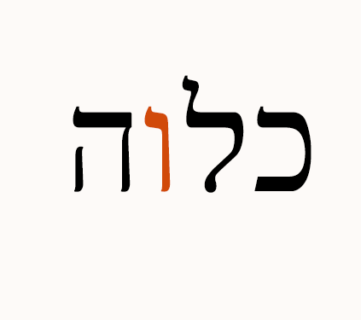
“Kaloveh” is translated as “so with the borrower” in the following passage:
And it shall be, H1961 as with the people, H5971 so with the priest; H3548 as with the servant, H5650 so with his master; H113 as with the maid, H8198 so with her mistress; H1404 as with the buyer, H7069 so with the seller; H4376 as with the lender, H3867 so with the borrower; H3867 as with the taker of usury, H5383 so H834 with the giver of usury H5378 to him.
The second word is “Kovay” and it only has one “vav” but is pronounced with a “V” sound as well as a long “O” sound as illustrated in the Hebrew.
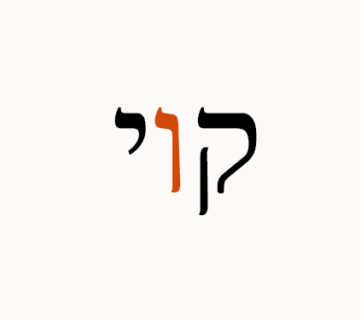
“Kovay” is translated as “that wait” in the following passage:
And kings H4428 shall be H1961 thy nursing fathers, H539 and their queens H8282 thy nursing mothers: H3243 they shall bow down H7812 to thee with their face H639 toward the earth, H776 and lick up H3897 the dust H6083 of thy feet; H7272 and thou shalt know H3045 that H3588 I H589 am the LORD: H3068 for they H834 shall not H3808 be ashamed H954 that wait H6960 for me.
The third word is “Kovacha” and it only has one “vav” but is pronounced with the “V” sound and the long “O” sound as illustrated in the Hebrew.
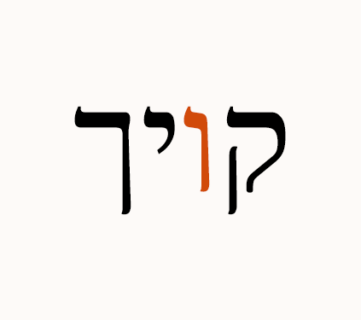
“Kovacha” is translated as “them that wait on” in the following passage:
Let not H408 them that wait on H6960 thee, O Lord H136 GOD H3069 of hosts, H6635 be ashamed H954 for my sake: let not H408 those that seek H1245 thee be confounded H3637 for my sake, O God H430 of Israel. H3478
“Kovay” and “Kovacha” are words from the same word family with the same reference number in Strong’s Exhaustive Concordance of the Bible #H6960. Essentially, this means that Mr. Gordon only has two citations in all of scripture to validate his use of “Yehovah” for the Creator’s Name.
Mr. Benner responded with the following to Mr. Gordon in a subsequent letter.
How confident are you that the nikkudot [vowel pointings or dots and dashes] preserve the original pronunciation of Hebrew words? I ask because I have the opinion that while they do preserve the pronunciation fairly well, history suggests that the pronunciations of words do change over time, especially from one dialect to another. So, while כלוה (Is 24:2) is pronounced “kalovah” in the Masoretic text, could it have originally been “kalavah” (or something similar)? .” https://www.ancient-hebrew.org/god-yhwh/is-the-name-of-god-pronounced-yehovah.htm
Nehemiah Gordon did not provide a response to this comment.
Because languages and the pronunciation of words change over time, the prophet Yeshayahu (Isaiah) may have pronounced the word in 24:2 as “kalavah” during his time and today it is pronounced as “kalovah” which means the “vav” in this word represents only the “V” sound. In essence, Mr. Benner is saying that it is a very real possibility that the letter “vav” may have been used solely as the “V” sound in this word in the past. This same reasoning could be applied to all three examples presented by Nehemiah Gordon.
As previously discussed, the Masoretes were only one of three groups attempting to codify the pronunciation of the Hebrew language. Not all groups agreed. How do we know if one or two of the groups pronounced “kaloveh” as “kalavah” in the 10th century? This would nullify Nehemiah Gordon’s position completely. The reality is that the dots and dashes are not authoritative and do not necessarily express the perspectives of the original authors who lived thousands of years prior to the development of the vowel pointing systems in the 10th century. Based on this evidence, the pronunciation of our Creator’s Name is not “Yehovah”.
In the book of Bemidbar (Numbers), the Priests were instructed to place the Name of our Creator upon the House of Israel.
Speak unto Aahron and unto his sons, saying, On this wise ye shall bless the children of Yashar’El, saying unto them, Yahuah bless you, and keep you: Yahuah make his face shine upon you, and be gracious unto you: Yahuah lift up his countenance upon you, and give you peace. And they shall put My Name upon the children of Yashar’El; and I will bless them.
In the context of these passages, this would indicate that His Name is literally placed upon His people and they are identified by His Name. Is it possible to determine the pronunciation of His Name by examining the names of people who are known to be His?
“Jehu” or “Yahu” or ‘Jehu’ was a King of Yahudah (Judah). Brown-Drivers-Briggs defines it the following way:
יהוּא
yêhû’
BDB Definition:
Jehu = “Jehovah is He”
“Yehu” or “Yahu” is identified with the Name of our Creator. Here is the name “Yehu” with the dots and dashes in Strong’s Exhaustive Concordance of the Bible and it is pronounced “Yay-hoo” with these dots and dashes. The letter highlighted in orange is a suffix meaning “he”.
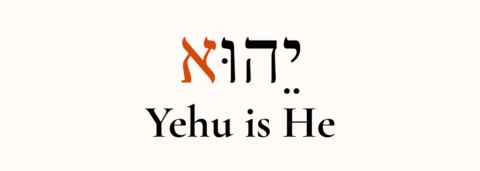
As we have established previously, the dots and dashes represent the perspective of one group of people and are not authoritative. It is possible that other vowel sounds can be applied to the name “Yehu”. In scripture, “Yah” is a shortened form of our Creator’s Name used in the Hebrew as illustrated in the following passage:
Sing H7891 unto God, H430 sing praises H2167 to his name: H8034 extol H5549 him that rideth H7392 upon the heavens H6160 by his name H8034 YAH, H3050 and rejoice H5937 before H6440 him.
Following is the entry of the shortened version in Strong’s Exhaustive Concordance #H3050.
יָהּ
yâhh
yaw
Contracted for H3068, and meaning the same; Jah, the sacred name: – Jah, the Lord, most vehement. Cp. names in “-iah,” “-jah.”
The term “Yah” is not seen very often in scripture because it is most often translated as “LORD” in all uppercase letters as noted in the following examples which have Strong’s #H3050.
Let every H3605 thing that hath breath H5397 praise H1984 the LORD. H3050 Praise H1984 ye the LORD. H3050
I said, H559 I shall not H3808 see H7200 the LORD, H3050 even the LORD, H3050 in the land H776 of the living: H2416 I shall behold H5027 man H120 no H3808 more H5750 with H5973 the inhabitants H3427 of the world. H2309
The Hebrew word for “praise” is “hallel”. When the Hebrew word for “praise” is combined with “Yah” as it is in Tehillim (Psalms) 150:6, it is spoken as “HalleluYah”. Nehemiah Gordon teaches that this shortened form takes the first and the last letter of the Tetragrammaton with the vowel sound associated with last syllable.
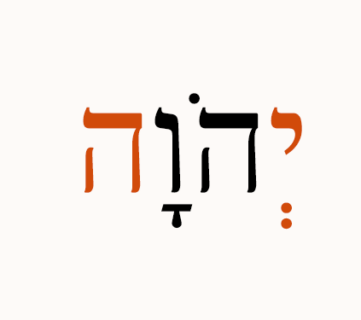
The last vowel sound makes an “AH” sound as in “saw”. It looks like a little “T” under the letter “vav” in the above example. However, it may also be possible that the shortened form of our Creator’s Name used the first and second letter of His Name and is also pronounced “Yah”. If the Name of our Creator has been placed upon His people, it is possible that the pronunciation of “Yehu” is actually “Yahu”. Based on this evidence, “Yehudah” could be pronounced “Yahudah” as well.
Here is a long list of Hebrew names found in scripture with the “Yahu” on the end of their name. The orange highlights were added for emphasis.
Achazyahu, Achiyahu, Adayahu, Adoniyahu, Amatsyahu, Athalyahu, Atsalyahu, Aviyahu, Azaryahu, Benayahu, Chilqiyahu, Eliyahu, Gedalyahu, Konyahu, Ma`aseyahu, Malkiyahu, Mattanyahu, Mattithyahu, Miykayahu, Toviyahu, Chananyahu, Nethanyahu, Ovadyahu, Pedayahu, Remalyahu, Serayahu, Shema`yahu, Shephatyahu, Tsephanyahu, Tsidqiyahu, Uriyahu, Uzziyahu, Ya’azanyahu, Yechizqyahu, Yekolyahu, Yekonyahu, Yesha`yahu, Yetheyahu, Yeverekyahu, Yirmeyahu, Yo’shiyahu, and Zakaryahu. https://www.cepher.net/blog.aspx?post=4257
These are the names of just 42 men who belonged to the tribes of Yashar’El… people who bear the Name of our Creator. Following is the entry for “Yirmeyahu” or “Jeremiah” in Strong’s Exhaustive Concordance of the Bible #H3414:
ירמיהוּ / ירמיה
yirmeyâh / yirmeyâhû
There are two possibilities for pronunciation: “Yirmeyah” and “Yirmeyahu”. Both of these names bear the Name of our Creator. The parts highlighted in orange are “Yahu” in “Yirmeyahu” and “Yah” in “Yirmeyah” which is the prophet “Jeremiah”.
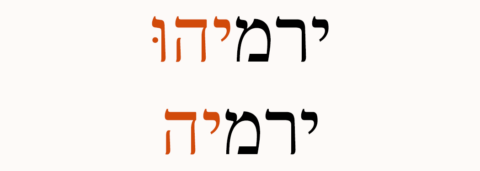
The endings are pronounced “ya-hoo” and “yah”. In the very first verse of his scroll, Yirmeyahu (Jeremiah) uses his name as one called by our Father in heaven. He has written and uses the name with the letter “vav” (ו) on the end. It is highlighted in orange.
דברי H1697 ירמיהו H3414 בן H1121 חלקיהו H2518 מן H4480 הכהנים H3548 אשׁר H834 בענתות H6068 בארץ H776 בנימן׃ H1144
The prophet calls himself “Yirmeyahu”. The letter “vav” is most commonly used as the “EW” sound or a “U”. Yirmeyahu says the Name of our Creator is literally upon his name in the following passage:
Yahuah, you know: remember me, and visit me, and revenge me of my persecutors; take me not away in your longsuffering: know that for your sake I have suffered rebuke. Your words were found, and I did eat them; and thy word was unto me the joy and rejoicing of my heart: for I am called by Your Name, O Yahuah Elohiym of hosts.
“Yahu” bears three of the four letters of the Tetragrammaton and is literally attached to the name “Yirmeyahu”.

The prophet Yirmeyahu (Jeremiah) is literally called by His Name. The next name we will examine is “Zekaryahu” otherwise known as the prophet “Zechariah”. Strong’s Exhaustive Concordance of the Bible #H2148:
זְכַרְיָהוּ זְכַרְיָה
zekaryâh zekaryâhû
He also has two versions of his name in this entry: Zekaryah and Zekaryahu. The part highlighted in orange is “Yahu” in “Zekaryahu” and “Yah” in “Zekaryah”.
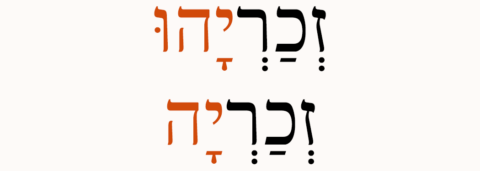
The prophet calls himself Zekaryah (Zechariah) in the following passage without the letter “vav” (ו) as noted in the name highlighted in orange.
בחדשׁ H2320 השׁמיני H8066 בשׁנת H8141 שׁתים H8147 לדריושׁ H1867 היה H1961 דבר H1697 יהוה H3068 אל H413 זכריה H2148 בן H1121 ברכיה H1296 בן H1121 עדו H5714 הנביא H5030 לאמר׃ H559
The next name is “Yeshayahu” or the prophet “Isaiah”. Strong’s Exhaustive Concordance of the Bible #H3470:
יְשַׁעְיָהוּ יְשַׁעְיָה
yesha‛yâh yesha‛yâhû
The part highlighted in orange is “Yahu” in “Yeshayahu” or the name of the prophet “Isaiah”.
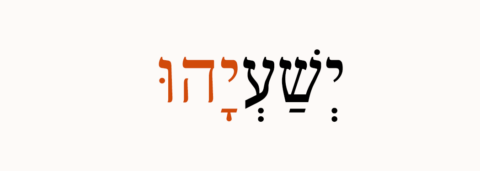
The prophet calls himself “Yeshayahu” (Isaiah) in the following passage which has the “vav” (ו) on the end of his name highlighted in orange.
חזון H2377 ישׁעיהו H3470 בן H1121 אמוץ H531 אשׁר H834 חזה H2372 על H5921 יהודה H3063 וירושׁלם H3389
The next name is “Eliyahu” or “Elijah” the prophet. This entry is from Strong’s Exhaustive Concordance of the Bible #H452 and there are two versions for his name as well.
אֵלִיָּהוּ אֵלִיָּה
‘êlı̂yâh ‘êlı̂yâhû
The part highlighted in orange is “Yahu” and bears three of the four letters of the Tetragrammaton.

In the scriptures, the prophet is identified as “Eliyahu” with the letter “vav” (ו) on the end of his name highlighted in orange.
ויאמר H559 אליהו H452 התשׁבי H8664 מתשׁבי H8453 גלעד H1568 אל H413 אחאב H256 חי H2416 יהוה H3068 אלהי H430 ישׂראל H3478 אשׁר H834 עמדתי H5975 לפניו H6440 אם H518 יהיה H1961 השׁנים H8141 האלה H428 טל H2919 ומטר H4306 כי H3588 אם H518 לפי H6310 דברי׃ H1697
The next name is “Yahudah” or “Judah” Strong’s Exhaustive Concordance of the Bible #H3063:
יְהוּדָה
yehûdâh
In this name, “Yahu” is found at the beginning of the name and only has one version. The part highlighted in orange is “Yahu” in “Yahudah” or the tribe of “Judah”.

The next name is “Yahusef” or “Joseph” Strong’s Exhaustive Concordance of the Bible #H3084.
יְהוֹסֵף
yehôsêph
This is a fuller version of the patriarch’s name with only one occurrence noted below:
This he ordained H7760 in Joseph H3084 for a testimony, H5715 when he went out H3318 through H5921 the land H776 of Egypt: H4714 where I heard H8085 a language H8193 that I understood H3045 not. H3808
Here is his name highlighted in orange in the Hebrew:
עדות H5715 ביהוסף H3084 שׂמו H7760 בצאתו H3318 על H5921 ארץ H776 מצרים H4714 שׂפת H8193 לא H3808 ידעתי H3045 אשׁמע׃ H8085
His name has three of the four letters of our Creator’s Name… ‘Yahu’ as in ‘Yahuseph:

The next name is “Yehosha” or “Joshua”. It is also the name given to our Messiah. Strong’s Exhaustive Concordance of the Bible #H3091:
יְהוֹשֻׁעַ
yehôshûa‛
In this particular name, the Masoretes decided to use the “vav” with the long “O” sound rather than the “vav” with the “EW” sound. As stated previously, dots and dashes are simply the opinion and perspective of one people group and are not authoritative. In the following passage of scripture, no dots and dashes have been added.
ויאמר H559 משׁה H4872 אל H413 יהושׁע H3091 בחר H977 לנו אנשׁים H376 וצא H3318 הלחם H3898 בעמלק H6002 מחר H4279 אנכי H595 נצב H5324 על H5921 ראשׁ H7218 הגבעה H1389 ומטה H4294 האלהים H430 בידי׃ H3027
If we are following the pattern already illustrated in so many other names, the first part of this name would be pronounced “Yahu” and the last part is pronounced “sha”. This would make the pronunciation of this name “Yahusha”. “Yahu” in this name is highlighted in orange as well.

In all of these examples, the names include three of the four letters found in our Creator’s Name as illustrated below highlighted in orange.

If all these names plus the ones listed pronounce these letters as “Yahu,” then the evidence strongly illustrates that the first three letters of our Creator’s Name are also pronounced “Yahu”. With the added letter “hey”, His Name would be pronounced “Yahuah”.
Let’s examine another angle towards the pronunciation of His Name. The name “Yahudah” actually includes all four letters of our Creator’s Name with the addition of a “dalet” or the letter “D” sound. Here are the two for comparison with the “dalet” in ‘Yahudah’ highlighted in orange.

The Ancient Hebrew Lexicon of the Bible written by Jeff A. Benner defines “dalet” the following way.
LD דל Action: Back and Forth, Hang, Lift, Leap Object: Door Abstract: Poor Definition: The tent door was hung down as a curtain, covering the entrance to the tent, from a horizontal pole. The door was then moved to the side for going in and out of the tent.Ancient Hebrew: The pictograph D is a door. The L is a picture of staff and represents any rod. Combined these pictures mean “the door on the rod”.

The “dalet” is a door to a tent suspended by a rod so that it swings back and forth. With this in mind, the message says that “Yahudah is the door to Yahuah”. This is prophesied by Ya’akov (Jacob) in the following passage:
Yahudah is a lion’s whelp: from the prey, my son, you are gone up: he stooped down, he couched as a lion, and as an old lion; who shall rouse him up? The scepter shall not depart from Yahudah, nor a lawgiver from between his feet, until Shiloh come; and unto him shall the gathering of the people be.
This is a prophecy of the coming Messiah who would come through the line of Yahudah and specifically through the line of King David. In essence, the “Messiah is the door to Yahuah” and this is what he says in the eyewitness account of Yochanan (John).
Verily, verily, I say unto you, He that enters not by the door into the sheepfold, but climbs up some other way, the same is a thief and a robber. But he that enters in by the door is the shepherd of the sheep. To him the porter opens; and the sheep hear his voice: and he calls his own sheep by name, and leads them out. And when he puts forth his own sheep, he goes before them, and the sheep follow him: for they know his voice. And a stranger will they not follow, but will flee from him: for they know not the voice of strangers. This parable spoke Yahusha (Jesus) unto them: but they understood not what things they were which he spoke unto them. Then said Yahusha (Jesus) unto them again, Verily, verily, I say unto you, I am the door of the sheep. All that ever came before me are thieves and robbers: but the sheep did not hear them. I am the door: by me if any man enter in, he shall be saved, and shall go in and out, and find pasture.
In the eyewitness account of Mattithyahu (Matthew), Yahusha (Jesus) is the man who stands at the door and determines who will enter into the Kingdom of Yahuah Elohim. He is saying he is the door to Yahuah.
Not everyone that says unto me, Lord, Lord, shall enter into the kingdom of heaven; but he that does the will of my Father which is in heaven. Many will say to me in that day, Lord, Lord, have we not prophesied in your name? and in your name have cast out devils? and in your name done many wonderful works? And then will I profess unto them, I never knew you: depart from me, you that work without Law.
YahuDah
Yahuah
This confirms the evidence revealed in our study of the names of men from the House of Yashar’El who are called by His Name. However, there is one more witness to consider. When Adam was created, he was a whole entity until Yahuah Elohim removed something from him to create woman.
And Yahuah Elohim caused a deep sleep to fall upon Adam, and he slept: and he took one of his ribs, and closed up the flesh instead thereof; And the rib, which Yahuah Elohim had taken from man, made he a woman, and brought her unto the man. And Adam said, This is now bone of my bones, and flesh of my flesh: she shall be called Woman, because she was taken out of Man. Therefore, shall a man leave his father and his mother, and shall cleave unto his wife: and they shall be one flesh. And they were both naked, the man and his wife, and were not ashamed.
A man is not a whole being without his long, lost rib… woman. In the Hebrew language, names of women will often end with an “H” sound or the Hebrew letter “hey”. Following are names of Hebrew women in scripture with letter ‘hey’ on the end.



When we add the names of men and women from Yashar’El, the Name of our Creator is found with both of them combined. Together a man and a woman bear the image and likeness of Yahuah Elohim.
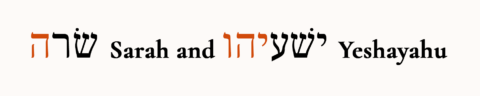
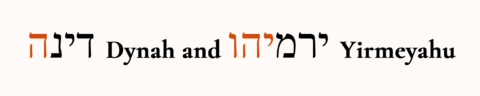
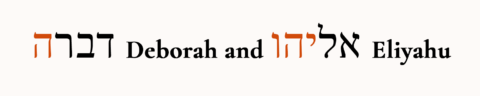
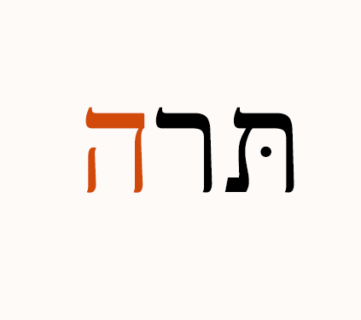
The Name of our Father within the man’s name “Yahu” combined with the ending in the woman’s name “ah” provides the pronunciation “Ya-hoo-ah”. Let us take it another step further. Many Hebrew words in general are designated as either masculine or feminine. For example, the Hebrew word “Torah” is often translated as “Law” in the King James Bible and is a feminine noun in the Hebrew language. Here is a portion of the entry in the Brown-Drivers-Briggs Lexicon:
תּרה / תּורה
tôrâh
Part of Speech: noun feminine
Here is the Hebrew word “Torah” with the letter “hey” on the end of the word highlighted in orange.
When the word “Torah” is combined with the name of a man from Yashar’El such as “Yirmeyahu”, they make a man in the image and likeness of Yahuah Elohim and bear His whole Name. A man is whole and complete with the Torah which is a representation of His Word or Instructions.
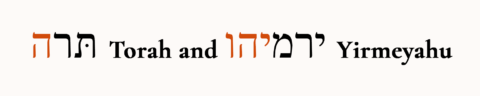
“Yahu” in the name “Yirmeyahu” combined with the ending “-ah” in “Torah” provides the pronunciation of “Ya-hoo-ah” for the Name of our Creator.
Download this Article here