
122-1 Restore the Name, “Yahusha”
And she shall bring forth a son, and You shall call his name Yahusha: for he shall save his people from their sins.

Yahusha Ben David is our Messiah, our Redeemer and coming King. He is real and he is alive. He has thoughts, feelings, preferences, desires and customs. He is a greater King than the earthly Kings we have in our world today. He also deserves great reverence and respect as we would grant to any earthly King, President or Pope today.
He is a Hebrew from a Hebrew culture. He thinks like a Hebrew. He speaks the Hebrew language. Here is the evidence:
Whereupon as I went to Damascus with authority and commission from the chief priests, At midday, O King, I saw in the way a light from heaven, above the brightness of the sun, shining round about me and them which journeyed with me. And when we were all fallen to the earth, I heard a voice speaking unto me, and saying in the Hebrew tongue, Shaul, Shaul, why do you persecute me? is it hard for you to kick against the pricks. And I said, Who are you, Lord? And he said, I am Yahusha whom you persecute.
Messiah Yahusha spoke to Shaul of Tarsus (Paul) in the Hebrew tongue. This is our Messiah’s primary language and the language of the Kingdom of Heaven. The Hebrew language does not have the letter “J” in it even to this day. When our Messiah spoke to Shaul, he did not use the name, “Jesus”. In fact, the letter “J” was not added to the alphabet until 1524 by Gian Giorgio Trissino.
Both I and J were used interchangeably by scribes to express the sound of both the vowel and the consonant. It wasn’t until 1524 when Gian Giorgio Trissino, an Italian Renaissance grammarian known as the father of the letter J, made a clear distinction between the two sounds. Trissino’s contribution is important because once he distinguished the soft J sound, as in “jam” (probably a loan sound), he was able to identify the Greek “Iesus” a translation of the Hebrew “Yeshua,” as the Modern English “Jesus.” Thus, the current phoneme for J was born. https://www.dictionary.com/e/j/
“Jesus” was not his name when he walked this earth and it wasn’t his name for several hundred years afterwards. However, this parallels the life of the patriarch Yoseph (Joseph) who was sold to the Egyptians by his own brothers. Through a series of events, Yoseph became second in power over all of Egypt. The Pharaoh gave him the name “Zaphnathpaaneah” which is pronounced “Zof-noth-pah-nay-ah).
And Pharaoh called Yoseph’s name Zaphnathpaaneah; and he gave him to wife Asenath the daughter of Potipherah priest of On. And Yoseph went out over all the land of Egypt.
In the eyes of the entire known world at this time, people knew him as “Zaphnathpaaneah”. The famine had begun and his brothers came to Egypt to buy food. Yoseph (Joseph) recognized them but they did not recognize him.
And Yoseph was the Governor over the land, and he was the one that sold to all the people of the land: and Yoseph’s brethren came, and bowed down themselves before him with their faces to the earth. And Yoseph saw his brethren, and he knew them, but made himself strange unto them, and spoke roughly unto them; and he said unto them, From where do you come? And they said, From the land of Canaan to buy food. And Yoseph knew his brethren, but they knew not him.
In the eyes of the world, everyone knows our Messiah as “Jesus”. It is the Greek name recognized by the world just like “Zaphnathpaaneah” was the name everyone used to identify the patriarch, Yoseph. “Zaphnathpaaneah” was still Yoseph just as “Jesus” is still Yahusha. The patriarch Yoseph did not reveal himself to the world as “Yoseph”. He revealed himself to his brothers.
Then Yoseph could not refrain himself before all them that stood by him; and he cried, Cause every man to go out from me. And there stood no man with him, while Yoseph made himself known unto his brethren. And he wept aloud: and the Egyptians and the house of Pharaoh heard. And Yoseph said unto his brethren, I am Yoseph; does my father yet live? And his brethren could not answer him; for they were troubled at his presence. And Yoseph said unto his brethren, Come near to me, I pray you. And they came near. And he said, I am Yoseph your brother, whom you sold into Egypt. Now therefore be not grieved, nor angry with yourselves, that you sold me here: for Elohiym did send me before you to preserve life.
This account is a prophetic picture of our Messiah. The Prophet Amos said that Yahuah would send a famine in the land, but this famine is not a lack of food and water. It is a famine of truth.
Behold, the days come, says Adonai Yahuah, that I will send a famine in the land, not a famine of bread, nor a thirst for water, but of hearing the Words of Yahuah: And they shall wander from sea to sea, and from the north even to the east, they shall run to and fro to seek the Word of Yahuah, and shall not find it.
People will seek His Word and shall not find it. We are living in these days. It is very challenging to find leaders who speak the truth 100%. This prophecy in Yirmeyahu (Jeremiah) has also come to pass.
And they bend their tongues like their bow for lies: but they are not valiant for the truth upon the earth; for they proceed from evil to evil, and they do not know me, says Yahuah. Take heed every one of his neighbors, and trust not in any brother: for every brother will utterly supplant, and every neighbor will walk with slanders. And they will deceive everyone his neighbor, and will not speak the truth: they have taught their tongue to speak lies, and weary themselves to commit iniquity.
What did Yoseph’s brothers do in the famine? They went to Egypt and sought Yoseph (Joseph). In this famine, we must seek Yahusha. He will feed us the truth. He will feed us the Words of the Most High. He is alive and he is real. He has the words of life.
When Yahusha revealed his name to me, this account with Yoseph and his brothers described my experience exactly. For thirty years of my life, I had known him as “Jesus”. I have loved him all of my life. When he revealed his name to me, he was drawing me into his inner circle. Everyone on the outside still knew him as “Jesus,” but now I knew him as “Yahusha”.
He said to me, “come near to me, I pray you, I am Yahusha your Messiah who redeemed you”. Who was I that he would reveal himself to me in this way? I was no longer a stranger to him. He had made me his sister in the Household of Yahuah. It was very special! I felt tremendously honored that he would draw me closer to him. I did not need to see evidence. I did not cling onto the name “Jesus” because it was more familiar to me. I wanted to call him by the name he gave me which is the same name he gave to Shaul of Tarsus (Paul) many years ago.
We know that his name is “Yahusha” because this name means “Yahuah’s Salvation”. In ancient Hebrew culture, children were named according to their purpose or character. Yahuah gave this name to His Son because He sent His Son to save mankind. We would expect Yahuah to give this name to His Son based on His previous patterns. We discussed the name “Noach” in our study titled: Intelligent Designers Communicate. Here is the passage when Noach (Noah) was named:
And he called his name Noach, saying, This same shall comfort us concerning our work and toil of our hands, because of the ground which Yahuah has cursed.
Noach was named for the purpose for which he was created. Here are the ancient Hebrew pictographic letters:

“Noach” means “seed continues securely outside the wall”. Through Noach (Noah), his seed would be preserved as well as the seed of all the animals on earth. Yahuah preserved him through the flood that enveloped the earth. However, Noach would still live outside the wall that surrounds the Garden of Eden where Yahuah dwells. Through Noach, there was an end to the oppression and violence upon the earth. His seed as well as the animals would find rest. His name defined his purpose. Yahuah also gave Abraham his name as well.
Neither shall your name any more be called Abram, but your name shall be Abraham; for a father of many nations have I made you.
Here are the two Hebrew words side-by-side. The only difference between them is the letter “hey” highlighted in orange.
MRBA
Abram
MHRBA
Abraham
The first two letters of “Abram” and “Abraham” mean “father”:
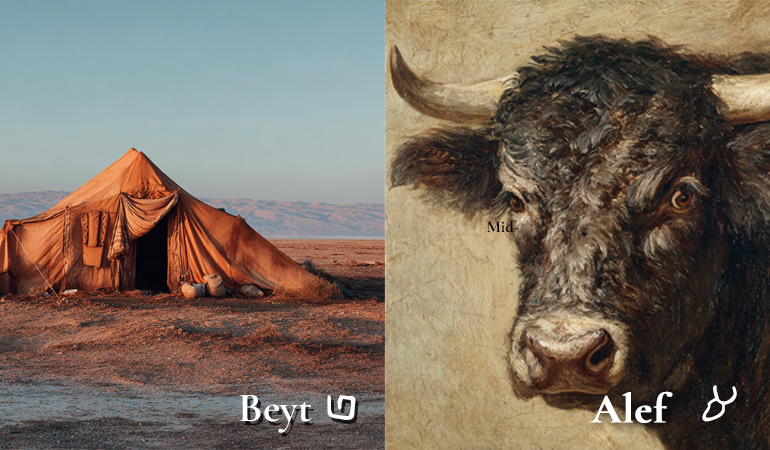
“Fathers” are the “strength of the house” or “strength of the family”. The last three letters of “Abraham” include the following three letters:

“Abram” includes the “resh” and the “mah” which could mean “chief of multitudes” or “mighty chief”. It could also mean “a multitude of chiefs or men”. The addition of the letter “hey” is a man trying to get the attention of others. He is saying, “Hey! Look at this Strength of the House! Look at this mighty chief!” The letter “hey” also represents “breath”. Abraham is a mighty father of many men who has breath. People with breath are alive. His name could also mean “Father of many nations who have breath”. The addition of the letter “hey” as “breath” indicates someone who will be resurrected from the dead. This is confirmed by the words of Yahusha in the following passage:
But as touching the resurrection of the dead, have you not read that which was spoken unto you by Elohiym, saying, I am the Elohiym of Abraham, and the Elohiym of Yitzhak, and the Elohiym of Ya’aqob? Elohiym is not the Elohiym of the dead, but of the living.
He was quoting Shemoth (Exodus) 3:15.
And Elohiym said moreover unto Moshe, Thus, shall you say unto the children of Yashar’El, Yahuah Elohiym of your fathers, the Elohiym of Abraham, the Elohiym of Yitzhak, and the Elohiym of Ya’akob, has sent me unto you: this is My Name forever, and this is My Memorial unto all generations.
Yahuah was speaking in the present tense indicating that these men are still alive. He did not say “I was the Elohiym of Abraham…” Yahuah gave Abraham “breath” when He changed his name from “Abram” to “Abraham”. Because Yahuah is so precise when it comes to naming people, we would most certainly expect Him to Name His Son, “Yahusha”. This is what testimony says:
And she shall bring forth a son, and you shall call his name Yahusha: for he shall save his people from their sins.
And his father Zakaryah was filled with the Set-Apart Spirit, and prophesied, saying, Blessed be Yahuah Elohiym of Yashar’El; for he has visited and redeemed his people, And has raised up an horn of salvation for us in the house of his servant David; As he spoke by the mouth of his set-apart prophets, which have been since the world began: That we should be saved from our enemies, and from the hand of all that hate us;
The purpose of Yahuah’s Son is to save people. The Hebrew word translated as “salvation” is “yeshuah” which is a feminine word. This would not have been the name given to Yahusha because he was a male. Feminine words include a “hey” on the end of the word which we described in our study titled: Pronunciation of the Name, “Yahuah”. The Ancient Hebrew Lexicon of the Bible written by Jeff A. Benner defines it as:
H[WFY ( fem., ישועה / ye-shu-ah) Translation: RELIEF Definition: A deliverance or freedom from a trouble, burden or danger. KJV Translations: salvation, help, deliverance, health, save, saving, welfare Strong’s Hebrew #: h.3444
“Salvation” from the perspective of Yahuah is the act of delivering someone from troubles, burdens and danger. This is the same definition in the three-lettered root of this Hebrew word. The Ancient Hebrew Lexicon of the Bible defines it as:
[FY ( common, ישע / y.sh.ah) Translation: RESCUE (V) Definition: To free or deliver from a trouble, burden or danger. KJV Translations: save, saviour, deliver, help, preserved, salvation, avenge, defend, rescue, safe, victory Strong’s Hebrew #: h.3467
[FY ישע Definition: When one of the flock is in trouble, the shepherd rescues it.
When the flock is in danger, the shepherd rescues them. This Hebrew word is described exactly in the following testimony spoken by Messiah Yahusha.
I am the good shepherd: the good shepherd gives his life for the sheep. But he that is a hireling, and not the shepherd, whose does not own the sheep, sees the wolf coming, and leaves the sheep, and flees: and the wolf catches them, and scatters the sheep. The hireling flees, because he is a hireling, and does not care for the sheep. I am the good shepherd, and know my sheep, and am known of mine. As the Father knows me, even so know I the Father: and I lay down my life for the sheep.
The hireling fled when the wolf came to attack the sheep. But the shepherd who owns the sheep protects his flock even to the point of laying down his life for them. The shepherd destroys the enemy. This is clearly pictured in the two-lettered root of this Hebrew word:
[F שע Action: Watch, Cry, Rescue, Lean, Look Object: Shepherd, Staff, Eye, Window Abstract: Delight, Support Definition: The shepherd carefully watches over the flock and the surrounding area always on the lookout for danger. When a predator comes to attack, the shepherd destroys the enemy. Ancient Hebrew: The pictograph F is a picture of the teeth used for devouring or destruction, the [ is a picture of the eye. Combined these mean “destroyer watches”.
We can see the two front teeth in the letter “shin”. Teeth are used to devour and consume food. We can see the eye in the letter “ayin” which in this particular word means “watch”. We can see the definition, “destroyer watches” in this two-lettered root. Shepherd’s watch over their sheep and destroy anything that attacks them. King David is an excellent example:
And David said unto Shaul, your servant kept his father’s sheep, and there came a lion, and a bear, and took a lamb out of the flock: And I went out after him, and smote him, and delivered it out of his mouth: and when he arose against me, I caught him by his beard, and smote him, and slew him. Your servant slew both the lion and the bear: and this uncircumcised Philistine shall be as one of them, seeing he has defied the armies of the living Elohiym.
This is the meaning of “salvation” from an ancient Hebrew perspective. Here are the pictographic letters of the three-lettered root meaning “salvation”.

The shepherd uses his arm to destroy the enemies of his sheep. This Hebrew word is used in the following prophecy:
Yahuah has made bare his set-apart arm in the eyes of all the nations; and all the ends of the earth shall see the salvation [H3444] of our Elohiym.
The context of this passage says the “set-apart arm of Yahuah” will be named “Yahusha”. We have clearly established that people named by Yahuah are named according to their purpose or function. The purpose of the set-apart arm is to bring salvation to the nations. This is the message communicated in the context of this passage because it refers to the “eyes of the nations”. The context of the passage says that the nations will see Yahuah’s salvation which means that it is a physical individual. Because the function of the set-apart arm is to save the nations, his name would be “Yahusha” meaning “Yahuah’s Salvation”. The context of the passage also says that His servant shall be “exalted, extolled and very high”.
Behold, my servant shall deal prudently, he shall be exalted and extolled, and be very high.
This would indicate that the set-apart arm is being established as “King” over all the earth. This is validated by the following prophecy spoken by King David:
Yet have I set my King upon My Set-Apart hill of Tziyon. I will declare the decree: Yahuah has said unto me, “You are my Son; this day have I begotten you. Ask of me, and I shall give you the heathen for your inheritance, and the uttermost parts of the earth for your possession. You shall break them with a rod of iron; you shall dash them in pieces like a potter’s vessel”.
Yahuah is going to “exalt, extoll and set very high” His King in Tziyon. This King is His Son. This Son will come out of the line of Yishai (Jesse).
And there shall come forth a rod out of the stem of Yishai, and a Branch shall grow out of his roots:
King David is the son of Yishai (Jesse):
Now these are the generations of Pharez: Pharez begat Hezron, And Hezron begat Ram, and Ram begat Amminadab, And Amminadab begat Nahshon, and Nahshon begat Salmon, And Salmon begat Boaz, and Boaz begat Obed, And Obed begat Yishai, and Yishai begat David.
Based on this evidence, the “Branch” in Yeshayahu (Isaiah) 11:1 is someone from the line of King David since King David had died at this point in time. The Prophet Yechezqel (Ezekiel) says that David will be King over the House of Yashar’El after the resurrection.
And David my servant shall be king over them; and they all shall have one shepherd: they shall also walk in my judgments, and observe my statutes, and do them.
The identity of our Messiah is described by the Prophets of Yahuah. Here is the evidence:
- The set-apart arm of Yahuah will be exalted, extolled and very high (Yeshayahu/Isaiah 52:13)
- The name of this set-apart arm is “Yahusha” meaning “Yahuah’s Salvation”. (Yeshayahu/Isaiah 52:1o)
- He will be established as “King” in Tziyon and exercise authority over all the nations. This King is the Son of Yahuah Elohiym. (Tehillim/Psalms 2:6-9)
- This King will be from the line of Yishai (Jesse) who is the father of King David. (Yeshayahu/Isaiah 11:1)
- David will be King over the House of Yashar’El and the House of Yahudah after the resurrection (Yechezqel/Ezekiel 37:24)
Based on this evidence, our Messiah and King is named “Yahusha Ben David” according to the Prophets representing Yahuah. He is also the Son of Yahuah Elohiym.
And many other signs truly did Yahusha in the presence of his disciples, which are not written in this book: But these are written, that you might believe that Yahusha is the Messiah, the Son of Elohiym; and that believing you might have life through his name.
Yochanan (John) was a firsthand eyewitness to the life and words of Messiah Yahusha Ben David. This is his perspective. He believed that Yahusha Ben David is the Messiah promised by the Prophets of Yahuah. In Mattithyahu (Matthew) there is a conversation recorded between Messiah Yahusha and his disciples that reveals his identity as well:
When Yahusha came into the coasts of Caesarea Philippi, he asked his disciples, saying, “Whom do men say that I am, the Son of man?”
And they said, “Some say that you are Yochanan the Immerser: some, Eliyahu; and others, Yirmeyahu, or one of the prophets”.
He said unto them, “But whom say do you that I am?”
And Shimon Kepha answered and said, “You are the Messiah, the Son of the living Elohiym”.
And Yahusha answered and said unto him, “Blessed are you, Shimon Bar-Yonah: for flesh and blood has not revealed it unto you, but my Father which is in heaven”.
Shimon Kepha (Peter) was also a firsthand eyewitness to the life and words of Messiah Yahusha. This expresses his perspective. He believed that Yahusha is the promised Messiah, the Son of Yahuah. The problem is that he was not made King over all the nations as prophesied by Yeshayahu (Isaiah). However, the context of this passage in Yeshayahu says that the set-apart arm must die. We have provided testimony from the King James Version and the Brenton Septuagint.
He was taken from prison and from judgment: and who shall declare his generation? for he was cut off out of the land of the living: for the transgression of my people was he stricken. And he made his grave with the wicked, and with the rich in his death; because he had done no violence, neither was any deceit in his mouth.
In his humiliation his judgment was taken away: who shall declare his generation? for his life is taken away from the earth: because of the iniquities of my people he was led to death. And I will give the wicked for his burial, and the rich for his death; for he practiced no iniquity, nor craft with his mouth.
In context, this passage is speaking about the set-apart arm of Yahuah mentioned in Yeshayahu (Isaiah) 52:10. Here is the testimony that confirms this.
O Yahuah, who has believed our report? and to whom has the arm of Yahuah been revealed?
In Yeshayahu (Isaiah) 52:13, it says that Yahuah has exalted, extolled and set him very high. But now he has died? In order for this sequence of events to happen, Yahuah must resurrect him! Death is the act of being brought very low. People are not exalted in death. The Prophet continues and says that the set-apart arm will receive great spoil because he has poured out his soul unto death.
Yet it pleased Yahuah to bruise him; he has put him to grief: when you shall make his soul an offering for sin, he shall see his seed, he shall prolong his days, and the pleasure of Yahuah shall prosper in his hand. He shall see the travail of his soul, and shall be satisfied: by his knowledge shall my servant justify many righteous; for he shall bear their iniquities. Therefore, I will divide him a portion with the great, and he shall divide the spoil with the strong; because he has poured out his soul unto death: and he was numbered with the transgressors; and he bare the sin of many, and made intercession for the transgressors.
What good is spoil to a dead man? Yeshayahu (Isaiah) 52:10 to 53:12 is discussing the identity of the set-apart arm of Yahuah but also that he must die and be resurrected. The timing of his exaltation is also revealed in the context of Yeshayahu. The wording in the following passage is a direct link to the first exodus from Egypt except this time they will not leave in haste.
Depart, depart, go out from there, touch no unclean thing; go out of the midst of her; be clean, that bear the vessels of Yahuah. For you shall not go out with haste, nor go by flight: for Yahuah will go before you; and the Elohiym of Yashar’El will be your rear guard.
Here is the passage referring to the first exodus:
And the Egyptians were urgent upon the people, that they might send them out of the land in haste; for they said, We be all dead men. And the people took their dough before it was leavened, their kneading-troughs being bound up in their clothes upon their shoulders.
In Yeshayahu (Isaiah), Yahuah is saying that in the second exodus the people will NOT leave in haste. This indicates that there will be a second sequence of events repeated that will be similar to the first exodus from Egypt depicted in Shemoth (Exodus) 1-14. This is also confirmed in the following passage:
Therefore, behold, the days come, says Yahuah, that it shall no more be said, Yahuah lives, that brought up the children of Yashar’El out of the land of Egypt; But, Yahuah lives, that brought up the children of Yashar’El from the land of the north, and from all the lands where he had driven them: and I will bring them again into their land that I gave unto their fathers.
There will be a second greater exodus. This is the timing when Yahusha Ben David will be exalted, extolled and very high. At this time, the work of salvation would have been completed which means that his death and resurrection must have occurred prior to this event. These prophecies were spoken hundreds of years before Messiah Yahusha Ben David was born.
- King David lived approximately 1000 years before Messiah Yahusha Ben David.
- Yeshayahu (Isaiah) lived 700 years before Messiah Yahusha Ben David.
- Yirmeyahu (Jeremiah) lived 600 years before Messiah Yahusha Ben David.
- Yechezqel (Ezekiel) lived 620 years before Messiah Yahusha Ben David.
Yahuah says that He declares events before they occur.
I am Yahuah: that is My Name: and my glory will I not give to another, neither my praise to graven images. Behold, the former things are come to pass, and new things do I declare: before they spring forth, I tell you of them.
This is evidence that these words are true. Testimony in the eyewitness accounts verify that Yahusha Ben David is the promised Messiah who died and was resurrected just as the Prophet Yeshayahu (Isaiah) declared. We can expect the remainder of that prophecy to come to pass in the very near future. In the first exodus, Yahuah intervened on behalf of the House of Yashar’El to rescue them from their oppressors. Messiah Yahusha is Yahuah’s Salvation. He is the great Shepherd who is watching his sheep. There will come a point in which he will destroy those who are oppressing his flock. He will fulfill the function of his name.
We do not see these things in the name “Jesus”. We could not see how our Messiah fulfilled the prophecy in Yeshayahu (Isaiah) using the name “Jesus”. It is not his name. It is a Greek name assigned to him by the leaders of this world just like pharaoh assigned the name “Zaphnathpaaneah” to the patriarch Yoseph (Joseph). Yoseph was still Yoseph. Yahusha is still Yahusha.