
121-5 Yahuah is “Elohiym”
Unto you it was shown, that you might know that Yahuah, he is Elohiym; there is none else beside him.
The Hebrew word “Elohiym” is most often translated as “God” in English translations of the Hebrew text. It is pronounced “el-o-heem”. The word, “God” is not a transliteration of the word “Elohiym”. It is a substitution. When a word is transliterated from one language to another, they make an attempt to preserve the pronunciation of the word in the original language. The Hebrew word “Baal” is an example. The pronunciation of his name has been preserved in all languages throughout time. These are examples of transliteration.
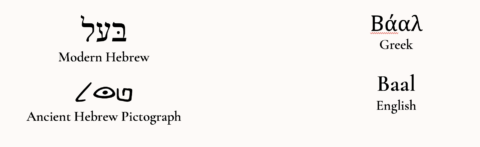
The word “God” does not sound anything like “Elohiym”. Therefore, it is not a transliteration of the underlying Hebrew word. “God” is a transliteration of the name “Gad” who is one of the twelve tribes of Yashar’El.
And Zilpah Leah’s maid bare Ya’akob a son. And Leah said, A troop comes: and she called his name Gad.
It is pronounced “gawd” which is exactly the way we pronounce “God” in the English language and so, it is a transliteration of the Hebrew name “Gad”. It contains the letters “gimmel” and “dalet”. The English letters with the same sound is directly below the letter and is read right to left, which is the opposite direction to English.
DG
D-G
This is a perfect example of a transliteration. Yahuah never uses this Hebrew word to describe His nature and character. Because Yahuah focuses on the “function” of a name, it is important to consider the meaning from an ancient Hebrew perspective. The Ancient Hebrew Lexicon of the Bible written by Jeff A. Benner defines “Gad” the following way:
DWG ( common, גוד / g.w.d) Translation: INVADE (V) Definition: To enter for conquest or plunder. The slicing through of a band of men. KJV Translations: overcome, invade with troops Strong’s Hebrew #: h.1464
DG גד Action: Slice, Band, Invade, Magnify Object: Bunch, Riverbank, Company, Band, Sinew, Coriander, Rope.
DG ( masc., גד / gad) Translation: FORTUNE Definition: A store of material possessions. Relationship to Root: A seed cut out of the plant. A prized spice. KJV Translations: troop Strong’s Hebrew #: h.1409
Is our Father in Heaven an invader for the purpose of conquest and plunder? Does He acquire a store of material possessions like pirates? When most people use the word “God,” they are not thinking of these definitions or intentionally assigning these qualities to Him. However, Yahuah thinks in terms of “function”. The issue is not necessarily about our intentions but about His perceptions. Here are two Hebrew words in this same word family.
DWDG( masc., גדוד / ge-dud) Translation: BAND Definition: A gathering of men for attacking or raiding. KJV Translations: band, troop, army, company, men Strong’s Hebrew #: h.1416
DDG ( common, גדד / g.d.d) Translation: BAND (V) Definition: To gather or assemble together as a group for attacking or raiding. KJV Translations: gather together, assemble by troop, gather Strong’s Hebrew #: h.1413
This Hebrew word gives us this idea of an invading army used to gather spoil like pirates. Yahuah is El Shaddai. He is a Defender of His cubs. He does not attack other people groups for the sake of plunder or for acquiring material possessions. This does not describe His Nature and Character. Testimony says that He specifically instructs His Kings not to multiply silver and gold to themselves.
Neither shall he multiply wives to himself, that his heart turn not away: neither shall he greatly multiply to himself silver and gold.
Invading other cities and countries is the act of acquiring material possessions including silver and gold. Why would Yahuah impose a quality upon His Kings if He did not bear this quality Himself? Yahuah does not multiply to Himself, silver and gold. He would not invade a people group for the purpose of acquiring material possessions.

Let’s consider the ancient Hebrew pictographic letters for the name “Gad” to confirm its definition. The name, “Gad” has the letters, “gimmel” and “dalet”. The “gimmel” or “gam” is a picture of a foot.
This letter involves anything with the foot especially walking. The name of the letter itself includes the “mem” or “mah” which is a picture of water. Together, they mean “gather at the water”. We can see shepherds walking to a watering hole to water their flocks. Army troops gather together to prepare for an invasion. The “dalet” is a picture of a door to a tent that swings back-and-forth. Invading armies move back-and-forth from one settlement to another. They also gather at the door or gates of a city before overtaking it.
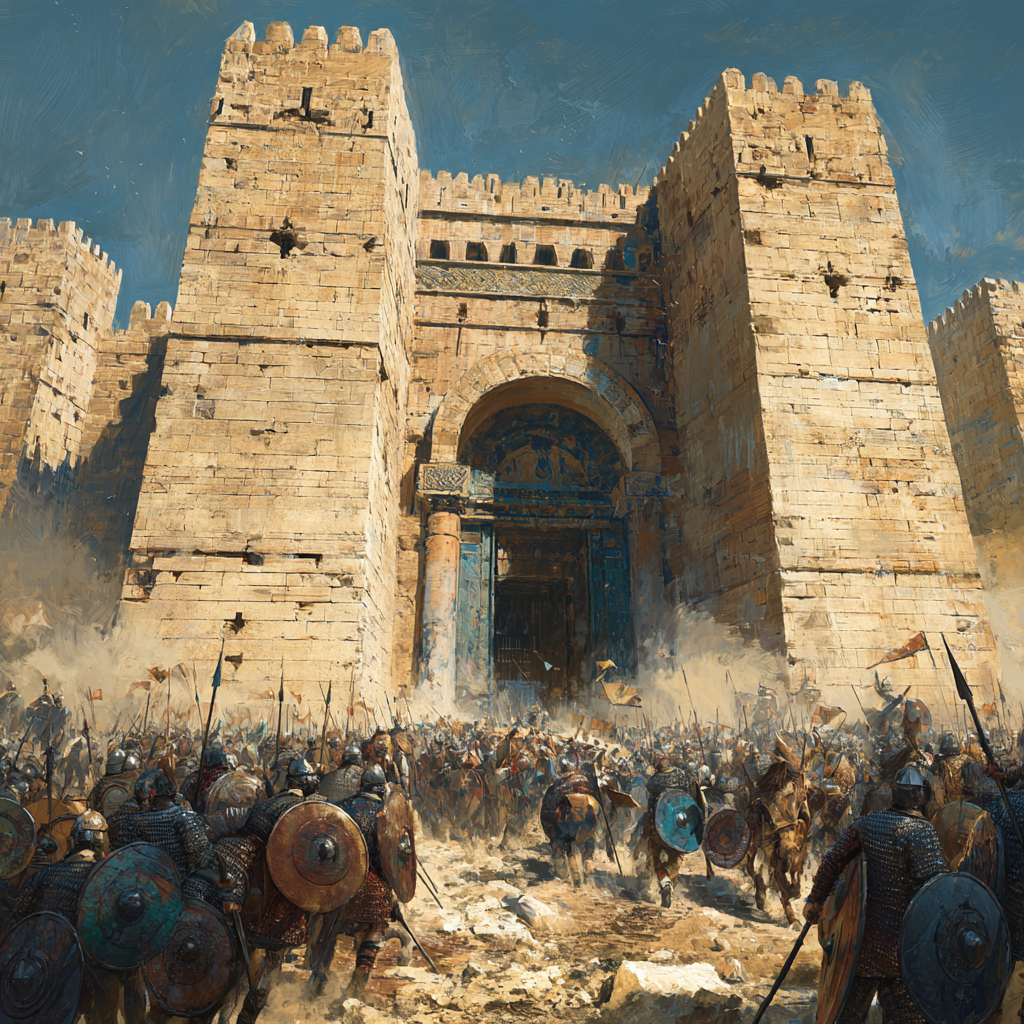
This picture reflects the nature and character of the name “Gad”. We can verify the meaning of this word by looking at the context of passages in the Hebrew writings that use this word. Several renditions of this word are used in the following passage:
Gad [H1410], a troop [H1416] shall overcome [H1464] him: but he shall overcome [H1464] at the last.
All of these underlying Hebrew words are in the same word family. “Gad” is one of the twelve tribes of Yashar’El. His name means “troop”. This is a prophecy spoken over him by his father, Ya’akob (Jacob). An invading army is going to overcome him but he shall overcome the invading army in the end. The purpose of a troop is to overcome another group of people. In the following testimony, “gedud” is translated as a “band” of men from Moab who invaded the land.
And Elisha died, and they buried him. And the bands [H1416] of the Moabites invaded the land at the coming in of the year.
In the following passage “gedud” is translated as a troop of robbers who lie in wait for a man to attack him.
And as troops of robbers [H1416] wait for a man, so the company of priests murder in the way by consent: for they commit lewdness.
In the following testimony, King David says Yahuah helps him to run through an army of men or troop. This illustrates that Yahuah protects His people from invading armies. He is “El Shaddai”.
For thou will save the afflicted people; but will bring down high looks. For you will light my candle: Yahuah my Elohiym will enlighten my darkness. For by you, I have run through a troop [H1416]; and by my Elohiym have I leaped over a wall. As for Elohiym, his way is perfect: the Word of Yahuah is tried: he is a shield to all those that trust in him.
In the next testimony, the Prophet is making a reference to Yahuah. Translators of the King James Version used the word “invade” when it could also mean to “overcome” as illustrated in Bereshith (Genesis) 49:19.
When I heard, my belly trembled; my lips quivered at the voice: rottenness entered into my bones, and I trembled in myself, that I might rest in the day of trouble: when he comes up unto the people, he will invade [H1464] them with his troops.
The Brenton Septuagint translates it differently.
I watched, and my belly trembled at the sound of the prayer of my lips, and trembling entered into my bones, and my frame was troubled within me; I will rest in the day of affliction, from going up to the people of my sojourning.
This also illustrates that Yahuah defends His people and judges the nations. He has no need to invade a people group to acquire possessions like a pirate, nor does He condone it among His people. However, these are characteristics of other mighty ones. These passages provide context to verify the meaning of the Hebrew word, “Gad” and the “function” it represents.
Does “Gad” represent the Nature and Character of Yahuah?
“Gad” does not represent the Nature and Character of our Father. Testimony in Yeshayahu (Isaiah) identifies “Gad” as the name of a Babylonian deity of “fortune”.
But you are they that forsake Yahuah, that forget my set-apart mountain, that prepare a table for Gad, and that furnish the drink offering unto Meni.
The people mentioned in this passage, “forsake Yahuah” and are worshipping and serving “Gad” and “Meni”. “Gad” is the “Lord of Fortune” which was a Canaanite deity as well, mentioned in the book of Yahusha (Joshua)
Even from the mount Halak, that goes up to Seir, even unto Baal-gad in the valley of Lebanon under mount Hermon: and all their kings he took, and smote them, and slew them.
And these are the kings of the country which Yahusha and the children of Yashar’El smote on this side Yarden on the west, from Baal-gad in the valley of Lebanon even unto the mount Halak, that goes up to Seir; which Yahusha gave unto the tribes of Yashar’El for a possession according to their divisions;
And the land of the Giblites, and all Lebanon, toward the sunrising, from Baal-gad under mount Hermon unto the entering into Hamath.
Here is the name as it appears in the Hebrew writings.
DG L[B
Baal-Gad (Lord God)
This translates as the “Lord Gad” which is pronounced exactly the way English people say, “Lord God”. Here is the entry from Strong’s Exhaustive Concordance of the Bible illustrating its pronunciation.
בַּעַל גָּד Baʻal Gâd, bah’-al gawd; from H1168 and H1409; Baal of Fortune; Baal-Gad, a place in Syria:—Baal-gad. https://www.blueletterbible.org/lexicon/h1171/kjv/wlc/0-1/
“Gad” is the name of a false deity worshipped and served by people just like “Zeus” and “Apollo”. Would we say that “Zeus” and “Apollo” are acceptable substitutions to use in English versions of Bibles and Tanakhs?
- Gad: deity of fortune (obtained by invading armies)
- Zeus: supreme deity of thunder
- Apollo: deity of the sun
By replacing the Name of our Father with “God”, we are giving a false deity credit for the deeds of our Father. When singing songs to “God,” we are giving praise to the name of a false deity instead of Yahuah Elohiym. When praying to “God,” we are sending our prayers to the name of a false deity. If He answers these prayers, is He communicating to us that these are acceptable substitutions? Perhaps using the names of these false deities actually prevents Him from answering our prayers. What would happen if we actually prayed in His Name?
“Elohiym” Defined:
“God” is a transliteration of “Gad”. It is not a transliteration of the Hebrew word “Elohiym” because they do not sound anything alike. It is a substitution for the Hebrew word “Elohiym” authorized by men and not Yahuah. Is “God” an appropriate substitution based on modern-day definitions? Oxford English Dictionary defines “god” and “deity” as:
- God: a superhuman being or spirit worshiped as having power over nature or human fortunes; a deity.
- Deity: divine status, quality, or nature.
Is this what the word “Elohiym” means from an ancient Hebrew perspective? The root of this Hebrew word is “El” and it is defined by The Ancient Hebrew Lexicon of the Bible as:
LA אל Action: Yoke, Guide, Swear Object: Ox, Oak, Yoke Abstract: Strength, Oath, Learn Definition: The yoke is understood as a “staff on the shoulders” (see Isaiah 9:4) in order to harness their power for pulling loads such as a wagon or plow. Hence, the two pictographs can also represent “the ox in the yoke”. Often two oxen were yoked together. An older, more experienced ox would be teamed up (yoked) with a younger, less experienced ox. The older ox in the yoke is the “strong authority” who, through the yoke, teaches the younger ox. Ancient Hebrew: The pictograph A is a picture of an ox head and also represents its strength. The L is a picture of a shepherd staff and also represents the authority of the shepherd. Combined these two pictographs mean “the strong authority” and can be anyone or thing of strong authority.

“El” is a picture of two oxen yoked together. The older ox has already been thoroughly trained and knows what to do. He has been tamed. When a younger ox is yoked with him, the older ox shows the younger ox what to do. This is how oxen are trained from one generation to another.
Our Father in heaven is the older ox. When we are yoked together with Him, He teaches us what to do. He trains us. He is stronger than us and can direct our path. He becomes our “Authority”.
This is also the teacher’s role. We attend a biology class. The teacher imparts his or her knowledge to the students. When a student attends the class, they are yoking themselves together with the teacher. The teacher has the “authority” to evaluate our efforts in the form of assignments, tests or grades. They have the power to flunk students. The teacher is not a superhuman being with power over nature or human fortunes. However, they are an “elohiym”.
Employers provide job descriptions for their employees. When people accept a position at this company, they are yoking themselves together with this employer and fulfilling the requirements of the job description. The employer has “authority” over their employees. They have the power to remove people from their positions and evaluate their performance. The employer is not a superhuman being with power over nature and human fortunes. However, they are an “elohiym”.
Parents provide guidance and direction for their children and teach them in the way that they should go. They have “authority” over their children and can dictate their privileges and responsibilities. They hold their children accountable. Children are yoked together with their parents. Our parents are not superhuman beings with power over nature and human fortunes. However, they are an “elohiym”.
Are teachers, employers and parents “superhuman beings having power over nature and human fortunes”?
Most of us would not consider the people in these roles as “gods” or “goddesses”. They would not be classified as “deities” either. However, they are “strong authorities” which have the power to establish rules and guidelines. The actual word translated as “Elohiym” comes from the following word, “Eloah” which is defined by The Ancient Hebrew Lexicon of the Bible as:
HWLA ( masc., אלוה / e-lo-ah) Translation: POWER Definition: Possession of control, authority, or influence over others; physical might. The power or might of one who rules or teaches. One who yokes with another. Often applies to rulers or a god. Often used in the plural form literally meaning “mighty ones,” but often used in a singular sense to mean “The Mighty One.” KJV Translations: God, god, judge, angel, mighty, godly, heathen deity Strong’s Hebrew #: h.0433 Aramaic Spelling: אלה Strong’s Aramaic #: a.0426, a.0430
HLA אלה Definition: The yoking together of two parties. A treaty or covenant binds two parties together through an oath (yoke). The oath included blessings for abiding by the covenant and curses for breaking the covenant (see Deuteronomy 28). The God of the Hebrews was seen as the older ox that is yoked to his people in a covenant relationship.
Ancient Hebrew is focused upon “function” and not appearance. “Eloah” is someone who exerts authority, influence or power over another. This term can be applied to rulers as well. People bind themselves together with Yahuah through covenant agreements. This terminology is observed in the following words spoken by our Messiah.
Come unto me, all you that labor and are heavy laden, and I will give you rest. Take my yoke upon you, and learn of me; for I am meek and lowly in heart: and you shall find rest unto your souls. For my yoke is easy, and my burden is light.
He is encouraging people to enter into covenant with him. He is encouraging them to bind themselves to him. He is the teacher; we are the student. He is the older ox and we are the younger ox. Messiah Yahusha is confirming the definition of this Hebrew word in his own testimony. People are not yoked with Yahuah unless they are in covenant with Him. In Shemoth (Exodus) 3:15, testimony says that Yahuah is the “Elohiym of Abraham, the Elohiym of Yitzhak (Isaac) and the Elohiym of Ya’akob”. This tells us that Yahuah was and is their Strong Authority and that they were in covenant with Him. Testimony never states that Yahuah was the “Elohiym” of Adam. However, Yahuah is the Elohiym of the Hebrew people.
And Yahuah Elohiym took the man, and put him into the garden of Eden to dress it and to keep it. And Yahuah Elohiym commanded the man, saying, Of every tree of the garden you may freely eat:
And I will take you to me for a people, and I will be to you a Elohiym: and ye shall know that I am Yahuah your Elohiym, which brings you out from under the burdens of the Egyptians.
Yahuah is still a Strong Authority over all of His Creation. However, there is a difference between His people and the rest of mankind and this is subtlety denoted in testimony.
- Yahuah Elohiym: People who are not in covenant with Yahuah but He still exercises authority over them whether they like it or not. These people may not even acknowledge His Existence.
- Yahuah your Elohiym: People who are in covenant with Yahuah and want Him to exercise authority over them. These people have a relationship with Him.
Tehillah (Psalms) 2 provides an excellent example of these two groups of people under the leadership of our Messiah King.
The Hebrew word “elohiym” does not mean a “superhuman being who has power over nature and human fortunes”. Testimony says that the Prophet Moshe (Moshe) was an “Eloah”. Moshe is just a man. These are the words spoken by Yahuah to Moshe.
And Yahuah said unto Moshe, See, I have made you an Elohiym [H430] to Pharaoh: and Aahron your brother shall be your prophet.
Yahuah acknowledges the existence of other “elohiym” and has identified the Prophet Moshe (Moses) as an “elohiym”. Gad, Zeus and Apollo are inventions of the human mind and do not really exist. Popes, Presidents and Prophets exist. They represent real men and women who have authority over others in the earth just like the Prophet Moshe.
“Elohiym” is the plural form of “Eloah”. Here is the Hebrew word as it appears in Shemoth (Exodus) 7:1 using the ancient Hebrew pictographic language:
MYHLA
“Eloah” is highlighted in red. The two letters in black are a suffix added to Hebrew words that denote a plural meaning more than one or someone or something that is extremely powerful and mighty. We would consider the office of Pope or President as positions which exercise considerable authority over the inhabitants of the earth. The word “Elohiym” is strictly referring to the Prophet Moshe (Moses) in Shemoth (Exodus) 7:1, so this occurrence is singular, meaning powerful and mighty and this is referring to a man. Testimony uses “elohiym” in this passage which is referring to many, but it is also a reference to men.
A Psalm of Asaph. Elohiym [H430] stands in the congregation of the mighty; he judges among the elohiym [H430].
I have said, You are elohiym [H430]; and all of you are children of the Most High.
Children of the Most High are “elohiym”. Are the children of the Most High, “superhuman beings having power over nature and human fortunes”? No, they are just men and women like the Prophet Moshe (Moses).
Using the English term “God” can also cause us to misunderstand the original intended message given to us by our Creator. Consider the following example:
You shall have no other gods [H430] before me.
This is essentially saying that you shall have no “superhuman beings with power over nature and human fortunes” before me. This is exactly how I interpreted this passage as a young woman. But is this what this passage is actually saying?
You shall have no other strong authorities [H430] above me.
Kings have authority over their subjects. We do not consider them “superhuman beings with power over nature and human fortunes”. They are men with great authority over the inhabitants of the earth. The same is true of queens. The horns on the ox in the Hebrew word “El” represent the points on the crown of a King. The shepherd’s staff in the Hebrew word “El” is represented by the scepter. It is a symbol of their authority. We can see these represented in the Hebrew language which confirms that “elohiym” is referring to Kings and not “superhuman beings with power over nature and human fortunes”.

LA
Yahuah Elohiym is saying that His people are not to place the authority of kings, priests, popes, emperors, chiefs or pharaohs above His Authority. The following pictures are “elohiym” from the perspective of Yahuah.
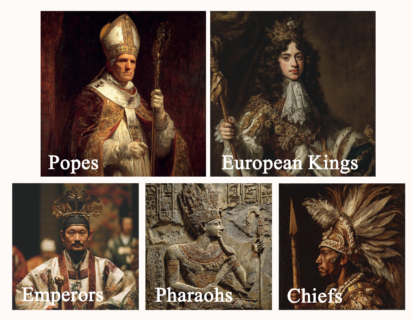
Strong authorities are rulers. All rulers have a set of laws they impose upon their subjects. Some of these laws are in alignment with the Laws of Yahuah and some are not. When people choose to obey the laws of these rulers instead of the Laws of Yahuah, they have placed the authority of these rulers above Yahuah Elohiym. Here is an example:
And unto Adam he said, Because you have heard and obeyed the voice of your wife, and have eaten of the tree, of which I commanded you, saying, You shall not eat of it: cursed is the ground for your sake; in sorrow shall you eat of it all the days of your life; Thorns also and thistles shall it bring forth to you; and you shall eat the herb of the field; In the sweat of your face shall you eat bread, till you return unto the ground; for out of it were you taken: for dust you are, and unto dust shall you return.
Adam chose to hear and obey the voice of his wife instead of hearing and obeying the Voice of Yahuah Elohiym. His Law said:
And Yahuah Elohiym commanded the man, saying, Of every tree of the garden you may freely eat: But of the Tree of the Knowledge of Good and Evil, you shall not eat of it: for in the day that you eat from it you shall surely die.
However, this is what happened.
And when the woman saw that the tree was good for food, and that it was pleasant to the eyes, and a tree to be desired to make one wise, she took of the fruit thereof, and did eat, and gave also unto her husband with her; and he did eat.
Adam placed the authority of his wife above the authority of Yahuah Elohiym when he chose to obey her instead of Yahuah. These situations arise when there is a law imposed by a man or woman that contradicts the Laws of Yahuah. People must make a decision in these situations. Are they going to obey the Laws of Yahuah or obey the laws of this leader? If people choose to hear and obey their leader instead of Yahuah Elohiym, they are serving and worshipping their leader and not serving and worshipping Yahuah. This is idolatry in His eyes. Adam violated the words spoken in Shemoth (Exodus) 20:3.
It is highly likely that we would have never understood the message in Shemoth (Exodus) 20:3 in this light if we continued to interpret “elohiym” as “gods”. The English word “God” does not convey an accurate picture of the underlying Hebrew word “elohiym”.
Let’s consider some other examples in the Word of Yahuah. The first passage uses the word “gods” and the second passage uses “kings, leaders, priests, strong authorities”. Note the differences in the message conveyed.
You shall not revile the gods, nor curse the ruler of your people.
You shall not revile the kings, leaders, priests, strong authorities, nor curse the ruler of your people.
This is telling us to show respect to the people Yahuah has placed in authority over us. Consider this one:
You shall make no covenant with them, nor with their gods.
You shall make no covenant with them, nor with their kings, leaders, priests, strong authorities.
This passage is telling us not to enter into covenant with kings, leaders, priests or anyone else in authority especially if they include laws that contradict the Laws of Yahuah. Here is another example:
You shall not go after other gods, of the gods of the people which are round about you;
You shall not go after other kings, leaders, priests, strong authorities, of the kings, leaders, priests, strong authorities of the people which are round about you;
Yahuah is telling His people not to serve other kings, leaders, priests and authorities other than Him. He is specifically speaking of those in the surrounding nations at the time. However, things are not much different than they were then.
Conclusion:
The English word “God” is not a good substitution for “Elohiym”. Here is a review of the evidence that has led us to these conclusions:
- “God” is a transliteration of the name of a Babylonian and Canaanite deity. This would be like calling our Creator by the name of Zeus or Apollo. It is not appropriate.
- The meaning of “Gad” does not convey the nature and character of our Father in Heaven.
- “Ba’al Gad” means “Lord of Fortune” which is not a characteristic of our Father.
- “Gad” or “Ba’al Gad” is not a name which Yahuah uses to refer to Himself.
- The English definition of the word “god” does not align with the Hebrew definition of “elohiym”. It causes people to misunderstand and misinterpret the original intended message of our Creator.
- The word “god” means “someone with superhuman powers over nature and the fortunes of man”. This term does not describe men and women. The Hebrew text does refer to men and women as “elohiym” so the term “god” is not appropriate term to use when translating “elohiym”.
For these reasons, we translate every occurrence of “elohiym” as “Elohiym” when it refers to Yahuah. When translating other occurrences of the word “elohiym”, we may use “elohiym, mighty ones or strong authorities”. We have eliminated the English word “god” altogether. The “function” described in the word “Gad” does not edify our Father and it has been used as a name for a pagan deity of fortune. Using this name is like a wife calling her husband by the name of her previous lover. This would not lead to a positive interaction between this husband and wife. We love and care for our Father in Heaven. We do not wish to offend Him in any way, shape or form. From our perspective, it is safe to call Him by the Names He has used in His Word to describe Himself like the Name, “El Shaddai”.
Download this Article here