
121-6 The Name “Yahuah”
And Elohiym said moreover unto Moshe, Thus, shall you say unto the children of Yashar’El, Yahuah Elohiym of your fathers, the Elohiym of Abraham, the Elohiym of Yizhak, and the Elohiym of Ya’akob, has sent me unto you: this is My Name forever, and this is My Memorial unto all generations.
This particular Name is surrounded by great controversy. Rabbinic Judaism prohibits people from uttering it and several other groups insist on a particular pronunciation. Some will even go so far as to say that people are not saved if they pronounce it wrong. This has created so much confusion, strife and division. These behaviors are NOT characteristic of our Father in Heaven. He says His Name means “unity” in the following passage:
Hear, O Yashar’El: Yahuah our Elohiym is one Yahuah:
The Hebrew word translated as “one” is “echad” and it can be a reference to the number one but it can also represent “unity”. In this passage, Yahuah is saying that He represents “unity”. The Ancient Hebrew Lexicon of the Bible written by Jeff A. Benner defines “echad” the following way:
DXA ( masc., אחד / e-hhad) אחת ( fem., אחת / e-hhat) Translation: UNIT Definition: A unit within the whole, a unified group. A single quantity. Alternate Translations: first; one; other; few (when in the plural form) KJV Translations: one, first, another, other, any, once, every, certain, an, some Strong’s Hebrew #: h.0259
DXA אחד Definition: A uniting together. All things are a unity with something else (one man is a unity of body, breath and mind, one family is a unity of father, mother and children, one tree is a unity of trunk, branches and leaves, one forest is a unity of trees).
“Echad” means “one” as well as “united”. When people create division, they are not emulating the Nature and Character of Yahuah Elohiym. The Ancient Hebrew Lexicon of the Bible defines the two-lettered root of “echad” as:
DX חד Action: Unite, Sharpen, Join, Hide, Set apart, Surround, Renew Object: Unit, Sharp, Riddle, Thorn, New moon, Prostitute Abstract: Unity, Special, New Definition: A wall separates the inside from the outside. Only through the door can one enter or exit uniting the inside with the outside. Ancient Hebrew: The pictograph X is a picture of a wall. The D is a picture of a door. Combined these mean “wall door”.
When people enter the door of a house, they are together. They are united. Families use the door to enter their tent. They are one. Yahuah is One. Messiah Yahusha was speaking of “unity” in the following testimony:
Neither do I pray for these alone, but for them also which shall believe on me through their word; That they all may be one; as you, Father, are in me, and I in you, that they also may be one in us: that the world may believe that you have sent me.
Based on this evidence, it seems creating division between the people over the pronunciation of “YHWH” is contrary to His actual Nature and Character. Our aim is NOT to create division. We are simply providing evidence and drawing our own conclusions based on that evidence. If people prefer to call Him, “Yahweh,” that is their choice to do so. If people want to call Him, “Yehovah,” that is their choice to do so. If people want to continue to use substitutions such as “HaShem” and “the LORD God,” that is their choice to do so. In these studies, we are providing the evidence we have used to reach our conclusions and our provide rationale for doing so.
“Yahuah” is the way we have chosen to pronunce the Tetragrammaton commonly known as “YHWH”. We pronounce it as “Yah-hoo-ah”. The word, “Tetragrammaton” is a Greek word that literally means “four letters” and is a direct reference to this particular Name of our Creator. This Name is the most common used in reference to our Father. It occurs 6,823 times in the Hebrew writings based on our word search in Esword. Most people who have an English translation of the Bible or Tanakh do not recognize this Name because it has been replaced with “the LORD” and “GOD” in all capital letters. It has been concealed from people.
“God” is the substitution used for the Hebrew word “elohiym” and “the LORD” in all capital letters is the substitution for “Yahuah”. Here is an example:
These are the generations of the heavens and of the earth when they were created, in the day that the LORD [H3068] God [H430] made the earth and the heavens,
“GOD” in all capital letters is the substitution for “Yahuah” when it is paired with “Adonai” in the underlying text. Here is an example.
Thus, saith the Lord [H136] GOD [H3069]; Woe unto the foolish prophets, that follow their own spirit, and have seen nothing!
“Adonai” pronounced, “Ad-O-nigh,” is most often translated as “Lord” so it would have been odd to translate Yechezqel (Ezekiel) 13:3 as “the Lord LORD”. So, translators chose to translate the Name, “Yahuah” as “GOD” in all capital letters in these occurrences. In our studies, we transliterate “Adonai” as well.
When translating a text from one language to another, there are established rules translators use to guide them in the process. Heikki Särkkä, a retired lecturer in English of the Savonlinna School of Translation Studies of the University of Joensuu, Finland is the author of an article titled, Translation of Proper Names in Non-fiction Texts. He says the following:
2.3. Personal names
The basic rule concerning personal names is that they are left untranslated. In some cases, transliteration or transcription may be needed depending on the language. There are however, exceptions to this basic rule. A trivial one is that in certain languages (Chinese and Japanese, for instance) the order of a person’s first and last name is the opposite to the most common Western order of first name + last name. In Europe, Hungarian last names come before first names. https://translationjournal.net/journal/39proper.htm
The name “Baal” is an example of the appropriate way to translate a proper name. In the following example, the pronunciation is preserved in all languages: Hebrew, Greek and English.

Translators did not show the same respect to our Creator. They replaced His Name with a generic title in the Greek and the English. None of these words sound the same. Therefore, they are not transliterations. Here they are in the same three languages:

The author of the Scriptures version 2009 left the Name of our Creator in its original language which is transcription of proper names. Here is an example:
And Elohim said further to Mosheh, “Thus you are to say to the children of Yisra’ěl, ‘יהוה Elohim of your fathers, the Elohim of Aḇraham, the Elohim of Yitsḥaq, and the Elohim of Ya‛aqoḇ, has sent me to you. This is My Name forever, and this is My remembrance to all generations.
These are the rules for properly translating a proper name from one language to another in texts. Transliteration of our Father’s Name or the transcription of His Name in its original Hebrew would have demonstrated the most respect and reverence to Him as our Creator and King of Kings. For example, the English name, “Charles” means “free man”. How would King Charles like being called “King free man”? How would King Charles feel about using a substitution for his name like “King John”? It is for this reason, proper names are transliterated or transcripted.
It is highly like that Christianity has been influenced by Rabbinic Judaism because they have chosen to use substitutions rather than transliterations or transcription. Here are the differences in these terms as they relate to our Father in Heaven.
- Substitutions: “the LORD” or “GOD” or “HaShem”
- Transliteration: “Yahuah” or “Yahweh” or “Yehovah”
- Transcription: יהוה or HWHY
The rules for translating proper names which are actual names of people is to transliterate it or transcribe it. Substitutions are inappropriate for the translation of proper names like יהוה. In our studies, we use the transliteration, “Yahuah,” because this is the appropriate way to handle the proper name of our Father. Now, it is quite possible that Yahuah, Himself, has removed His Name from the mouths of people. Consider the following testimony:
Thus says Yahuah of hosts, the Elohiym of Yashar’El, saying; You and your wives have both spoken with your mouths, and fulfilled with your hand, saying, “We will surely perform our vows that we have vowed, to burn incense to the queen of heaven, and to pour out drink offerings unto her”: you will surely accomplish your vows, and surely perform your vows. Therefore, you hear the Word of Yahuah, all Yahudah that dwell in the land of Egypt; Behold, I have sworn by my great Name, says Yahuah, that My Name shall no more be Named in the mouth of any man of Yahudah in all the land of Egypt, saying, Adonai Yahuah lives.
This prophecy was spoken specifically to the tribe of Yahudah who fled to Egypt and not the ones who were taken captive into Babylon during the Babylonian captivity in 586 BCE (Before the Common Era). But these words show that this is something Yahuah would do to preserve the integrity of His Name. Either one of these situations is possible.
- Has Yahuah prevented those in Rabbinic Judaism from speaking His Name as well as Christians and Catholics?
- Have people arbitrarily placed manmade substitutions in the text to conceal His actual Name based on a misinterpretation of “olam” in Shemoth (Exodus) 3:15?
We discussed the misinterpretation of “olam” in our study titled, Call upon the Name of Yahuah. The Name of “Yahuah” is not hidden. It was clearly conveyed in the following passage:
And Elohiym said moreover unto Moshe, Thus, shall you say unto the children of Yashar’El, Yahuah Elohiym of your fathers, the Elohiym of Abraham, the Elohiym of Yitzhak, and the Elohiym of Ya’akob, has sent me unto you: this is My Name forever, and this is My Memorial unto all generations.
This is confirmed by King David:
Your Name, O Yahuah, endures forever; and Your Memorial, O Yahuah, throughout all generations.
“Yahuah Elohiym” is His Name forever throughout ALL generations. People are awakening. Yahuah is opening the eyes and ears of people all over the world, revealing His Name to them. He has been lifting the veil and restoring His Name to His people. This is fulfillment of the following prophecy:
And it shall come to pass in that day, says Yahuah, that she shall call me, My husband, and shall no longer call me Baalim. And I will take away the names of Baalim out of her mouth, and their names shall be remembered no more at all.
Yahuah is doing this right now. The name, “the LORD God” is a name used in reference to “Baal Gad”. He is removing this substitution from our mouths and restoring His actual Name to His people. This is the purpose of this series of studies. Eventually, this name will be utterly destroyed and never spoken again.
In Shemoth (Exodus) 3:15, Yahuah identified Himself as the “Elohiym of Abraham, the Elohiym of Yitzhak and the Elohiym of Ya’akob” which are also a part of His Name. In our study titled, Yahuah is “Elohiym”, we defined “Elohiym” as “strong authority”. When we rephrase this passage, it communicates a different message:
The Strong Authority of Abraham, the Strong Authority of Yitzhak and the Strong Authority of Ya’akob
Yahuah was and is their Strong Authority which means they obeyed His Laws and were yoked with Him in covenant. The patriarchs did not know Him as “Yahuah”. They may have “known” His Name but they did not experience the qualities or characteristics of this Name and its function. He nourished them and protected them like a mama bear. They experienced Him as “El Shaddai”. Here is the testimony.
And I appeared unto Abraham, unto Yitzhak, and unto Ya’akob, by the name of El Shaddai, but by My Name Yahuah was I not known to them.
Our Father in Heaven identified Himself using the Name “YHWH” because it conveyed an important quality about Him that He wanted His people to know and experience about Him. It is impossible for this quality to be conveyed with the substitution, “the LORD,” because it is not the same word or even a representation of it. The following passage conveys the characteristic Yahuah wants to communicate to His people:
And Elohiym said unto Moshe, I AM [H1961] THAT I AM [H1961]: and he said, Thus, shall you say unto the children of Yashar’El, I AM [H1961] has sent me unto you.
The Hebrew word that appears here three times is a root of “YHWH”. Here is the word as it appears in the passage above in the Hebrew writings and the ancient Hebrew pictographic language.
אהיה
HWHY
This Hebrew word is defined by The Ancient Hebrew Lexicon of the Bible written by Jeff A. Benner as;
HYH ( common, היה / h.y.h) Translation: EXIST (V) Definition: To have real being whether material or spiritual; to have breath. Alternate Translations: come to pass; is; what is needed (when used in the infinitive form and prefixed with “from~”) KJV Translations: was, come to pass, came, been, happened, become, pertained, better for thee Strong’s Hebrew #: h.1961
This word simply means someone “Exists” They have breath. Someone who is breathing is alive and they “exist”. There is nothing fancy about this Name and the way it rolls off the tongue. Another word in the same Hebrew word family which virtually means the same thing is defined the following way by The Ancient Hebrew Lexicon of the Bible as:
HWH ( common, הוה / h.w.h) Translation: BE (V) Definition: To exist or have breath. That which exists has breath. In Hebrew thought the breath is the character of someone or something. Just as a man has character, so do objects. KJV Translations: be, hath, was Strong’s Hebrew #: h.1933 Aramaic Spelling: הוא Strong’s Aramaic #: a.1934
This three-lettered root means the same thing. Someone who has breath “exists”. They are alive. This particular three-lettered root are three of the letters in the Tetragrammaton highlighted in red. The black letter is the letter “yod” and it is a prefix meaning “he”.
יהוה
HWHY
“He Exists”
This is the message that He wants to communicate to His people. He is alive. He Exists. He has breath. He lives forever. This message is not conveyed in the English title, “the LORD” or the Greek word, “kurios”. This is a very important message because it means “life”. He knows how to live forever. He has the secret to eternal life which is the ability to continue to breathe. Yahuah instructed the priests to place His Name upon the House of Yashar’El.
And they shall put My Name upon the children of Yashar’El; and I will bless them.
Is this a seal that says, “the LORD God”? Is it a seal that says, “Yahuah”? Perhaps it is a functional quality placed upon the House of Yashar’El that says, “she exists” or “he exists”. This functional quality is telling us that they will live forever. They will breathe or have breath.
- Dead people don’t breathe
- Living people breathe.
Yechezqel (Ezekiel) makes this distinction in the following testimony
Then he said to me, “Prophesy unto the wind, prophesy, son of man, and say to the wind, Thus says Adonai Yahuah; Come from the four winds, O breath, and breathe upon these slain, that they may live.
In the resurrection, the House of Yashar’El will bear the Name “Yahuah” in them!
The letter “hey” is used twice in this Name. It is a picture of a man with his hands raised trying to get the attention of others. It represents someone pointing out something really amazing or an impending danger. It is also a breath or a sigh. The other two letters are the “yod” and the “vav”. The “yod” is a picture of a man’s arm and the “vav” is a hook used to put things together securely. Here are the pictures of these letters.

The arm and hand represent “works” or “actions”. Dead bodies are incapable of doing any actions. In His Name, He is connecting together works and breath with breath again. Here is an illustration:
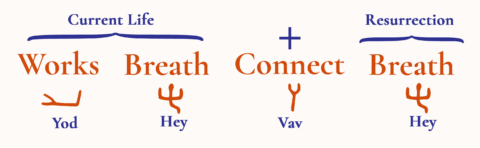
The resurrection is in His Name, “Yahuah”. The prophecy in Yechezqel (Ezekiel) is fulfillment of His Name which He has placed upon His people. The prophecy speaks about the resurrection of the whole House of Yashar’El. We do not see this message in “the LORD God” or “HaShem”.
Which Name do you want placed upon you?
Which Name was placed upon Messiah Yahusha?
Be it known unto you all, and to all the people of Yashar’El, that by the name of Messiah Yahusha of Natzareth, whom you crucified, whom Elohiym raised from the dead, even by him does this man stand here before you whole.
Yahuah Elohiym raised Messiah Yahusha from the dead. Yahusha experienced the Name “Yahuah”.
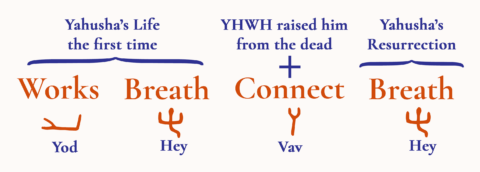
This is the meaning of the Name “Yahuah” and its function. We want this Name upon us and in us. We want to experience the Name “Yahuah”. This Name leads to eternal life. It is the Name that leads to salvation as the prophet states:
And it shall come to pass, that whosoever shall call on the Name of Yahuah shall be saved: for in mount Tziyon and in Yerushalayim shall be deliverance, as Yahuah has said, and in the remnant whom Yahuah shall call.
“Yahuah” is the Name of resurrection power! From my perspective, this is an important Name to be preserved and protected. This is why we restore His Name in all testimonies and do not use manmade substitutions which have no meaningful message to communicate to us. Men and women do not have the authority to assign a new name to our Father in heaven. Do we have the authority to assign a new name to our earthly fathers? Do we have the authority to assign a new name to the King of England or the Pope? Now, is the time to restore the Name of our Father. It is fulfillment of the prophecy in Hoshea (Hosea) 2:16-17 happening right before our very eyes and it is His doing. He is preparing people for the transition in government. Soon, the kingdoms of this world will be the Kingdoms of our Father and His Messiah.
Download this Article here