
123-1 The Name, “Ya’aqob”
And he said to him, Your name shall no longer be called Ya’aqob, but Yashar’El shall be your name;for you have prevailed with Elohiym, and shall be mighty with men.
The people group most commonly identified who are associated with Yahuah Elohiym come from the seed of Ya’aqob (Jacob). We have been taught that his name was changed to “Israel” and most identify the “State of Israel” as a fulfillment of prophecy spoken in the Hebrew writings. Our culture typically views names as labels assigned to an individual, group or country. The name “Israel” appears to be acceptable from a Greek-English perspective because we do not tend to pair the label given with the function or purpose of an individual or group. We view them separately.
However, our Heavenly Father does not as we have previously discussed in this series. For example, He called the House of Yahudah by the names Sodom and Gomorrah in the following passage because the people were behaving like the people who lived in these cities prior to their judgment.
Hear the word of Yahuah, you rulers of Sodom; give ear unto the Law of our Elohiym, you people of Gomorrah.
Yahuah was assigning a new label to the House of Yahudah based on their function at the time. Being labeled “Sodom” and “Gomorrah” is not a very flattering name to be called by our Father in Heaven. “Israel” is also not a very flattering name to be called when considered from an ancient Hebrew perspective. The function identified by this name is NOT a function that we would want to assign to ourselves.
Typically, when Yahuah changes the name of an individual, it is a name of great honor and purpose. The name “Israel” is actually a step-down rather than a step-up from the name “Ya’aqob” from an ancient Hebrew perspective. This leads us to believe that the underlying Hebrew name given to Ya’aqob (Jacob) has not been interpreted correctly. Here is the passage regarding the name change.
And he said, Your name shall be called no more Ya’aqob [H3290], but Yashar’El [H3478]: for as a prince [H8280] have you power with Elohiym and with men, and have prevailed.
The context of the passage usually provides a hint to the meaning of the name as we demonstrated with the names Noach, Abraham, and Yahusha. In this passage, we would expect the name “Israel” or “Yashar’El’ to be related to a “prince with power”. However, the word “prince” does not appear in the Greek Septuagint:
And he said to him, Your name shall no longer be called Ya’aqob, but Yashar’El shall be your name; for you have prevailed with Elohiym, and shall be mighty with men.
The translation of the Greek Septuagint is 1300 years older than the Masoretic Text and has not undergone as many transcriptions which is the action of copying an older manuscript to make a new manuscript. Transferring words from one scroll to another can lead to errors and there are many examples including this one despite the meticulous practices observed by Hebrew scribes.
The Septuagint was translated approximately 1000 years after the prophet Moshe (Moses). If a Hebrew text written on lambskins lasted about 500 years, then the Septuagint was translated from the first transcription of the original writings of Moshe. Whereas the Masoretic Text was translated from the fourth transcription since the time of Moshe. This increases the chance for more scribal errors. Here is an illustration. We divided the continuum in 500-year increments to indicate the lifespan of a Torah Scroll. The Septuagint was translated around the time the second transcribed copy of the Law of Moshe would have been completed by the scribes.
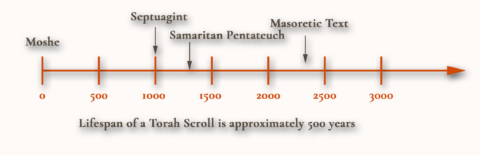
The Masoretic Text was completed close to the fifth transcription of the original writings of Moshe. With each transcription, the chances of a scribal error increase. This would indicate that the Greek Septuagint is likely more accurate. We discuss the significance of the Greek Septuagint in our study titled: What writings are contained in the “Law of Moshe”?
The Hebrew word for “prince” was likely not in the original writings of Moshe (Moses). The Brenton Septuagint gives the meaning of the name as “one who has prevailed with Elohiym and shall be mighty with men”. These are our clues to defining the name “Yashar’El”. Before we dive into the discussion between “Israel” and “Yashar’El”, we are going to define the name “Ya’aqob” from an ancient Hebrew perspective. There are many prophetic parallels in this transition of names that we want to address in these next two studies.
The Name “Ya’aqob”:
The name “Ya’aqob” itself gives us a clue to the name change. He was born with a particular function and at this moment in time, his function changed in the eyes of Yahuah. We would expect this function to be an improvement or an elevated position as depicted in the text. Below is the Hebrew word in the ancient pictographic Hebrew as it appears in the Bereshith (Genesis) 32:28 of the Masoretic Text. The word highlighted in red is the three-lettered root of this name which will enlighten us regarding the function of this name. The letter in black is a “yod” and it is a prefix meaning “I will”.
BQ[Y
The three-lettered root includes the letters: ayin, quph and beyt. It is defined by The Ancient Hebrew Lexicon of the Bible as:
BQ[( common, עקב / ah.q.b) Translation: RESTRAIN (V) Definition: To prevent from doing. Hold back, in the sense of grabbing the heel. KJV Translations: supplant, heel, stay Strong’s Hebrew #: h.6117
BQ[ עקב Definition: The restraining of the heel when taking a step forward.
BQ[ ( masc., עקב / e-qev) Translation: HEEL Definition: What is restrained when taking a step forward. Edenics: ankle; angle KJV Translations: heel, footstep, horsehoof, at last, step, liers Strong’s Hebrew #: h.6119, h.6120
The name “Ya’aqob” means “I will restrain”. In the following two passages, this three-lettered root is translated as “supplanted” and “supplant”.
And he said, Is not he rightly named Ya’aqob? for he has supplanted [H6117] me these two times: he took away my birthright; and, behold, now he has taken away my blessing. And he said, Have you not reserved a blessing for me?
Take heed every one of his neighbor, and trust not in any brother: for every brother will utterly supplant [H6117], and every neighbor will walk with slanders.
“Supplanting” from an English perspective is the idea of taking someone else’s place by undermining them. Merriam-Webster’s Online Dictionary defines “supplant” the following way:
sup·plant sə-ˈplant
1: to take the place of (another) especially by force or treachery
2a: to root out and supply a substitute for b: to gain the place of and serve as a substitute for especially by reason of superior excellence or power https://www.merriam-webster.com/dictionary/supplant#
In Bereshith (Genesis) Esau claims that Ya’aqob (Jacob) took his birthright and his blessing through treachery. Ya’aqob supplanted Esau as the firstborn son. He took the place of the firstborn son which is a place that rightfully belonged to Esau because he was the firstborn son. “Supplant” is related to the foot and which is the act of causing someone to stumble. It is the act of tripping them. This is discussed in the following entry from Etymonline:
supplant(v.)
1300, supplaunten, “dispossess, acquire (a position from someone) by strategy or scheming” (implied in agent noun supplanter), from Old French suplanter, sosplanter “to trip up, overthrow, drive out, usurp,” or directly from Latin supplantare “trip up, overthrow,” from assimilated form of sub “under” (see sub-) + planta “sole of the foot” (see plant (n.)). There is a sense-evolution parallel in Hebrew akabh “he beguiled,” from akebh “heel” (compare the biblical story of Jacob).
The English word is attested mid-14c. in a literal sense of “trip up, cause to stumble,” but it did not last. In reference to things or ideas, “take the place of another, replace one with another,” by 1670s. Related: Supplanted; supplanting; supplantation. https://www.etymonline.com/word/supplant
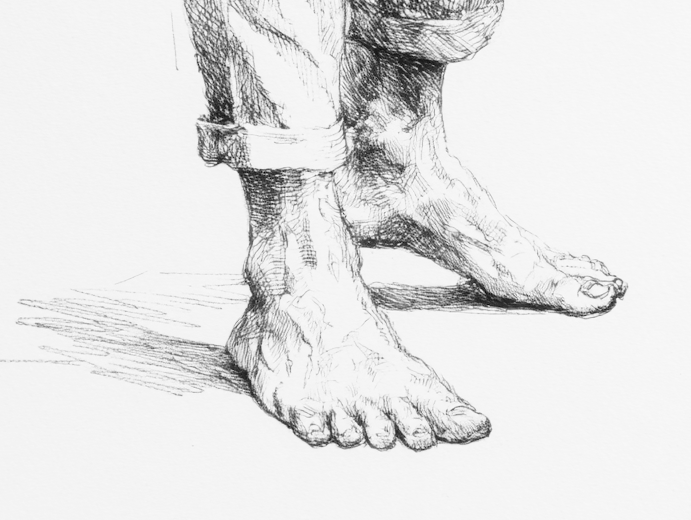
The English word “supplant” is related to the foot. Mr. Benner says “aqob” is also related to our English words “ankle” and “angle”. The heel of the foot is part of the ankle. Ya’aqob (Jacob) was given this name because he had grabbed Esau’s heel as they were being born.
And the first came out red, all over like a hairy garment; and they called his name Esau. And after that came his brother out, and his hand took hold on Esau’s heel [H6119]; and his name was called Ya’aqob [H3290]: and Yitzak was sixty-years old when she bore them.
Ya’aqob grabbed Esau’s foot as they were being born and was a prophetic act indicating that Ya’aqob would supplant Esau as the firstborn son. Rebekah also knew that Esau would serve the younger before they were born. She received the following message from our Father in Heaven.
And the children struggled together within her; and she said, If it be so, why am I thus? And she went to enquire of Yahuah. And Yahuah said unto her, Two nations are in your womb, and two manner of people shall be separated from your bowels; and the one people shall be stronger than the other people; and the elder shall serve the younger.
Ya’aqob (Jacob) would supplant his brother as the firstborn son. It was a prophecy given to their mother, Rebekah. He would essentially take his brother’s position by force or treachery. Esau sold his birthright to Ya’aqob for a bowl of lentil stew (Bereshith/Genesis 25:29-34). It is obvious that Esau did not regard his birthright very highly. Then, Ya’aqob pretended to be his brother and received the blessing of firstborn from his father, Yitzhak (Isaac) (Bereshith/Genesis 27:1-41). Ya’aqob had deceived his father. Here is the testimony.
And Yitzhak trembled very exceedingly, and said, Who? where is he that has taken venison, and brought it me, and I have eaten of all before you came, and have blessed him? yea, and he shall be blessed. And when Esau heard the words of his father, he cried with a great and exceeding bitter cry, and said unto his father, Bless me, even me also, O my father. And he said, Your brother came with subtilty, and has taken away your blessing.
Supplanting someone through deception is an unfavorable function. It is associated with stealing which is taking something that does not belong to them. The two-lettered root of this word is defined the following way by The Ancient Hebrew Lexicon of the Bible as:
BQ קב Action: Pierce, Drain, Gather, Bury Object: Cavity, Wine trough, Hole, Bowl, Grave Definition: A container or hole for storing or holding something. Ancient Hebrew: The pictograph Q is a picture of the sun at the horizon and the gathering of the light, the B is a picture of a tent and what is inside. Combined these mean “gather inside”.
The house is a space defined by walls which allows it to be filled with people and furniture. The letter “quph” means “gathering light”. Together, they mean to gather what is inside the house or container. This is why it is related to the Hebrew word translate as “drain”. The Ancient Hebrew Lexicon of the Bible defines it as:
[BQ ( common, קבע ) Translation: DRAIN (V) Definition: [To be verified] To empty something of its contents. KJV Translations: rob, spoil Strong’s Hebrew #: h.6906
Holes are drilled into a container and the contents are drained or emptied. Here is the Hebrew word used in context.
For Yahuah will plead their cause, and spoil [H6906] the soul of those that spoiled [H6906] them.
“Spoiling” something is taking things that do not belong to them. It is draining their wealth or taking things from their house and leaving it empty. Ya’aqob (Jacob) “drained” Esau of his birthright and the blessing of the firstborn. Here is another word in this Hebrew word family that illustrates this idea of “draining”. It is defined by The Ancient Hebrew Lexicon of the Bible as:
BQY ( masc., יקב) Translation: WINE.TROUGH KJV Translations: winepress, press, fats, pressfat, wine Strong’s Hebrew #: h.3342
BQY יקב Definition: A boxed cavity below the winepress where the juice drains into.
The winepress is emptied or drained into another container. This situation between Esau and Ya’aqob have significant prophetic parallels. Adam is the firstborn son of Yahuah Elohiym and Yahusha is the second born son like Ya’akob. Here is an illustration:
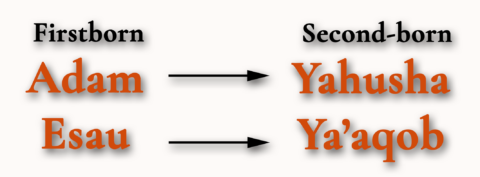
Esau was also called “Edom” which is in the same word family as “Adam”. The Hebrew letters that are similar are highlighted in red.
MWDA
Edom
MDA
Adam
Ya’aqob (Jacob) replaced his brother as the firstborn son; obtained the birthright; and the blessings as firstborn son. Messiah Yahusha Ben David replaced Adam as the firstborn son; obtained the birthright; and the blessings as firstborn son. Yahusha has “supplanted” Adam as the firstborn son through the Laws of Redemption. He has replaced Adam just as Ya’aqob (Jacob) replaced Esau. If the Sons of Adam had known that our Messiah had replaced them through his death, they never would have killed him. Shaul of Tarsus (Paul) discusses this in the following testimony:
Ya’aqob (Jacob) replaced his brother as the firstborn son; obtained the birthright; and the blessings as firstborn son. Messiah Yahusha Ben David replaced Adam as the firstborn son; obtained the birthright; and the blessings as firstborn son. Yahusha has “supplanted” Adam as the firstborn son through the Laws of Redemption. He has replaced Adam just as Ya’aqob (Jacob) replaced Esau. If the Sons of Adam had known that our Messiah had replaced them through his death, they never would have killed him. Shaul of Tarsus (Paul) discusses this in the following testimony:
Howbeit we speak wisdom among them that are perfect: yet not the wisdom of this world, nor of the princes of this world, that come to nought: But we speak the wisdom of Elohiym in a mystery, even the hidden wisdom, which Elohiym ordained before the world unto our glory: Which none of the princes of this world knew: for had they known it, they would not have crucified the Lord of glory. But as it is written, Eye has not seen, nor ear heard, neither have entered into the heart of man, the things which Elohiym has prepared for them that love him. But Elohiym has revealed them unto us by his Spirit: for the Spirit searches all things, yea, the deep things of Elohiym. For what man knows the things of a man, save the spirit of man which is in him? even so the things of Elohiym knows no man, but the Spirit of Elohiym.
The knowledge was hidden from them. Yahuah Elohiym does not impart His wisdom to the Sons of Adam who are opposed to Him. They are His enemy. Armies do not share their strategies with their enemies. They keep them hidden from their enemies. But they do not keep their strategies hidden from their fellow soldiers. Yahuah Elohiym reveals His truth to those who belong to Him. They were like Yitzhak (Isaac) who was blind when he blessed Ya’aqob (Jacob).
And it came to pass, that when Yitzhak was old, and his eyes were dim, so that he could not see, he called Esau his eldest son, and said unto him, My son: and he said unto him, Behold, here am I.
Yitzhak (Isaac) did not know that he was giving the blessing of the firstborn to his son, Ya’aqob (Jacob). Likewise, the Sons of Adam who were his rightful heirs did not know they were giving the right of firstborn to Messiah Yahusha when they killed him. He obtained this right through the Laws of Redemption which we discuss in great detail in our series titled: The Message of Salvation in the Torah. The Sons of Adam relinquished their right to exercise dominion over the earth and gave it to Messiah Yahusha Ben David when they killed him. If they had known this, they never would have killed him. This knowledge was hidden from them as it is to this day. However, there will be a transition in leadership soon.
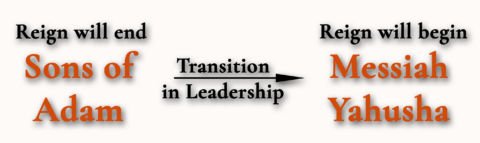
Messiah Yahusha Ben David will assume leadership over the earth, replacing the Sons of Adam who stand opposed to Yahuah Elohiym. He has supplanted them through the Laws of Redemption. The Hebrew word for “heel” is used in the following prophecy regarding the Messiah.
And I will put enmity between you and the woman, and between your seed and her seed; it shall strike your head, and you shall strike his heel [H6119].
The Hebrew word translated as “strike” or “bruise” in this passage is related to the bite of a serpent. The seed of woman will strike the head of the serpent meaning its leadership. The seed of the serpent which are the Sons of Adam who stand opposed to Yahuah Elohiym will strike the heel of the seed of woman. This could also be a reference to the idea of supplanting. The seed of the serpent will strike in the act of supplanting. This is exactly what happened. Messiah Yahusha called the scribes and the Pharisees “vipers” which are serpents.
O generation of vipers, how can you, being evil, speak good things? for out of the abundance of the heart the mouth speaks.
They are the seed of the serpent. They plotted to kill Messiah Yahusha Ben David.
After two days was the feast of the Passover, and of unleavened bread: and the chief priests and the scribes sought how they might take him by craft, and put him to death. But they said, Not on the feast day, lest there be an uproar of the people.
They were successful in striking the heel of Messiah Yahusha. They struck him when he was in the act of supplanting them through the Laws of Redemption. The Hebrew word translated as “strike” in Bereshith (Genesis) 3:15 is “shup”. It is defined by The Ancient Hebrew Lexicon of the Bible as:
PWF ( common, שוף / sh.w.p ) Translation: FALL.UPON (V) Definition: To suddenly and forcefully crash upon someone or something. KJV Translations: bruise, break, cover Strong’s Hebrew #: h.7779
The ancient Hebrew pictographic language illustrates that this is a bite from a serpent. The letter “shin” is a picture of two front teeth and the “pey” is a picture of the mouth. Here are the two letters compared to a cobra reading to strike its prey.

The letter “vav” is a picture of a hook which secures things together. The “strike” is secure and it is sure. The blow will indeed hit its mark. “Striking the head” represents removal of the serpent’s right to lead or exercise authority which is a lethal blow. “Striking the heel” is not a lethal blow but can impair one’s ability to walk. This can be visualized in the following situation with Ya’aqob (Jacob) after he received his new name.
And when he saw that he prevailed not against him, he touched the hollow of his thigh; and the hollow of Ya’aqob’s thigh was out of joint, as he wrestled with him.
This affected the way Ya’aqob (Jacob) would walk from this point forward. The Sons of Adam are the leaders of the earth in every facet of life: politics, religion, science, entertainment, education, and commerce. They do not teach people to walk our Father’s Way. They teach people to walk their way. They hinder people who choose to walk in the Way of our Father. They do this because they are currently the established authority exercising dominion in the earth. Those in authority have two choices:
- They can teach people to walk in alignment with our Father’s Way (Seed of Woman).
- They can teach people NOT to walk in alignment with our Father’s Way (Seed of Serpent).
Yahuah has given each of us freewill including the leaders and teachers in authority. The Sons of Adam are currently in power and they tend to support and promote leaders who are in alignment with them. Also, they tend to suppress and oppress those who walk in alignment with Yahuah Elohiym. They suppressed and oppressed Messiah Yahusha Ben David; they will suppress and oppress those who walk like him. Here is the testimony that confirms this:
If the world hate you, you know that it hated me before it hated you. If you were of the world, the world would love his own: but because you are not of the world, but I have chosen you out of the world, therefore the world hates you. Remember the word that I said unto you, The servant is not greater than his lord. If they have persecuted me, they will also persecute you; if they have kept my saying, they will keep yours also.
The seed of the serpent loves its own. Therefore, they promote, elevate and exalt those who are like them. Those who expose them, are hated. This is how the seed of the serpent strikes the heel of the seed of woman. The situation between Esau and Ya’aqob is a prophetic picture fulfilled in the life of Messiah Yahusha and his followers. When people choose to walk the way Yahusha walked, they become the seed of woman. As a result, they are hated by the world. They are rejected, persecuted and despised. However, when the transition from the Kingdoms of this world to the Kingdom of Yahuah Elohiym occurs, this will end.
The “serpent’s seed” will not prevent the “seed of woman” from becoming the head over all the earth. However, the “seed of woman” will utterly crush the head of the serpent. The Hebrew word translated as “head” is “rosh” and it is defined by The Ancient Hebrew Lexicon of the Bible as:
FAR ( masc., ראש / rosh ) Translation: HEAD Definition: The top of the body. A person in authority or role of leader. Alternate Translations: top; beginning; first; chief; best Alternate Spellings: ריש Edenics: raise – with the exchange of the s and sh KJV Translations: head, chief, top, beginning, company, captain, sum, first, principal, chapiters, rulers Strong’s Hebrew #: h.7218, h.7389 Strong’s Aramaic #: a.7217
The pictures associated with this word include the following:
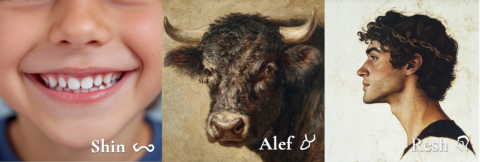
The simplest meaning of this word includes the definitions, “Chiefs strong exchange” or “Chiefs strong authority exchanged”. Essentially, this is the shift in leadership from father to son. Adam’s heirs are going to be crushed or struck like a serpent strikes its prey. This is communicated in the following testimony:
But with righteousness shall he judge the poor, and reprove with equity for the meek of the earth: and he shall smite the earth with the rod of his mouth, and with the breath of his lips shall he slay the wicked.
This passage is a reference to the Messiah. He will slay the wicked with the breath from his mouth. This is fulfillment of the prophecy in Bereshith (Genesis) 3:15 when the “seed of woman” strikes the head of the serpent. Yahusha Ben David will accomplish this when he returns to facilitate the second greater exodus. The name change from “Ya’aqob” to “Yashar’El” also has significant prophetic parallels regarding the Messiah which we will discuss in the next study.
Download this Article here